In brief
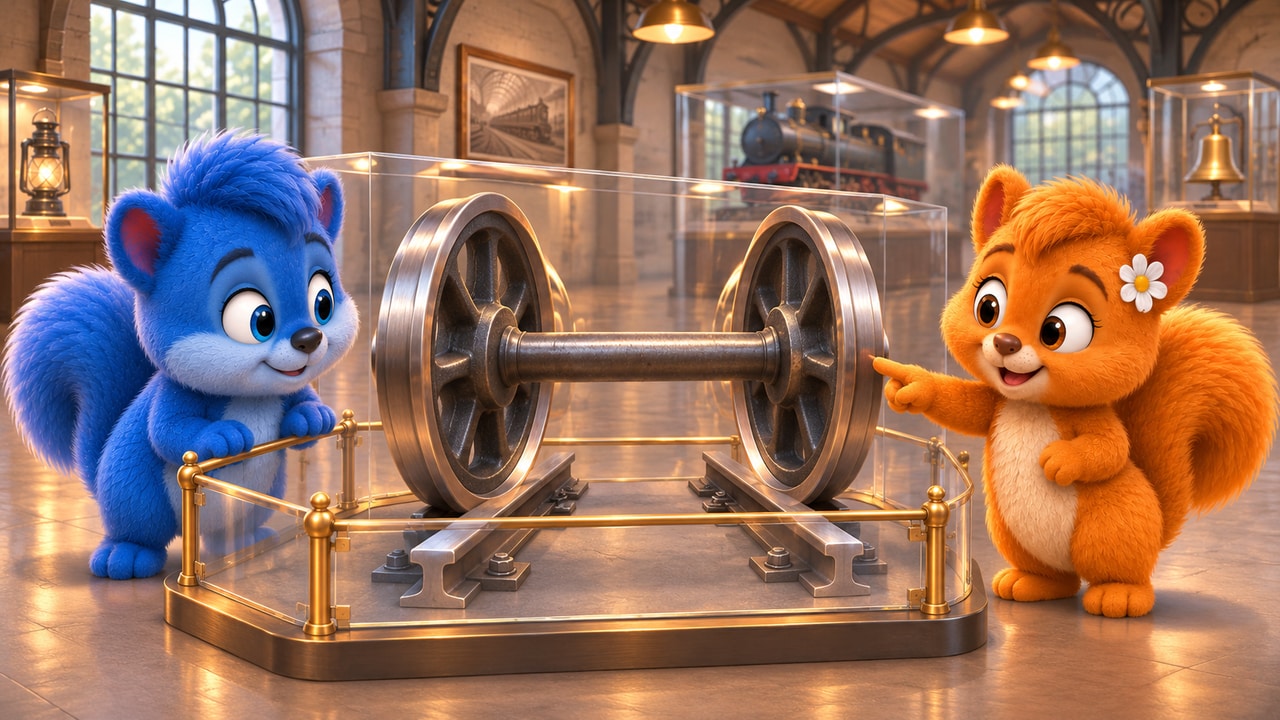
Shaped wheel treads and matching rails guide a train. On many trains, two wheels are fixed to a shared axle. Raised inner rims called flanges provide additional sideways guidance, when the wheel shape alone does not provide enough guidance.
Lumi’s rule
Never enter or play on tracks. Watch trains only from permitted areas behind the safety line.
Puschel and Flauschi investigate
At the railway museum, Puschel looks for a steering wheel on the model train. Instead, he finds two wheels on one axle, the rod connecting them.
Puschel “Who steers the wheels around a bend?”
Flauschi “The wheel shape and rails work together. Look at the surfaces they roll on.”
The cutaway shows raised rims on the inner sides. The rolling surfaces slope or curve across their width; they are not straight like the side of a tin.
Puschel “So the rims always scrape along the rails?”
Flauschi “Not all the time. The shape of the treads also helps guide the wheels. The rims provide additional guidance.”
Puschel now examines wheels and rails together. Neither part explains the journey on its own.
Listen to the story
With the narrator, Puschel and Flauschi. This recording contains the story; the explanations and quiz follow below.
In three steps
1
Roll on rails
The treads are the wheel surfaces that roll on the rails.
2
Shape helps guide
The special wheel shape matches the rails and helps guide the train.
3
Rims limit movement
Inner flanges provide additional sideways guidance.
Simplified explanatory models: colours distinguish parts, not real materials. Read the three steps in order. The text explains what each shape represents.
The explanation step by step
Two wheels, one axle
A conventional wheelset has two wheels fixed to an axle, the rod connecting them. They turn together. Their rolling surfaces have a special shape. A small sideways shift can make one wheel roll on a larger circle than the other. It then travels farther during the same turn. This also helps the wheelset travel around curves.
What do flanges do?
Flanges are on the wheel sides facing the centre of the track. They limit sideways movement and can contact the rail when the shape of the rolling surfaces alone does not provide enough guidance. They are not the surfaces normally carrying the train’s rolling weight. Wheel and track shapes, spacing and condition must match.
Points and limits
A turnout uses movable rail sections to guide a train onto another track. A train does not turn them like a car steering wheel. Speed, track condition and vehicle must suit each other; trains can derail in unsuitable conditions. Our model does not claim wheels can never leave rails.
Word help
- wheelset
- Two wheels fixed to one axle so they turn together.
- tread
- The wheel surface that rolls on the rail.
- flange
- A raised rim on the inner side of a wheel, limiting sideways movement.
- axle
- The rod connecting the two wheels.
- turnout
- Movable rail sections guiding a train onto a different track; also called points.
- derail
- To leave the rails instead of rolling along them.
Your explorer activity
Point to the first step in the diagram. Explain in your own words what changes by the final step. Use only the drawing; you do not need to open any appliance or recreate the process.
Remember this
Wheel shape, flanges and rails guide a train together.
Quiz question 1
Where is a flange?
Choose a), b) or c), then explain your choice.
- a)On the wheel side facing the track centre.
- b)On the outer side facing away from the track.
- c)In the middle of the normal rolling tread.
Show the explanation
Correct: a): On the wheel side facing the track centre.
The raised rims are on the inner wheel sides.
Quiz question 2
What guides a train?
Choose a), b) or c), then explain your choice.
- a)Rail wheels individually steered like car wheels.
- b)Only constantly touching flanges, with no effect from tread shape.
- c)Wheel shape, inner rims and rails working together.
Show the explanation
Correct: c): Wheel shape, inner rims and rails working together.
Several matched parts work together.
Quiz question 3
What does a turnout do?
Choose a), b) or c), then explain your choice.
- a)It changes speed but not the route.
- b)It replaces wheels while moving.
- c)It uses movable rails to guide a train onto another track.
Show the explanation
Correct: c): It uses movable rails to guide a train onto another track.
The turnout changes the guided route.
Sources and illustration note
Facts checked on 18 November 2026; language reviewed on 19 November 2026. The Wusel story is fictional. Simplified models show principles, not construction, repair or treatment instructions. Specialist references are for reading with an adult.