In brief
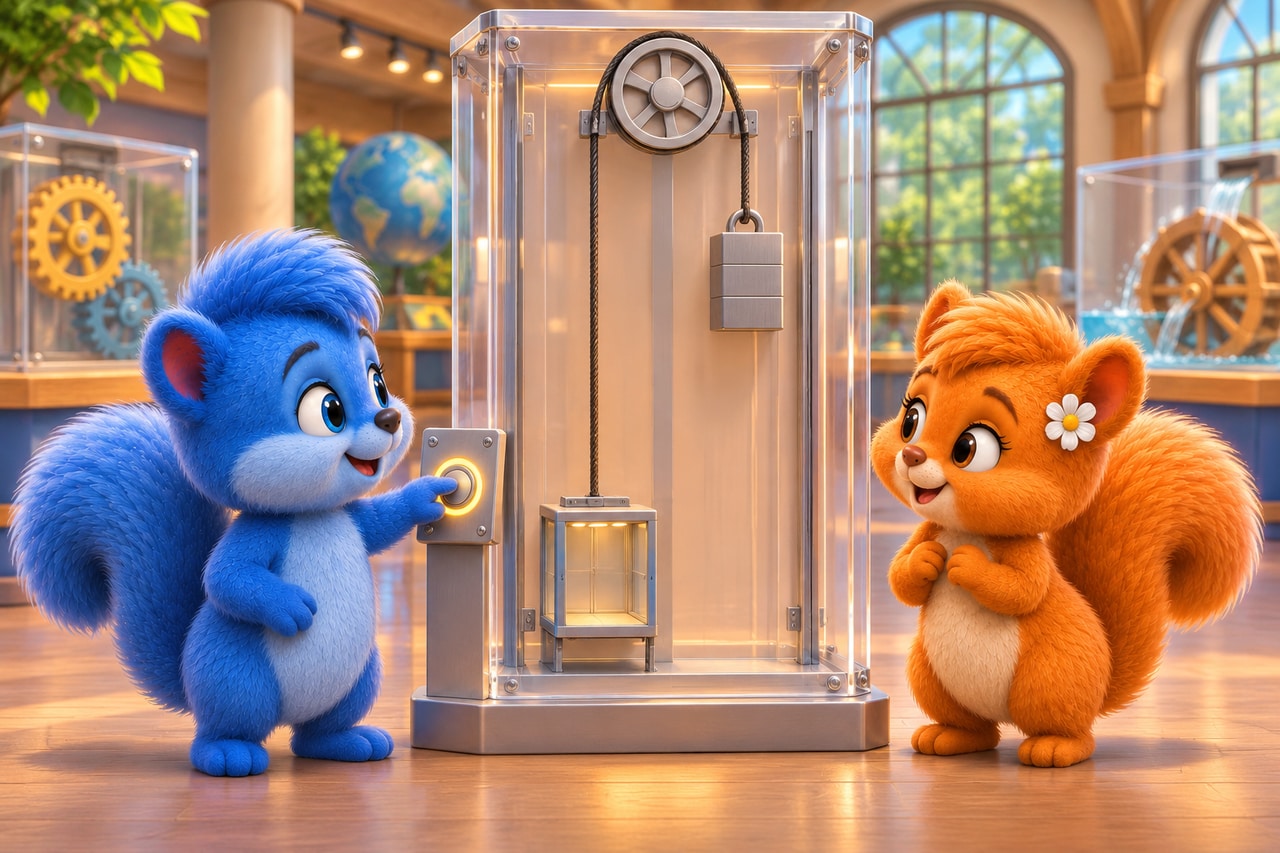
In this rope-driven lift, the passenger car and a heavy counterweight hang from ropes. A motor turns a wheel that moves the ropes. This raises or lowers the car. Rails guide it, and brakes hold it at a stop.
Lumi’s rule
Do not force or hold doors. If a lift stops unexpectedly, stay calm, use its alarm or emergency call and wait for help; do not climb out.
Puschel and Flauschi investigate
Puschel presses the call button on the museum model once. The little car, the compartment passengers ride in, is still upstairs. He waits.
Puschel “If I press ten times, will it move ten times faster?”
Flauschi “The button sends a request to the controller, the equipment managing the journey. It is not an accelerator.”
Behind the window, the car comes down. A heavy block rises on the other side.
Puschel “The weight always goes the other way!”
Flauschi “It balances part of the car’s weight. The motor does not have to lift everything on its own.”
The car stops at the floor. Only then does the model controller open the doors. Puschel points at the rails: even the way upstairs has guides.
Listen to the story
With the narrator, Puschel and Flauschi. This recording contains the story; the explanations and quiz follow below.
In three steps
1
Send a request
Pressing a button registers a journey request.
2
Move the car
A motor turns the rope wheel. Here the car moves down and the counterweight moves up.
3
Stop at the floor
The car stops in position before the doors open.
Simplified explanatory models: colours distinguish parts, not real materials. Read the three steps in order. The text explains what each shape represents.
The explanation step by step
Car and counterweight
The car is the compartment for passengers. In our rope-driven lift, several strong steel ropes support it. A heavy block hangs on the other side: the counterweight balances part of the load. A motor turns a drive sheave, the wheel the ropes pass over. Friction between wheel and ropes moves them, a little like a tyre gripping a road. As the car rises, the counterweight goes down. Its weight does not exactly match car and passengers on every trip.
How does it reach the right floor?
The controller is the equipment that manages the journey. Buttons and measuring devices tell it where passengers want to go and where the car is. It starts the motor and makes it slow down in time. Guide rails are fixed tracks that limit sideways movement. Brakes hold the car at a stop. Extra safety equipment checks doors and movement. Doors remain secured during normal travel.
Not all lifts use ropes
A hydraulic lift uses liquid under pressure. A movable part called a piston sits inside a strong housing. Liquid pushes on it; its movement raises the car directly or through a connection. Our drawing instead shows a rope-driven lift, also called a traction lift. A real lift displays how much weight it can carry. That limit matters even when there is space left.
Word help
- car
- The compartment passengers travel in.
- counterweight
- A heavy block that balances part of the load.
- controller
- Equipment that uses messages from buttons and measuring devices to manage travel and stops.
- drive sheave
- The motor-driven wheel that grips and moves the ropes by friction.
- guide rails
- Fixed tracks keeping the car and counterweight on their paths.
- piston
- A movable part inside a strong housing. Pressurised liquid can push it along.
- traction lift
- A lift whose motor-driven wheel grips ropes to move the car.
Your explorer activity
Point to the first step in the diagram. Explain in your own words what changes by the final step. Use only the drawing; you do not need to open any appliance or recreate the process.
Remember this
A rope-driven lift uses a counterweight, while its controller manages travel and stops.
Quiz question 1
What does the call button do?
Choose a), b) or c), then explain your choice.
- a)It registers a journey request.
- b)Each press sets a higher speed.
- c)It moves the car directly, without a controller.
Show the explanation
Correct: a): It registers a journey request.
The controller processes the request; repeated presses do not accelerate the car.
Quiz question 2
What is the counterweight for?
Choose a), b) or c), then explain your choice.
- a)It replaces the guide rails.
- b)It balances part of the load.
- c)It makes brakes unnecessary.
Show the explanation
Correct: b): It balances part of the load.
It helps the drive but does not replace brakes.
Quiz question 3
What is true of our drawing?
Choose a), b) or c), then explain your choice.
- a)Every lift has exactly this design.
- b)It shows only an escalator drive.
- c)It shows one design: a traction lift.
Show the explanation
Correct: c): It shows one design: a traction lift.
Our drawing shows a rope-driven lift. A hydraulic lift uses liquid pressure instead.
Sources and illustration note
Facts checked on 18 November 2026; language reviewed on 19 November 2026. The Wusel story is fictional. Simplified models show principles, not construction, repair or treatment instructions. Specialist references are for reading with an adult.