In brief
Water, detergent, movement and time loosen dirt from clothes. The machine then rinses them with fresh water. During the spin, much of the water moves out through holes in the drum.
Lumi’s rule
Adults handle detergent and appliances. Never climb inside a machine, open its casing or reach into a moving drum.
Puschel and Flauschi investigate
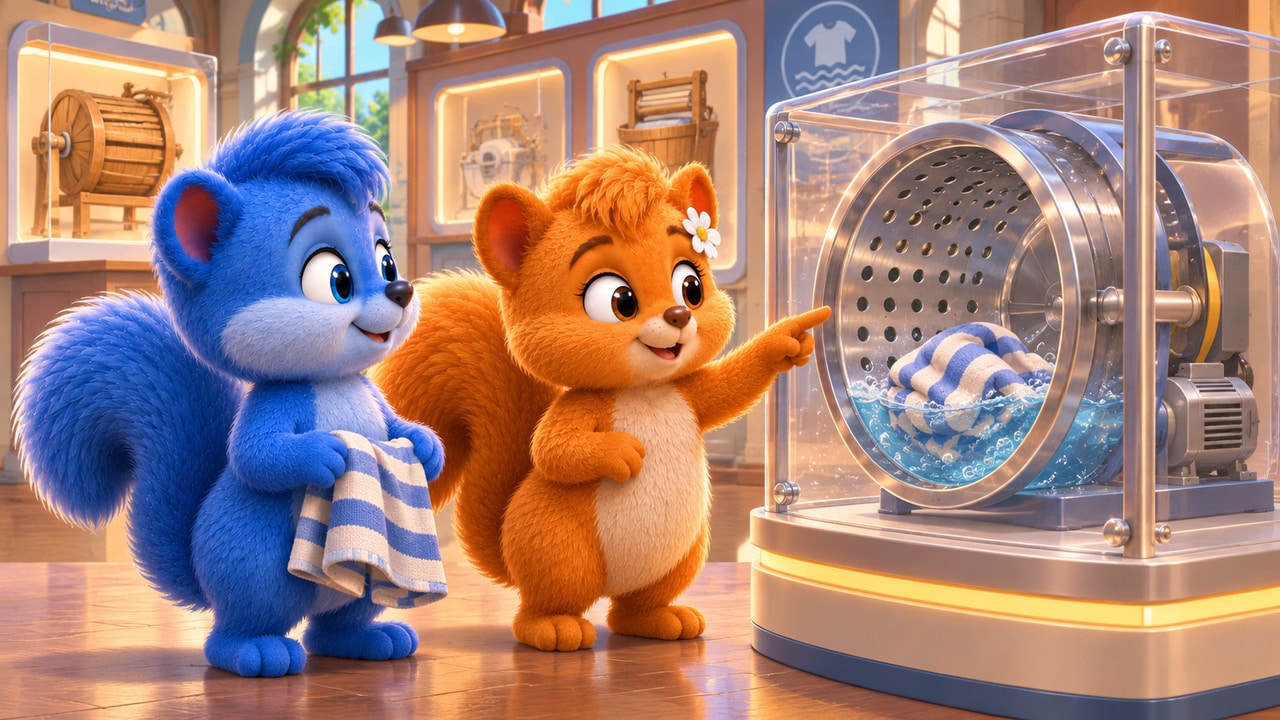
At the technology museum, Puschel stops beside a drum full of little holes. Behind its closed window, a striped cloth tumbles slowly.
Puschel “Those holes leak! Will the water run onto the floor?”
Flauschi spots a second container around the drum. Its wall is transparent in the cutaway model.
Flauschi “The drum can have holes. The container around it holds the water.”
First the drum lifts the cloth and lets it fall into the wash water. Later, the dirty liquid drains away. Fresh water enters for rinsing.
Puschel “Now it is spinning much faster. Is it blow-drying the cloth?”
Flauschi “The spin moves water outwards. The cloth is still damp afterwards.”
Puschel holds up his dry cloth for comparison. He counts three jobs: wash, rinse and spin. The drum is not a tiny tumble dryer.
Listen to the story
With the narrator, Puschel and Flauschi. This recording contains the story; the explanations and quiz follow below.
In three steps
1
Wash
The cloth tumbles slowly through water and detergent.
2
Rinse
Fresh water helps rinse away loosened dirt and detergent.
3
Spin
The drum turns fast. Water passes out through its holes.
Simplified explanatory models: colours distinguish parts, not real materials. Read the three steps in order. The text explains what each shape represents.
The explanation step by step
What loosens dirt?
Detergent contains surfactants: substances that help water loosen and carry away greasy dirt. The drum moves clothes through water mixed with detergent. Some programmes warm the water. Different fabrics need different temperatures and movements, so adults check the care label: its little symbols show how the item may be washed. They choose a suitable programme. More foam does not automatically mean cleaner clothes.
Why two containers?
Our example has its door at the front. Inside is a drum with small holes that carries the clothes. A watertight outer tub surrounds it. A pump sends used water to the drain. Rinsing brings in fresh water to remove remaining detergent and loosened dirt. The machine may change the water several times.
What happens during the spin?
The fast drum keeps turning the clothes along a circular path. Water can pass out through the holes and is pumped away. This does not dry all the clothes with heat. A washer-dryer has an additional drying function; an ordinary washing machine does not. Our model shows one design, not instructions for opening an appliance.
Word help
- drum
- The rotating inner container for clothes.
- surfactants
- Substances in detergent that help water loosen and carry away greasy dirt.
- outer tub
- The watertight container around the drum, holding the wash water.
- detergent
- A cleaning mixture added to the wash water.
- rinsing
- Using fresh water to help remove detergent and loosened dirt from clothes.
- spin
- The drum turns very fast. Water passes out through its holes, but the clothes stay damp.
- care symbols
- Little pictures on a clothing label giving washing and care instructions.
Your explorer activity
Point to the first step in the diagram. Explain in your own words what changes by the final step. Use only the drawing; you do not need to open any appliance or recreate the process.
Remember this
Washing loosens dirt, rinsing removes leftover detergent and dirt, and spinning removes much of the water.
Quiz question 1
Why does the drum have holes?
Choose a), b) or c), then explain your choice.
- a)To put detergent onto clothes without water.
- b)To let water pass through its wall.
- c)To let air dry clothes during washing.
Show the explanation
Correct: b): To let water pass through its wall.
The outer tub holds water; the drum with holes holds clothes.
Quiz question 2
What does rinsing do?
Choose a), b) or c), then explain your choice.
- a)It warms already dry clothes.
- b)It spins at maximum speed.
- c)It removes remaining residues with fresh water.
Show the explanation
Correct: c): It removes remaining residues with fresh water.
Fresh water carries away detergent residues and loosened dirt.
Quiz question 3
What are clothes usually like after a normal spin?
Choose a), b) or c), then explain your choice.
- a)Just as wet as immediately before the spin.
- b)Still damp, but holding much less water.
- c)Completely dry, as after a tumble dryer.
Show the explanation
Correct: b): Still damp, but holding much less water.
Spinning removes much water, but does not completely dry clothes.
Sources and illustration note
Facts checked on 18 November 2026; language reviewed on 19 November 2026. The Wusel story is fictional. Simplified models show principles, not construction, repair or treatment instructions. Specialist references are for reading with an adult.