In brief
A socket connects to a large network of wires. This power grid links power stations, wind turbines and solar panels to buildings. Electrical energy travels through the network and can make a lamp shine at home.
Lumi’s rule
Never open or touch the inside of sockets, electrical cabinets or wiring. Explore only purpose-designed safe learning models with an adult.
Puschel and Flauschi investigate
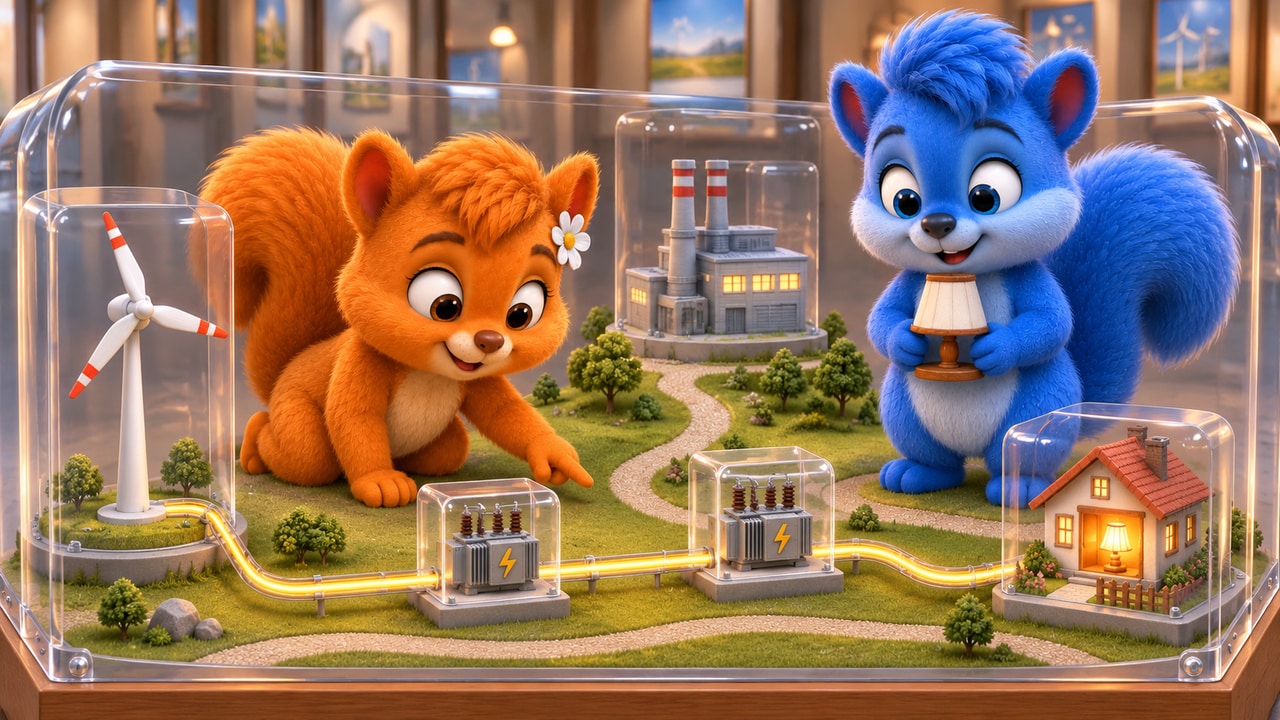
At the museum, Puschel sees a model house with a glowing lamp. A wire leads behind it to a little power station.
Puschel “Does electricity grow inside the wall?”
Flauschi “The socket is a connection. Energy reaches it through a whole network.”
They follow the line through two substations. They adjust voltage: the electrical push that can move charges. Another connection joins from the model wind turbine.
Puschel “So the lamp does not have a private route from just that wind turbine?”
Flauschi “Many sources supply electrical energy to the shared grid.”
Puschel turns the safe model switch. The lamp lights again. He would never investigate the inside of a real socket.
Listen to the story
With the narrator, Puschel and Flauschi. This recording contains the story; the explanations and quiz follow below.
In three steps
1
Generate
Different installations supply electrical energy.
2
Transmit and transform
Grid lines and transformers connect generators and buildings.
3
Distribute indoors
Wires inside the building carry energy to sockets and appliances.
Simplified explanatory models: colours distinguish parts, not real materials. Read the three steps in order. The text explains what each shape represents. Only one example pathway is shown; the real grid has many branches.
The explanation step by step
A network, not one private cord
Power stations, wind turbines and solar cells turn other forms of energy into electrical energy. They do not create energy from nothing. The grid connects many such sources to buildings. Appliances are users of this energy: a lamp turns it into light and heat. One appliance does not necessarily receive its energy from just one particular wind turbine.
Why different voltages?
Voltage describes the electrical push that can move charges. Electric charge is a property of tiny particles. When charged particles move together in one direction, an electric current flows. High voltage is useful over long distances: to transfer the same amount of energy each second, a smaller current is needed. That means less heating in the wires. In the usual grid, current changes direction back and forth. This is alternating current. Transformers raise or lower voltage in this grid. They are found, for example, in substations, where parts of the grid connect. Voltage is reduced before homes, but household electricity is still extremely dangerous.
What is a circuit?
For a lamp to shine, there must be a complete path from one connection of the energy source, through the lamp, to the other connection. This is a closed circuit. A switch can break the path. Metal wires already contain movable charged particles called electrons. The lamp does not wait for a particular particle from a distant turbine. Specialists keep electricity production and use in balance across the grid.
Word help
- power grid
- Connected wires and equipment bringing electrical energy to buildings and appliances.
- transformer
- A device that raises or lowers voltage with alternating current. It does not store energy.
- voltage
- The electrical push that can move charges. It is different from the amount of current flowing.
- electric charge
- A property of tiny particles. Moving charged particles can form an electric current.
- electrons
- Tiny negatively charged particles. Some can move within metal wires.
- circuit
- A complete path through an appliance between the two connections of an energy source.
- substation
- Equipment connecting parts of the power grid and using transformers to adjust voltage.
- alternating current
- Current that regularly changes direction back and forth.
Your explorer activity
Point to the first step in the diagram. Explain in your own words what changes by the final step. Use only the drawing; you do not need to open any appliance or recreate the process.
Remember this
A socket does not generate electricity: it connects an appliance to the grid.
Quiz question 1
What is a socket?
Choose a), b) or c), then explain your choice.
- a)An electricity generator in each wall.
- b)A battery built into every appliance.
- c)A connection to the electrical wiring inside the building.
Show the explanation
Correct: c): A connection to the electrical wiring inside the building.
Energy is supplied through the grid.
Quiz question 2
What does a transformer do?
Choose a), b) or c), then explain your choice.
- a)It creates extra energy from nothing.
- b)It stores all current for the night.
- c)It raises or lowers the voltage.
Show the explanation
Correct: c): It raises or lowers the voltage.
Transformers adjust voltage.
Quiz question 3
What else does a switched-on lamp need?
Choose a), b) or c), then explain your choice.
- a)Only one wire with no return path.
- b)Only high voltage with no conducting connection.
- c)A closed circuit.
Show the explanation
Correct: c): A closed circuit.
A complete conducting path allows current to flow.
Sources and illustration note
Facts checked on 18 November 2026; language reviewed on 19 November 2026. The Wusel story is fictional. Simplified models show principles, not construction, repair or treatment instructions. Specialist references are for reading with an adult.