Everyday Life & Technology
How does sunlight become electricity?
In brief
A solar cell uses light to supply electrical energy. This can run a small fan, for example. Inside the cell, light sets tiny charged particles in motion. Heat alone cannot do this job.
Lumi’s rule
Never climb roofs or open panels or their wiring. Illuminated panels can produce voltage even when connected appliances are switched off.
Puschel and Flauschi investigate
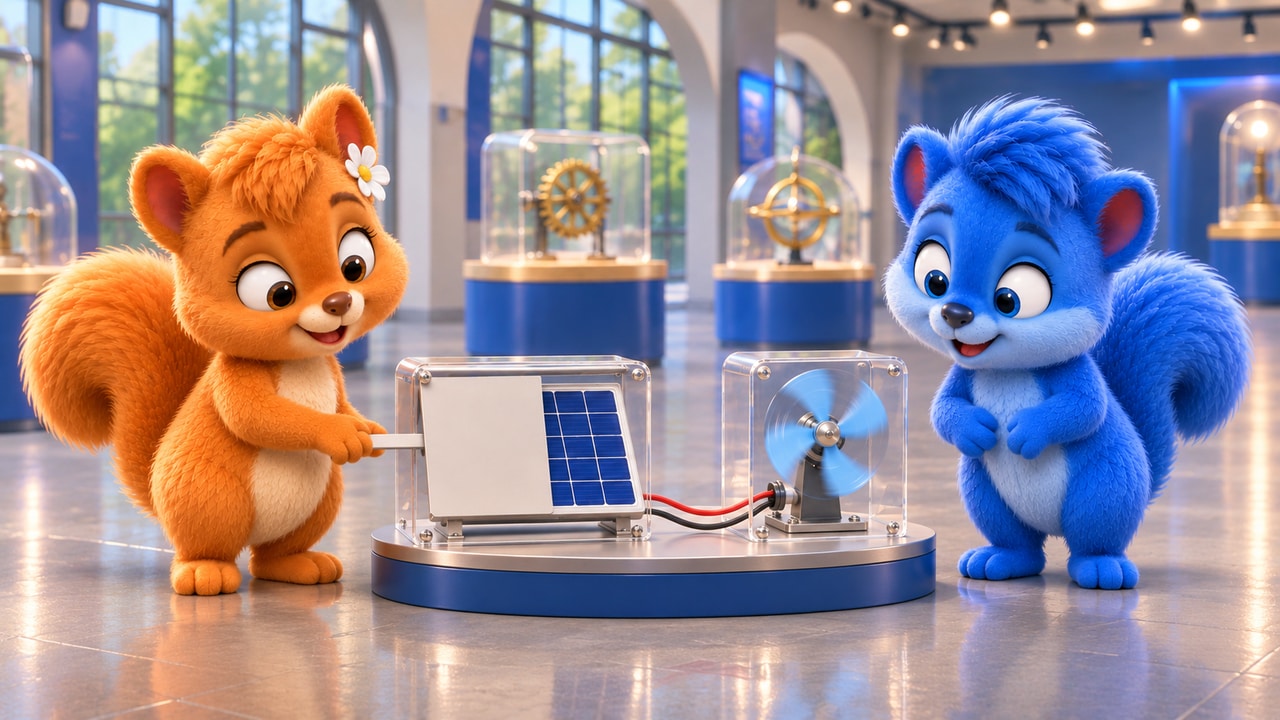
A small guarded fan turns at the museum station. Beside it lies a dark panel divided into many squares.
Puschel “Where is its wind turbine?”
Flauschi “Solar cells do not need a wind turbine. They convert light directly into electrical energy.”
Using the provided handle, Flauschi moves a shade card over part of the panel. The fan slows down.
Puschel “But the panel is still warm!”
Flauschi “Here the light matters. This panel is not a machine powered by heat alone.”
She moves the card away. Puschel watches the fan speed up again. The shade comparison gives him a clue; touching hot parts does not.
Listen to the story
With the narrator, Puschel and Flauschi. This recording contains the story; the explanations and quiz follow below.
In three steps
1
Light reaches the cell
The cell takes in energy from the light.
2
Charges are separated
The cell separates positive and negative charges, producing an electrical push.
3
Circuit powers an appliance
Wires connect both contacts to the appliance.
Simplified explanatory models: colours distinguish parts, not real materials. Read the three steps in order. The text explains what each shape represents. The plus and minus circles stand for positive and negative charges. The arrows point apart to show separation, not one kind turning into the other.
The explanation step by step
What does light do inside a cell?
Solar cells are often made from specially purified silicon. Silicon is a semiconductor: it does not let current flow as freely as metal, and treating it changes its electrical behaviour in useful ways. The material contains tiny particles with electric charge. Light supplies energy, making more charges able to move. The cell’s special structure separates positive and negative charges. This produces voltage between its two connections: an electrical push. Connecting them through an appliance makes a complete circuit in which current can flow.
From roof to appliance
Many cells make one panel, or solar module. Several panels can work together as a system. The cells provide direct current, or DC: it flows in the same direction around a connected circuit. The usual power grid instead uses alternating current, or AC, which changes direction back and forth. An inverter converts DC to suitable AC. Not every solar roof has a rechargeable battery to store energy.
Light rather than heat
Solar cells can supply electricity on cool days if light reaches them. Clouds and shade can change the amount. At night, without illumination, they supply no solar electricity. Turning light into electrical energy is called photovoltaics. Solar thermal systems do a different job: they use solar energy for heating, such as warming water.
Word help
- solar cell
- A component turning light into electrical energy.
- semiconductor
- Material such as silicon. It carries current less freely than metal and can be specially treated for solar cells.
- inverter
- A device turning DC from solar cells into suitable AC for the power grid.
- direct current (DC)
- Current that flows in the same direction around a connected circuit.
- alternating current (AC)
- Current that regularly changes direction back and forth.
- voltage
- The electrical push between the connections that can move charged particles.
- solar module
- A panel made of many connected solar cells.
- photovoltaics
- Turning light directly into electrical energy.
- solar thermal
- Using solar energy for heating, such as warming water.
Your explorer activity
Point to the first step in the diagram. Explain in your own words what changes by the final step. Use only the drawing; you do not need to open any appliance or recreate the process.
Remember this
Solar cells use light; collecting solar heat is a different process.
Quiz question 1
Which energy does a solar cell use?
Choose a), b) or c), then explain your choice.
- a)A necessary rotation of the cells.
- b)Light energy.
- c)Only the panel’s warming.
Show the explanation
Correct: b): Light energy.
Photovoltaics means turning light directly into electrical energy.
Quiz question 2
What does the shade comparison show?
Choose a), b) or c), then explain your choice.
- a)The shade charges a store inside the fan.
- b)The fan must keep the same speed while the panel is warm.
- c)Less light can make the fan slow down.
Show the explanation
Correct: c): Less light can make the fan slow down.
With less light, the cell can supply the fan with less energy each second.
Quiz question 3
Which device adapts direct current for the AC grid?
Choose a), b) or c), then explain your choice.
- a)An inverter.
- b)A battery that only stores energy.
- c)A heat store.
Show the explanation
Correct: a): An inverter.
An inverter changes the current from one direction to a regularly changing direction.
Sources and illustration note
Facts checked on 18 November 2026; language reviewed on 19 November 2026. The Wusel story is fictional. Simplified models show principles, not construction, repair or treatment instructions. Specialist references are for reading with an adult.