Everyday Life & Technology
How does a wind turbine generate electricity?
In brief
Wind makes the shaped blades turn. They are part of the rotor, the rotating part of the turbine. This turns a generator: a machine that changes movement into electrical energy.
Lumi’s rule
Observe turbines only from permitted paths. Never climb them or open equipment or electrical cabinets.
Puschel and Flauschi investigate
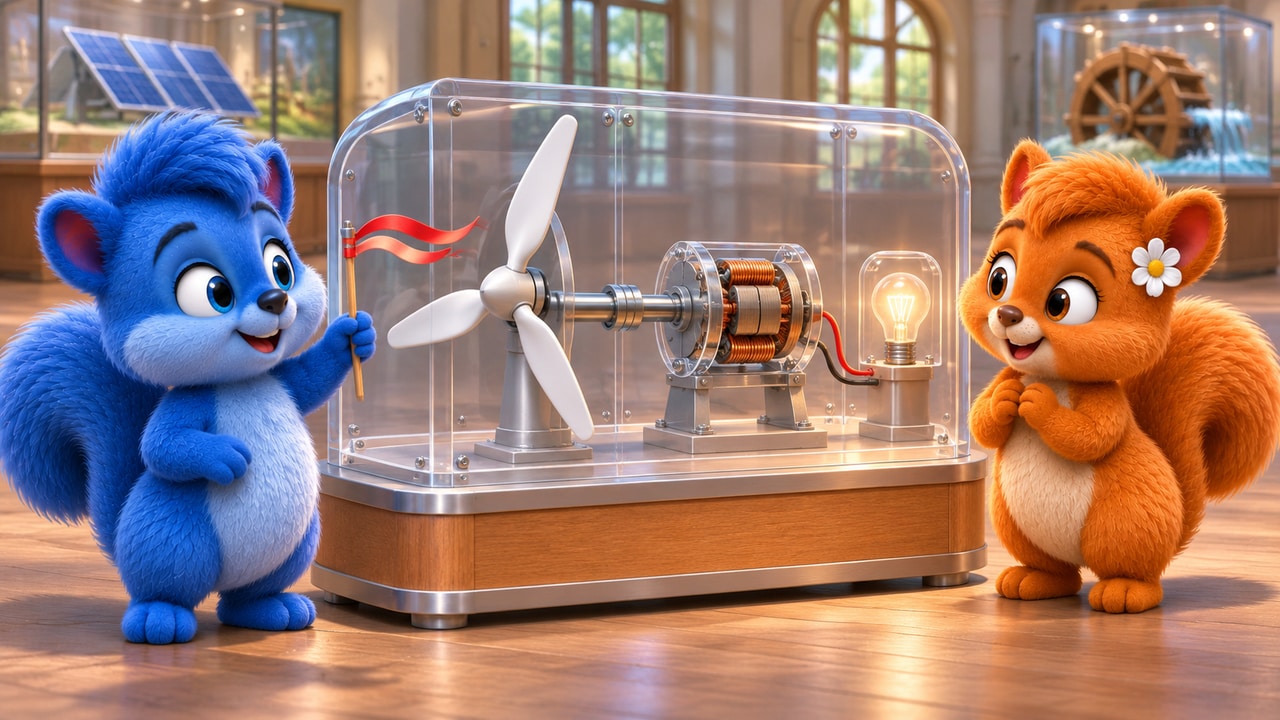
An airflow moves a ribbon at the museum model. Behind it, a little wind turbine starts turning. A lamp lights.
Puschel “So the blades catch electricity from the air?”
Flauschi “They take energy from moving air. The generator converts it into electrical energy.”
In the protected model they follow the rotor shaft to the generator. Puschel finds no bag full of wind.
Puschel “And without wind?”
Flauschi “Then this turbine supplies no wind energy. The grid needs other sources, storage and suitable planning.”
Puschel watches the ribbon again. It shows what causes the rotation, not a supply of electricity.
Listen to the story
With the narrator, Puschel and Flauschi. This recording contains the story; the explanations and quiz follow below.
In three steps
1
Wind turns the rotor
Shaped blades turn forces from the wind into rotation.
2
Shaft drives the generator
Rotation is passed on directly or through a gearbox.
3
Electrical energy
The generator supplies a connected circuit.
Simplified explanatory models: colours distinguish parts, not real materials. Read the three steps in order. The text explains what each shape represents. Yellow frame: the part discussed in this step. Follow how wind movement becomes electrical energy; the lines do not show every wire.
The explanation step by step
The blades have a special shape
The blades are not flat boards. Their shape and angle make the moving air exert forces on them, a little like an aircraft wing. Part of that force turns the rotor: the rotating part with its blades. The moving wind supplies the energy. Behind the rotor, the wind therefore has less energy of movement on average.
The generator converts energy
A shaft passes on the turning movement. This is a rotating rod. Some turbines use a gearbox: connected toothed wheels change how quickly and with how much turning force the next shaft turns. Others drive the generator directly. A generator turns movement into electrical energy. Inside it, magnets and metal parts that can carry current move relative to each other. This produces voltage, the electrical push that can move charged particles. A complete circuit lets the generator supply an appliance.
Not every wind speed is suitable
Controls, the equipment managing the turbine, turn it towards the wind and adjust the blades. Very little wind supplies too little energy. Very strong winds may require reduced output or a protective stop. More wind does not mean unlimited electricity.
Word help
- rotor
- The rotating part with its blades.
- generator
- A machine turning movement into electrical energy.
- gearbox
- Connected toothed wheels that change turning speed and turning force.
- shaft
- A rotating rod that passes on movement.
- voltage
- The electrical push that can move charged particles.
- circuit
- A complete path from one connection of the energy source, through an appliance, to the other connection.
Your explorer activity
Point to the first step in the diagram. Explain in your own words what changes by the final step. Use only the drawing; you do not need to open any appliance or recreate the process.
Remember this
Wind turns the rotor; the generator converts motion into electrical energy.
Quiz question 1
Which energy does a turbine use first?
Choose a), b) or c), then explain your choice.
- a)The motion of air.
- b)The tower’s heat instead of air movement.
- c)Ready-made electricity blown in by the wind.
Show the explanation
Correct: a): The motion of air.
Wind has kinetic energy.
Quiz question 2
What converts rotation into electricity?
Choose a), b) or c), then explain your choice.
- a)The blades alone, without other components.
- b)The generator.
- c)A counterweight inside the foundation.
Show the explanation
Correct: b): The generator.
The generator performs this conversion.
Quiz question 3
What can happen in very strong winds?
Choose a), b) or c), then explain your choice.
- a)Every design must always supply more electricity.
- b)The controller limits output or stops the turbine.
- c)The turbine must run faster without limit.
Show the explanation
Correct: b): The controller limits output or stops the turbine.
The turbine must stay within its operating limits.
Sources and illustration note
Facts checked on 18 November 2026; language reviewed on 19 November 2026. The Wusel story is fictional. Simplified models show principles, not construction, repair or treatment instructions. Specialist references are for reading with an adult.