Everyday Life & Technology
How does a letter reach the right letterbox?
In brief
The address identifies the destination. People and sorting machines arrange letters by region and delivery route. After transport, a postal worker takes the letter to the correct street, house number and name.
Lumi’s rule
Use fictional addresses in games. Do not display real private addresses publicly; ask an adult to help send mail.
Puschel and Flauschi investigate
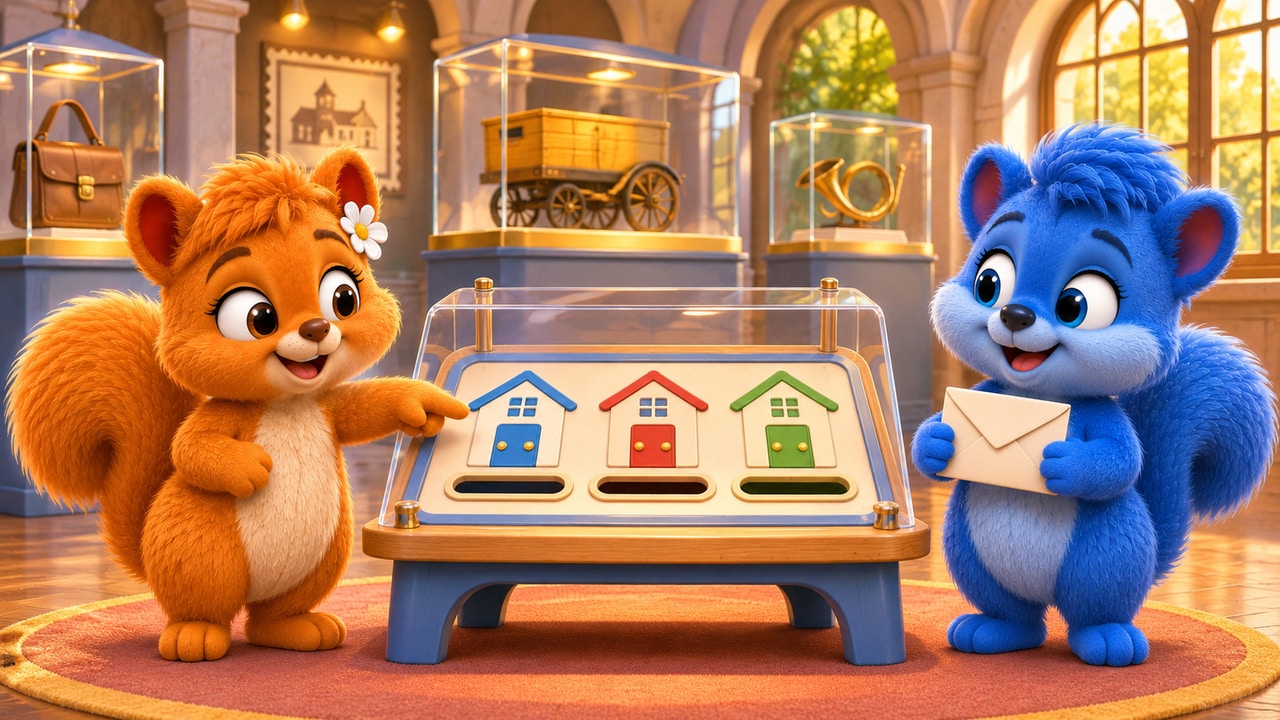
At the museum, Puschel holds a pretend letter. Three model houses have different door colours.
Puschel “Can the letter read where it needs to go?”
Flauschi “People and machines read the address. The letter does not travel on its own.”
They first place it in the correct model region’s tray, then beside the matching house. The colours are only clues in this game.
Puschel “So in real life I do not write down the door colour.”
Flauschi “You need the full address. Postcode and town alone do not identify every letterbox.”
Puschel places the pretend letter at the matching house. The colour game explained the route, but did not replace a real address.
Listen to the story
With the narrator, Puschel and Flauschi. This recording contains the story; the explanations and quiz follow below.
In three steps
1
Read the address
The complete address identifies the destination.
2
Sort by destination
Mail centres sort letters and send them onwards.
3
Deliver to the building
A postal worker reaches the correct letterbox.
Simplified explanatory models: colours distinguish parts, not real materials. Read the three steps in order. The text explains what each shape represents.
The explanation step by step
The address identifies the destination
For an ordinary letter within Germany, the destination includes the name of the person receiving it, street and house number, postcode and town. The postcode helps identify an area. The other details narrow down the destination. A clear, complete address helps people and machines sort the letter.
Sort and transport
After collection, letters reach a mail centre. Machines read addresses and sort mail for destination regions. People help process letters machines cannot read. Vehicles transport the mail onwards; a letter may pass through several stations.
The final part
At the destination, mail is sorted further for delivery areas and route order. A postal worker brings it to the building and correct letterbox. A stamp does not replace an address. Delivery time varies; our story does not promise a fixed arrival time.
Word help
- postcode
- A code helping identify a postal area. German postcodes have five digits.
- mail centre
- A place where many letters are sorted by address.
- delivery route
- The planned journey of a person delivering letters.
- recipient
- The person who is meant to receive the letter.
- postal worker
- A person who collects, sorts or delivers mail.
- address
- Details saying who should receive the letter and where, such as name, street, house number, postcode and town.
Your explorer activity
Point to the first step in the diagram. Explain in your own words what changes by the final step. Use only the drawing; you do not need to open any appliance or recreate the process.
Remember this
The address shows the destination; people and machines get the letter there.
Quiz question 1
What else matters besides postcode and town?
Choose a), b) or c), then explain your choice.
- a)Street, house number and name of the person receiving it.
- b)Only the sender’s name.
- c)Only the value printed on the stamp.
Show the explanation
Correct: a): Street, house number and name of the person receiving it.
The destination must identify the correct building and recipient.
Quiz question 2
What does a mail centre do?
Choose a), b) or c), then explain your choice.
- a)It sorts only by envelope colour.
- b)It reads addresses and sorts letters by destination.
- c)It identifies the destination only from the sender.
Show the explanation
Correct: b): It reads addresses and sorts letters by destination.
The address on the envelope matters for sorting.
Quiz question 3
A letter has only a name, with no street, house number or town. Does a stamp identify its destination?
Choose a), b) or c), then explain your choice.
- a)No, the full destination address is still missing.
- b)Yes, the stamp’s value identifies the house.
- c)Yes, every stamp stores the destination address.
Show the explanation
Correct: a): No, the full destination address is still missing.
A stamp shows payment for carrying the letter. It does not say who should receive it where.
Sources and illustration note
Facts checked on 18 November 2026; language reviewed on 19 November 2026. The Wusel story is fictional. Simplified models show principles, not construction, repair or treatment instructions. Specialist references are for reading with an adult.