In brief
A controller runs the lights: equipment deciding when each colour appears. A button can report that someone wants to cross. Green comes when its timing fits the other signals.
Lumi’s rule
Observe traffic only from safe places with an adult. The model is not permission to play on roads.
Puschel and Flauschi investigate
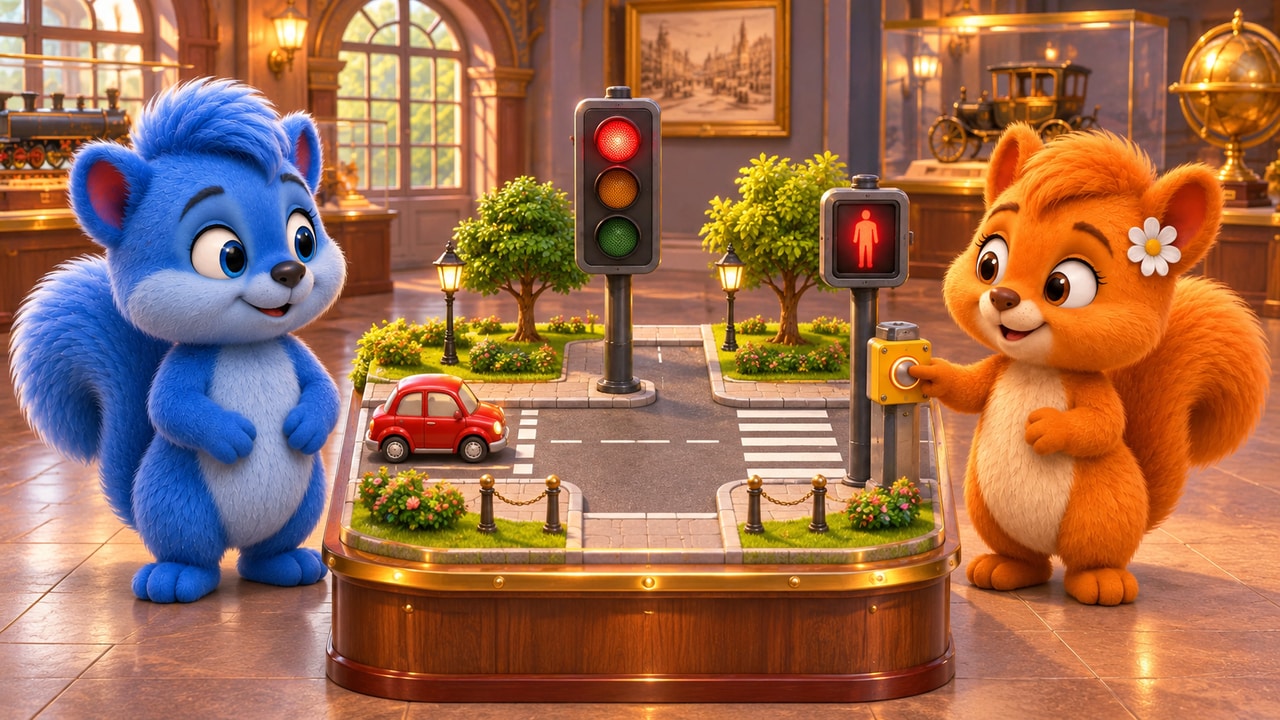
Flauschi presses the button at the model junction. Puschel watches the pedestrian signal; it stays red for now.
Puschel “Did the traffic light not hear me?”
Flauschi “Perhaps the controller already knows we want to cross. First, the other movements need to be stopped safely.”
The model cars stop. A short waiting interval passes. Then the pedestrian signal turns green.
Puschel “So the button was not an instant-green button.”
Flauschi “Exactly. The controller coordinates several routes.”
Puschel watches another cycle. Now he follows the whole junction, not just his own signal.
Listen to the story
With the narrator, Puschel and Flauschi. This recording contains the story; the explanations and quiz follow below.
In three steps
1
Register a request
A button can request a crossing phase.
2
Coordinate movements
The controller follows its signal plan and clearance intervals.
3
Display permission
The appropriate signal shows whose turn it is.
Simplified explanatory models: colours distinguish parts, not real materials. Read the three steps in order. The text explains what each shape represents.
The explanation step by step
Who changes the colours?
The controller is the equipment deciding when each signal changes. Some systems follow fixed timings. Others receive extra messages: a push-button tells the controller that someone wants to cross on foot. A detector is a measuring device that can notice waiting vehicles, for example. Pressing the button does not mean instant green. Its timing must fit the other signals.
Why do we sometimes wait?
Traffic cannot simply receive permission to move in every direction at once, or people and vehicles could collide. After one green period, that traffic needs time to leave the junction or crossing. This clearance time helps make the route clear. Our model shows a simple crossing: cars stop before pedestrians get green. Real junctions can be more complicated. Turning drivers may meet pedestrians even when both have green, and must give way.
Which signal applies to me?
In Germany, ordinary pedestrian signals use red and green. Vehicle signals use red, red with amber, green and amber. Follow the signal for your route, not just any green light. Do not start crossing on red. If it changes to red while you are crossing, continue promptly along your route. Even on green, check with an adult that vehicles really stop.
Word help
- signal
- A sign giving information. Traffic-light colours tell you whether to wait or move.
- detector
- A measuring device that notices something, such as a waiting vehicle.
- clearance time
- Time allowing traffic to leave the junction or crossing after its green period.
- controller
- Equipment using messages and timings to coordinate the lights.
- turning
- Changing direction to the right or left at a junction.
Your explorer activity
Point to the first step in the diagram. Explain in your own words what changes by the final step. Use only the drawing; you do not need to open any appliance or recreate the process.
Remember this
A crossing button registers a request; the controller coordinates a suitable safe phase.
Quiz question 1
What does a crossing-request button do?
Choose a), b) or c), then explain your choice.
- a)It registers a crossing request.
- b)It always gives an immediate green.
- c)It transfers all responsibility to vehicles.
Show the explanation
Correct: a): It registers a crossing request.
The controller fits the request into its timings. The button does not switch the light to green straight away.
Quiz question 2
Why is there clearance time after a green period?
Choose a), b) or c), then explain your choice.
- a)To let every direction start moving immediately.
- b)To let people and vehicles leave the junction or crossing.
- c)So the controller no longer needs vehicle detection.
Show the explanation
Correct: b): To let people and vehicles leave the junction or crossing.
Traffic already moving needs time to leave before other routes receive green.
Quiz question 3
What applies at a real green pedestrian signal?
Choose a), b) or c), then explain your choice.
- a)Still pay attention to traffic conditions.
- b)All turning vehicles are certainly stationary.
- c)You only need to watch the colour, never traffic.
Show the explanation
Correct: a): Still pay attention to traffic conditions.
Turning traffic and other people’s mistakes can still be dangerous.
Sources and illustration note
Facts checked on 18 November 2026; language reviewed on 19 November 2026. The Wusel story is fictional. Simplified models show principles, not construction, repair or treatment instructions. Specialist references are for reading with an adult.