Garden and orchard · Cydonia oblonga
Quinces: golden fruit often enjoyed cooked
A yellow apple? A lumpy pear? On the garden bench, Puschel and Flauschi discover a different pome fruit: quince.

The short answer
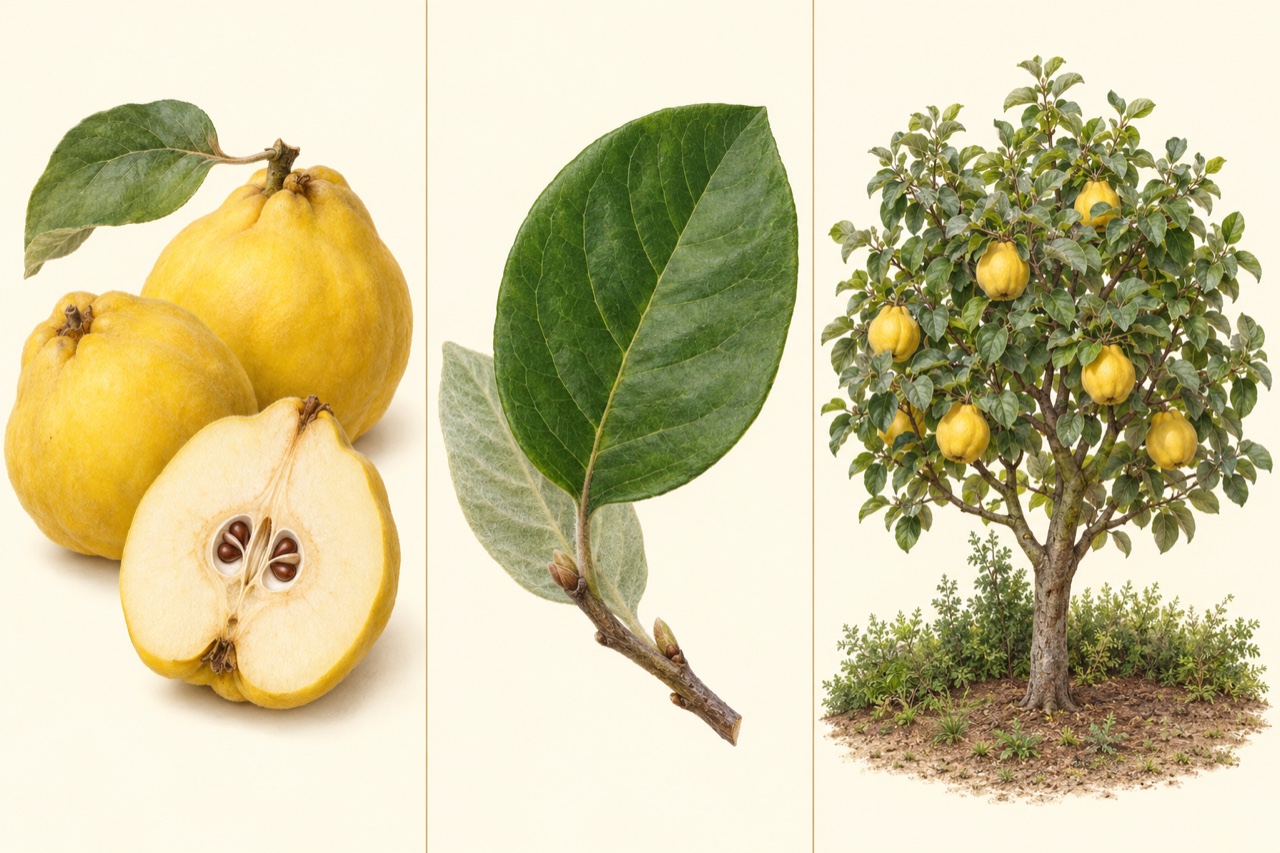
Quinces turn yellow when ripe and contain several seeds in a core, like apples. Many varieties are very hard and astringent raw and are used cooked. Adults check the variety and preparation.
An imagined Wusel scene
Puschel and Flauschi investigate
Puschel moves a little closer on the garden bench. Puschel“It looks like an apple with a pear idea!” Flauschi holds a known garden quince calmly in front of her.
Flauschi“It is a quince,” she says. Flauschi“It has several seeds inside. Many varieties are very hard and astringent raw.” Puschel keeps his paws on his knees and studies the uneven yellow skin.
Puschel“Then we will ask someone who knows the variety and can help cook our compote,” Puschel suggests. Flauschi nods. Their cosy kitchen idea can wait; today they compare shapes first.
The fruit
Quinces are pome fruits. They can be apple-shaped or pear-shaped and turn yellow as they ripen. Inside is a core with several seeds, rather than one large stone.
Leaf and plant
Quince grows as a small tree or large shrub. Its broad oval leaves have finely hairy undersides.
What makes it special
Many varieties grown here are hard and astringent raw and are usually cooked, for example into compote or jelly. Some varieties have ripe flesh that tastes pleasant raw.
Try explaining it
Does a quince have one large stone?
Choose a), b) or c), then explain your choice.
- a)Yes, and no seeds.
- b)No, several seeds sit inside a core.
- c)Yes, just like every mirabelle.
Show the explanation
Correct: b): No, several seeds sit inside a core.
Quinces turn yellow when ripe and contain several seeds in a core, like apples. Many varieties are very hard and astringent raw and are used cooked. Adults check the variety and preparation.
Word help
- cell
- A tiny living unit. Living things are made of cells.
- core
- Here, the central part of an apple or pear that holds the seeds.
Explore in more detail
Here you will find longer explanations and further details. You can explore them together.
What changes when a quince is cooked?
Many locally grown quinces are very firm and astringent when raw. Cooking softens their flesh by changing structures in the cell walls. Plant cells are tiny building units with a firm outer wall. Heat changes texture; it does not automatically make an unknown poisonous fruit edible.
Compare and understand
Like apples and pears, quinces are pome fruits, with a seed-bearing core rather than one large stone. Some varieties can be pleasant raw when ripe. Adults choose a known fruit for comparison and handle cutting and hot cooking.
An optional question for further exploration
You can use the longer explanation above. This is extra, not needed for the first quiz.
An extra question
How does the inside of a quince differ from the inside of a mirabelle plum?
Show answer
A quince has a core with several seeds. A mirabelle plum has a single stone.
Do all quince varieties have to be cooked to taste pleasant?
Show answer
No. Many varieties are cooked because their flesh is hard and astringent. Some have ripe flesh that tastes pleasant raw; adults must check the known variety and preparation.