Garden and orchard · Prunus domestica (Zwetschgen / European prune plums)
European prune plums: the longer plums
Puschel looks for round plums and finds longer fruit. Flauschi explains that these prune plums also belong to the plum family.

The short answer
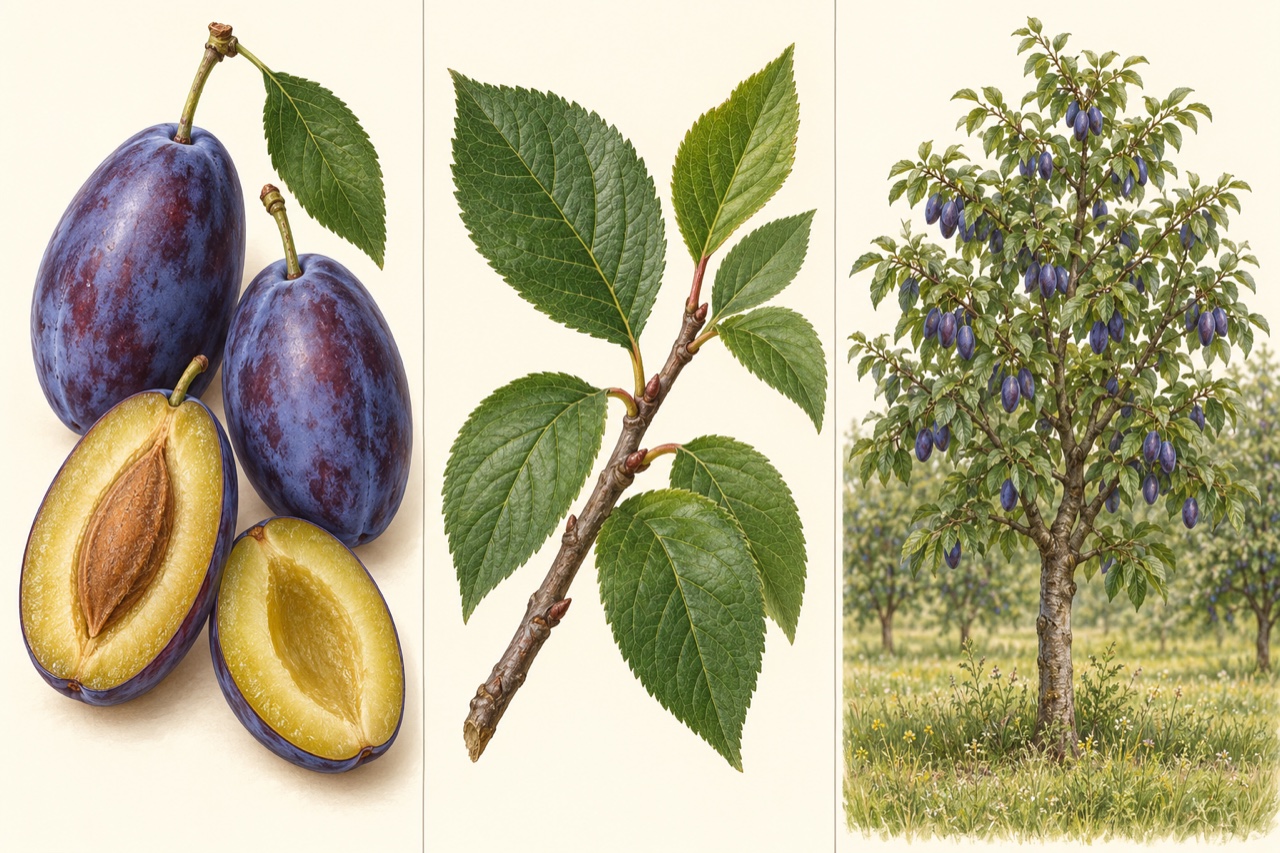
Prune plums (Zwetschgen) are a form of European plum. They are usually elongated and blue-purple, with one large stone inside. They are not a separate kind of berry.
An imagined Wusel scene
Puschel and Flauschi investigate
Puschel tilts his head. Puschel“I was looking for round plums. These look more like little eggs!” Elongated blue fruit hang from the branch in front of him.
Flauschi holds a shallow bowl of already harvested prune plums. Flauschi“These are Zwetschgen, or European prune plums. They are plums too, and have a stone inside.” Puschel looks at a fruit without pulling the branch down.
Puschel“One family can have different shapes,” he says. Adults will wash and stone the known fruit for a cake. Until then, the two compare elongated and rounder shapes.
The fruit
European prune plums, called Zwetschgen in German, belong to Prunus domestica, like European plums. Their fruits are usually elongated and blue-purple, with yellowish to green-yellow flesh.
Leaf and plant
They grow on trees with oval, toothed leaves. Prune plums are stone fruits: each fruit contains one stone.
What makes it special
In ripe prune plums, the stone usually separates readily from the firmer flesh. They are therefore popular for cakes; shape and other characteristics vary with the variety.
Try explaining it
How are prune plums and European plums related?
Choose a), b) or c), then explain your choice.
- a)Prune plums are a form of European plum.
- b)They are plums that have not yet ripened.
- c)They are dried plums rather than a distinct fruit form.
Show the explanation
Correct: a): Prune plums are a form of European plum.
Prune plums (Zwetschgen) are a form of European plum. They are usually elongated and blue-purple, with one large stone inside. They are not a separate kind of berry.
Explore in more detail
Here you will find longer explanations and further details. You can explore them together.
Why are many prune plums useful for baking?
In many ripe prune plum varieties, the stone separates easily from relatively firm flesh. This can be useful in baking because pieces can keep their shape better than very juicy plums. Varieties and stages of ripeness still differ.
Compare and understand
The pale bloom on many fruits is a natural waxy coating, not automatically mould. Adults still inspect and wash fruit before preparation. A prune plum remains a form of plum; its kitchen name does not describe an unrelated plant family.
An optional question for further exploration
You can use the longer explanation above. This is extra, not needed for the first quiz.
An extra question
A picture shows an elongated blue-purple fruit. Is that enough to identify a safe edible prune plum?
Show answer
No. Those are typical features, not a safe identification. Adults must check the known edible fruit and plant.
Why are many prune plum varieties useful for a cake?
Show answer
Their flesh is relatively firm, and the stone usually separates readily in ripe fruit. Adults wash and stone them.