Discovery 8 / 27
Puschel & Flauschi’s Forest Discoveries
Why Does the Forest Rustle?
The green explorer’s magnifying glass with a leaf-shaped handle
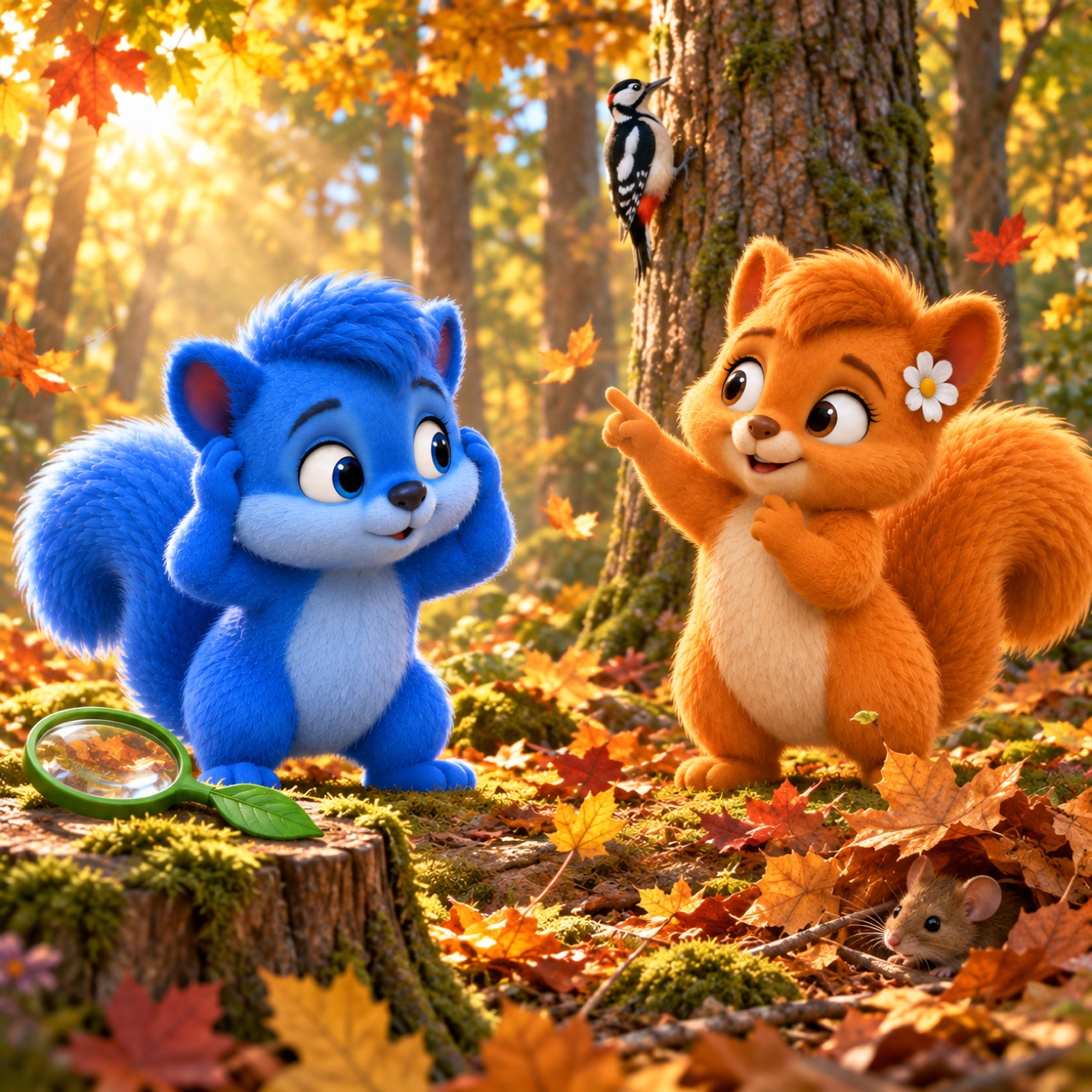
One bright afternoon, Puschel stopped in the middle of the path. Leaves swished above him. Something rustled to the right. A rapid tap-tap-tap came from a tree.
Puschel“The forest is speaking three languages at once! I cannot understand a single word.”
Flauschi placed a paw beside her ear. Puschel set the explorer’s magnifying glass on a stump and cupped both paws around his ears like enormous listeners.
Flauschi“Then we shall solve this mystery with our ears and one quiet minute.”
First came a soft shhhh from the treetops. Wind moved the leaves and made them rub together. A moment later, a wood mouse hurried through the dry leaf litter.
Puschel“One leaf whisper and four tiny rustling paws. I already understand two languages!”
The rapid drumming came from a great spotted woodpecker. It tapped its beak quickly on a branch that made the sound easy to hear. This sent other woodpeckers a message: “I am here!” It could also show which part of the woods it claimed as its own. That area is called its territory.
Flauschi“A message you can hear is also called a signal. When a woodpecker looks for food in wood, it pecks differently. The taps are often less evenly spaced.”
Puschel wanted to drum an excited reply, but that would cover the quiet sounds. So he simply bobbed his tail silently in time.
Puschel“The forest was not talking all at once. I simply had not been quiet enough to listen.”
Look closely
What the two discovered
Wind moves leaves and twigs. When leaves rub against each other, we hear swishing or rustling.
Mice, beetles and other small animals walk through dry leaves on the ground. The leaves rustle as they move. A tiny animal can make a surprisingly loud sound.
A woodpecker can tap very quickly on wood with its beak. This is called drumming. It is a message other woodpeckers can hear, or a signal: “I am here!” It pecks differently when searching for food.
We stand quietly and listen first in one direction, then another. This helps us hear where a sound comes from. We never chase an animal.
Explorer’s rule: Leave animals and plants in peace. Just watch and do not damage anything.
Sources for adults: NABU: Buntspecht / great spotted woodpecker
Keep exploring
Where shall we wusel next?
Choose how to keep exploring: another story or a related activity.
Look for woodland treasures
Take an adult along and choose the printable nature bingo. Leave plants and animal homes untouched.
Start exploring →Keep making in the workshop
Safe craft ideas include materials, steps and the adult help needed.
See workshop ideas →