Discovery 9 / 27
Puschel & Flauschi’s Forest Discoveries
Why Do Leaves Float on Water?
The green explorer’s magnifying glass with a leaf-shaped handle
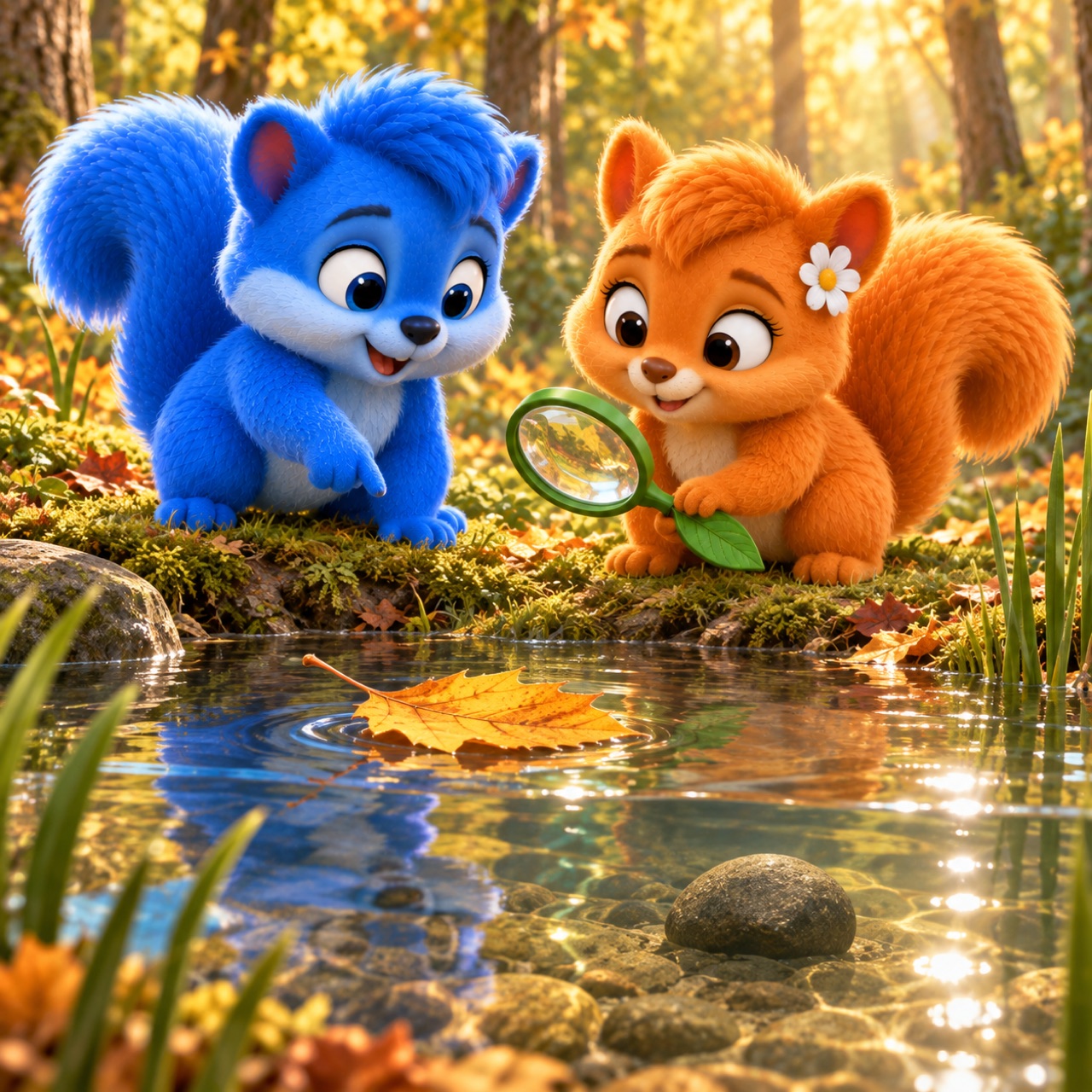
From the firm path beside the little woodland pond, Puschel saw a dry leaf that had fallen onto the water by itself. It stayed on top and slowly turned in a circle. The two kept back from the edge.
Puschel“It has no boat and still floats. Perhaps it can paddle in secret?”
Flauschi lifted the green explorer’s magnifying glass and looked towards the broad, light leaf. From their safe spot, they could not see whether air was trapped beneath it.
Flauschi“Water pushes things upwards. This push is called buoyancy. At the top, water also holds together a little like a thin, stretched skin. This is called surface tension. It can help hold up a very light leaf, but not you. Sometimes air beneath a leaf helps too.”
Puschel noticed a small round stone resting on the clear bottom nearby. He pointed without leaning over the water or throwing anything into it.
Puschel“The stone took the shortcut down!”
Flauschi explained that an ordinary stone is heavier than an equal-sized amount of water. We say it is denser. The water’s upward push is not enough to hold up the stone, so it sinks.
Flauschi“Being light or heavy is not the whole story. A ship has lots of space with air inside. When it sits in water, it pushes water aside. This can give it enough upward push to float.”
After a while, one edge of the leaf dipped lower and water washed over it. Flauschi explained that some leaves absorb water and sink later, while others float for longer.
Puschel“So it was a leaf boat for a while. I shall let it travel on without disturbing it.”
Look closely
What the two discovered
Water pushes things upwards. This push is called buoyancy. When something takes up space in water, it pushes water aside. A hollow ship can push enough water aside to stay afloat even with its load.
At the top, water holds together especially tightly. It acts a little like a thin, stretched skin. Very light things can rest on it. This is called surface tension. It is not a real skin and cannot hold you up.
An ordinary stone is heavier than an equal-sized amount of water. We say it is denser. The upward push is not enough to hold it up, so it sinks. The surface and air beneath a light leaf can also help it float. Being wide does not mean something will float.
Some leaves slowly soak up water and sink later. Others float for longer. We watch with an adult from a safe path and keep back from the edge. We throw nothing in.
Explorer’s rule: Leave animals and plants in peace. Just watch and do not damage anything.
Sources for adults: USGS: Oberflächenspannung / surface tension · NASA: Archimedisches Prinzip / buoyancy
Keep exploring
Where shall we wusel next?
Choose how to keep exploring: another story or a related activity.
Look for woodland treasures
Take an adult along and choose the printable nature bingo. Leave plants and animal homes untouched.
Start exploring →Keep making in the workshop
Safe craft ideas include materials, steps and the adult help needed.
See workshop ideas →