Discovery 7 / 27
Puschel & Flauschi’s Forest Discoveries
The Map on the Tree Bark
The green explorer’s magnifying glass with a leaf-shaped handle
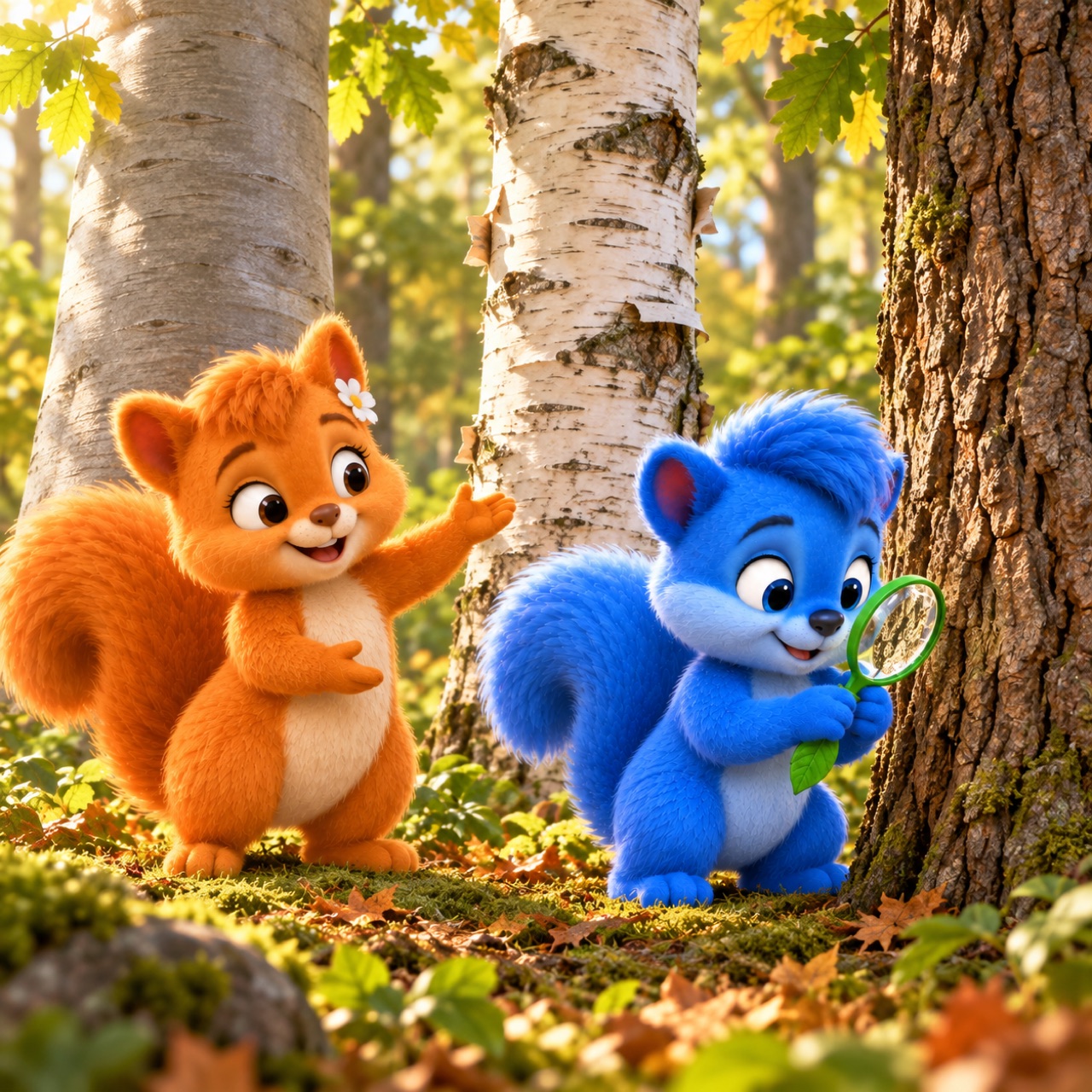
Three trees stood close together: a beech with smooth grey bark, a pale birch marked with dark lines and an oak with deep grooves. These grooves are called furrows. Puschel held the explorer’s magnifying glass a little way from the oak’s bark.
Puschel“I have found a treasure map! This channel must lead straight to the Giant Acorn.”
Flauschi moved her paw through the air in front of the three trunks without touching them. Their surfaces looked as if each tree had chosen a different coat.
Flauschi“That is the outer bark. It helps protect the tree from drying out and from small injuries.”
Puschel compared the patterns. The beech looked almost smooth. Paper-thin strips peeled naturally from the birch. The old oak wore deep ridges and furrows.
Puschel“Every tree coat is sewn differently. The oak definitely has the most pockets.”
Tiny animals found sheltered places in the grooves. Moss could grow there too. Little flat patches on the bark were lichens. Flauschi explained that bark alone does not always tell us which tree it is. Leaves, fruits and buds help too. Buds are little closed packages that later open into leaves or flowers.
Flauschi“A good tree detective gathers several clues using only her eyes, never by carving a mark.”
Puschel had already lifted a stick like a treasure-map pencil. He quickly returned it to the leaves and traced the bark patterns in the air with his paw instead.
Puschel“I did not find the Giant Acorn, but I can now recognise three tree coats without damaging any of them.”
Look closely
What the two discovered
Bark is the outside covering of a tree trunk, a little like a coat. It helps protect the inside of the tree. It stops the tree losing water so easily and helps protect it from injury.
Not every tree coat looks the same. Bark can be smooth or have little flakes and deep grooves. These grooves are called furrows. Bark also changes as a tree gets older.
Tiny animals find sheltered places in cracks and grooves. Moss and lichens can grow there too. Lichens can look like little flat patches or crusts on the bark.
To recognise a tree, we look at several things: bark, leaves, fruits and buds. Buds are little closed packages that later open into leaves or flowers. We never cut or peel bark off.
Explorer’s rule: Leave animals and plants in peace. Just watch and do not damage anything.
Sources for adults: SDW: Baumarten / tree species · Woodland Trust: Eiche und Tierwelt / oak and wildlife
Keep exploring
Where shall we wusel next?
Choose how to keep exploring: another story or a related activity.
Look for woodland treasures
Take an adult along and choose the printable nature bingo. Leave plants and animal homes untouched.
Start exploring →Keep making in the workshop
Safe craft ideas include materials, steps and the adult help needed.
See workshop ideas →