Discovery 30 / 33
Puschel & Flauschi’s Forest Discoveries
The Mysterious Patches on the Wood
The green explorer’s magnifying glass with a leaf-shaped handle
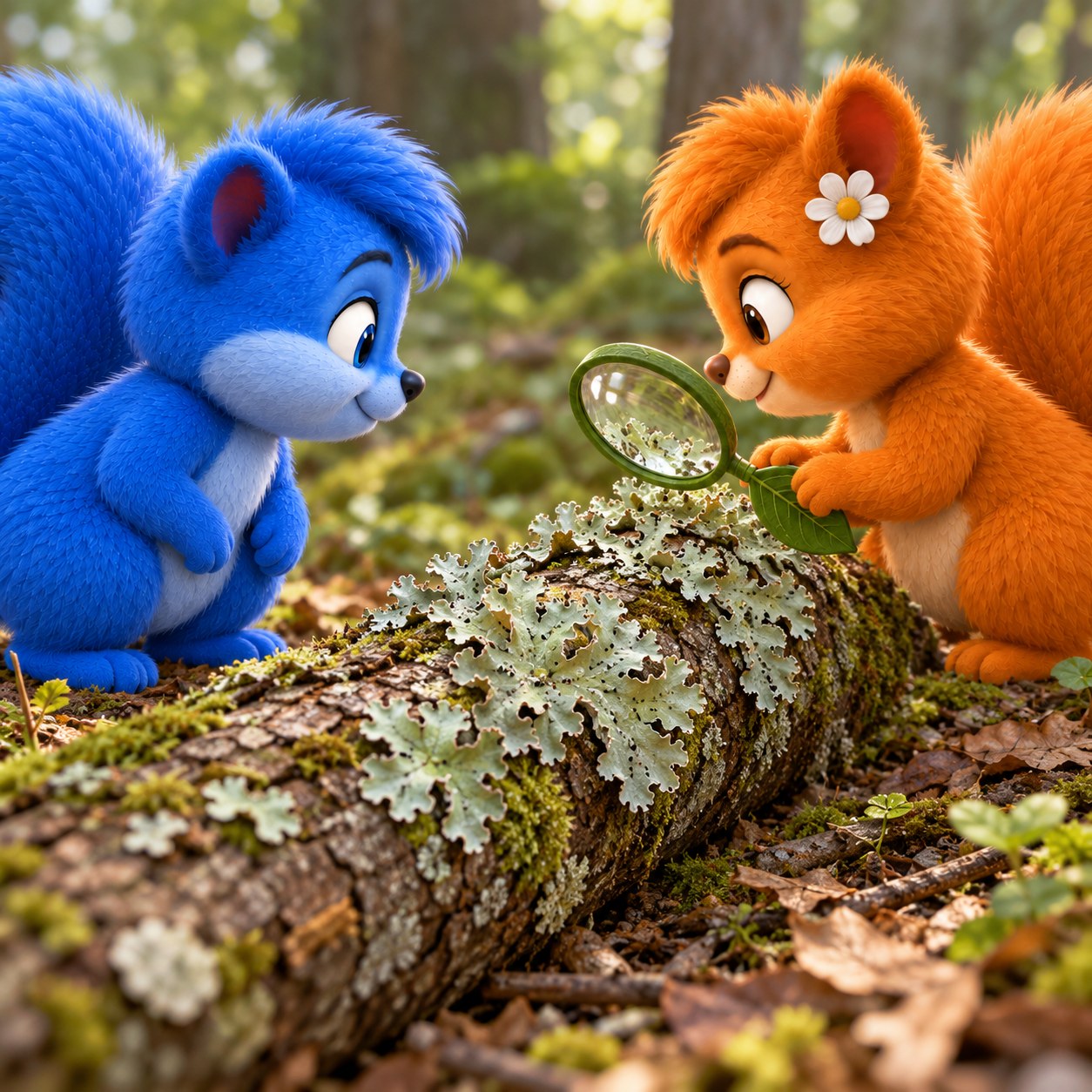
A fallen branch lay beside the woodland path. Grey-green patches with fine, crinkled edges grew on its bark. Puschel stopped. He looked at the branch and then at his own paws, as though checking for paint.
Puschel“Someone has painted the woods. Very neatly, but the colour is rather pale.”
Flauschi crouched down. She held the green magnifying glass over a patch without lifting the branch. Puschel leaned towards the branch from the other side. The edge looked like tiny flat frills. He did not rub a paw over it.
Flauschi“That looks like a lichen. Lichens are neither painted patches nor cushions of moss.”
Puschel“Is it a plant with a very flat hat, then?”
Flauschi“Different living things live closely together in a lichen. A fungus is a kind of living thing; mushrooms belong to this group. In a lichen, a fungus is usually joined with tiny algae. Algae are living things, and many can use light to make sugar.”
Puschel studied the patch again. Flauschi explained that the fungus helped build the lichen’s body. It sheltered the algae and helped supply water. The algae made sugar with light, and the fungus received some too.
Puschel“A shared home with a shared food cupboard. Who does the washing-up?”
Flauschi laughed. Of course, there were no plates or kitchen inside. Such a close living partnership was called symbiosis. Their ordinary magnifying glass could not show the tiny partners separately.
Flauschi“We can see the lichen. We cannot see its fine inside structure this way. We do not know its exact kind yet either.”
Puschel“Then the colour stays on. We do not need to scrape it off to be curious.”
Flauschi lowered the magnifying glass. The fallen branch stayed where it lay. As they walked on, Puschel noticed another patch on some bark. This time he did not call for a painter. First he simply looked more closely.
Look closely
What the two discovered
Lichens are close living partnerships. Usually a fungus lives with tiny algae. Some lichens have certain bacteria as partners: these are tiny living things too. Such close living together is called symbiosis.
Algae can use light to make sugar and supply the fungus with it. The fungus forms much of the lichen’s body, shelters the partners and helps supply water. This is living together, not a little kitchen.
Lichens can grow on bark, wood, stone and other surfaces. Some look crusty, leafy or branching. A lichen is not a cushion of moss; moss is made of small plants.
An ordinary magnifying glass shows shapes and surfaces. It cannot show the tiny partners inside separately. Colour alone cannot reliably identify the exact kind of lichen.
Little Wusel quiz
Choose one answer: a) or b).
How is a lichen different from a cushion of moss?
Show answer
The correct answer is b) A fungus and tiny partners live closely together in a lichen. Lichens are living partnerships, usually of a fungus and algae. Moss, however, is made of little plants.
Explorer’s rule: Leave animals and plants in peace. Just watch and do not damage anything.
Sources for adults: WSL SwissLichens: Was ist eine Flechte? · WSL: Lungenflechte und Symbiose
Keep exploring
Where shall we wusel next?
Choose how to keep exploring: another story or a related activity.
The Woodland Has Several Layers
From moss cushions to treetops, woodland grows at different heights. Puschel searches for the stairs and discovers something better.
Read another discovery →Keep exploring together
Nature bingo and woodland games for curious explorers.
Explore woodland games →