Discovery 31 / 33
Puschel & Flauschi’s Forest Discoveries
The Woodland Has Several Layers
The green explorer’s magnifying glass with a leaf-shaped handle
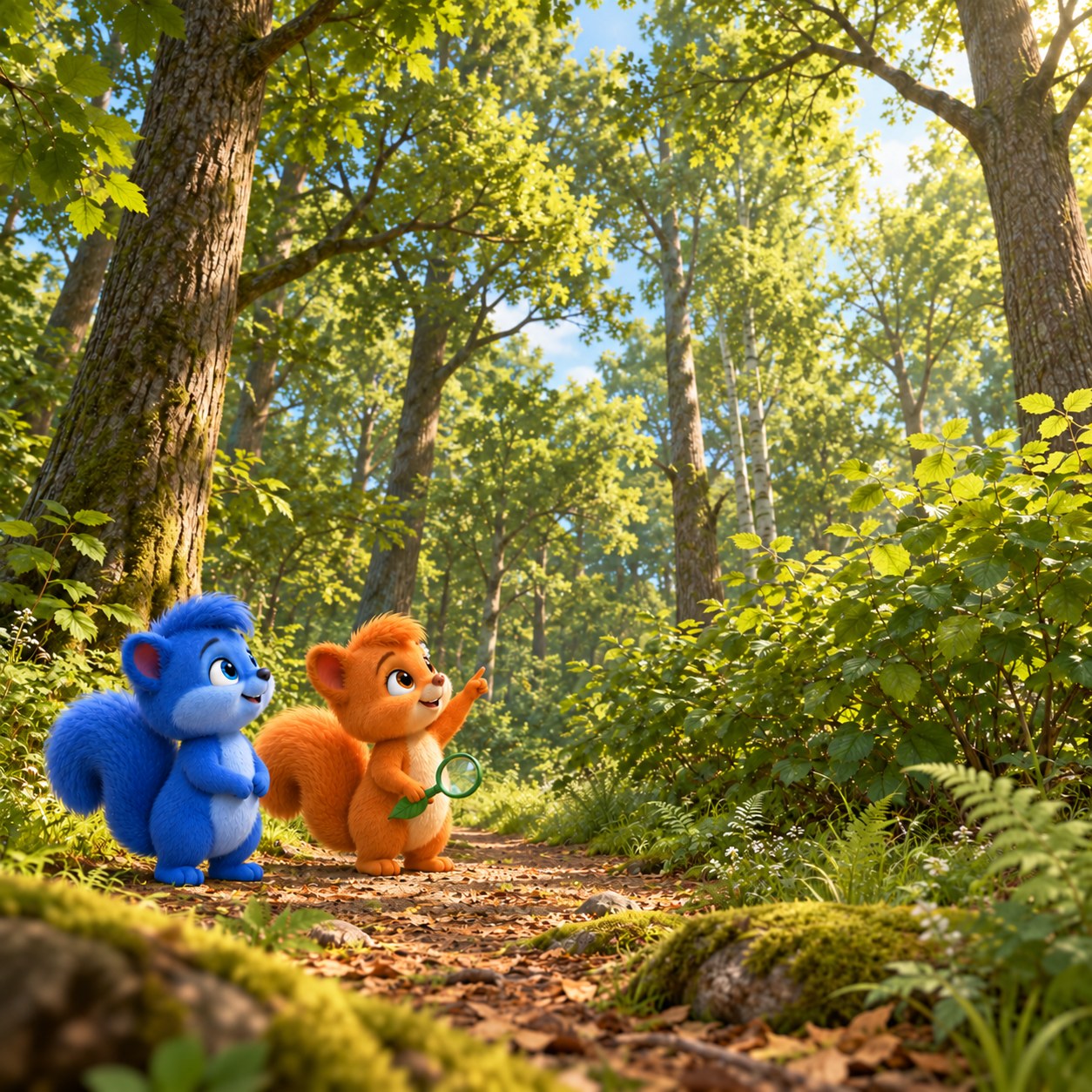
One bright summer day, Puschel and Flauschi stopped at an open part of the woodland path. Low green cushions grew beside them. A little farther away stood ferns and a leafy shrub. Above them, tall tree trunks reached into a roof of leaves.
Puschel“Someone is building upwards here. But the stairs are missing!”
Flauschi kept the green magnifying glass lowered and looked up with him from the path. It could not help with the high branches. They did not point it towards the sky. Puschel imagined a woodland house with lots of windows.
Flauschi“We can describe different layers in woodland. These are areas with plants growing at different heights, not solid floors like a house has.”
They began near the ground. A moss cushion grew beside the path. Grasses and ferns stood taller behind it. These low plants belonged to the herb layer. Here the word meant a woodland layer, not just herbs used for cooking.
Puschel“Then the fern is already a floor above the cushion. Without a lift.”
Flauschi“Higher up are shrubs, with woody branches. Tall trees form the tree layer. A tree’s crown is its upper part with branches and leaves or needles.”
Flauschi pointed from the low green plants to the shrub, then to the treetops. The areas overlapped. There were no closed rooms or straight dividing lines. Roots also grew in the soil under their feet, although they could not see them.
Puschel“Does every woodland have exactly the same house?”
Flauschi“No. Some have lots of shrubs, others very few. Light, the plants and their surroundings make a difference. Layers are a way to describe what we see.”
Puschel looked up again, then down at the little moss cushion. He did not need to climb anywhere. He could compare plenty from the path.
Puschel“I do not need my stairs. My eyes are enough for looking.”
Flauschi smiled. They walked on together. Puschel was no longer looking only at separate trees. He could see how much woodland grew between and beneath them too.
Look closely
What the two discovered
Woodland layers describe plants growing at different heights. The areas overlap. A woodland has no solid floors and does not always have the same number of clearly separated layers.
Mosses can grow near the ground. Above them there are often grasses, ferns and other low plants. This is called the herb layer. Here “herb” does not mean only a plant used in cooking.
Shrubs with woody branches form the shrub layer. Tall trees belong to the tree layer. Their crowns are the upper parts with branches and leaves or needles. Roots also reach into the soil.
Not every woodland shows all layers equally clearly. Light and the plants present affect its structure. Different layers offer animals different food, shelter and places to live.
Little Wusel quiz
Choose one answer: a) or b).
What do woodland layers describe?
Show answer
The correct answer is a) Areas with plants at different heights, from low greenery to tall trees. Mosses, low plants and shrubs also help describe woodland structure. Not every woodland shows the same clear divisions.
Explorer’s rule: Leave animals and plants in peace. Just watch and do not damage anything.
Sources for adults: SDW Mecklenburg-Vorpommern: Waldpädagogische Bildungsbausteine · SDW: Die Stockwerke des Waldes – Hintergrundwissen
Keep exploring
Where shall we wusel next?
Choose how to keep exploring: another story or a related activity.
What Keeps the Big Tree Standing?
A tall tree stands beside the path without a visible support. Puschel searches for its feet while Flauschi explains its hidden hold in the soil.
Read another discovery →Keep exploring together
Nature bingo and woodland games for curious explorers.
Explore woodland games →