How do whales eat without teeth?
Baleen whales filter food with special plates. Toothed whales use other approaches.
The short answer
Baleen whales have rows of baleen instead of teeth. They take in water with food and let water out while small prey remains trapped. Not every whale has baleen: toothed whales exist too.
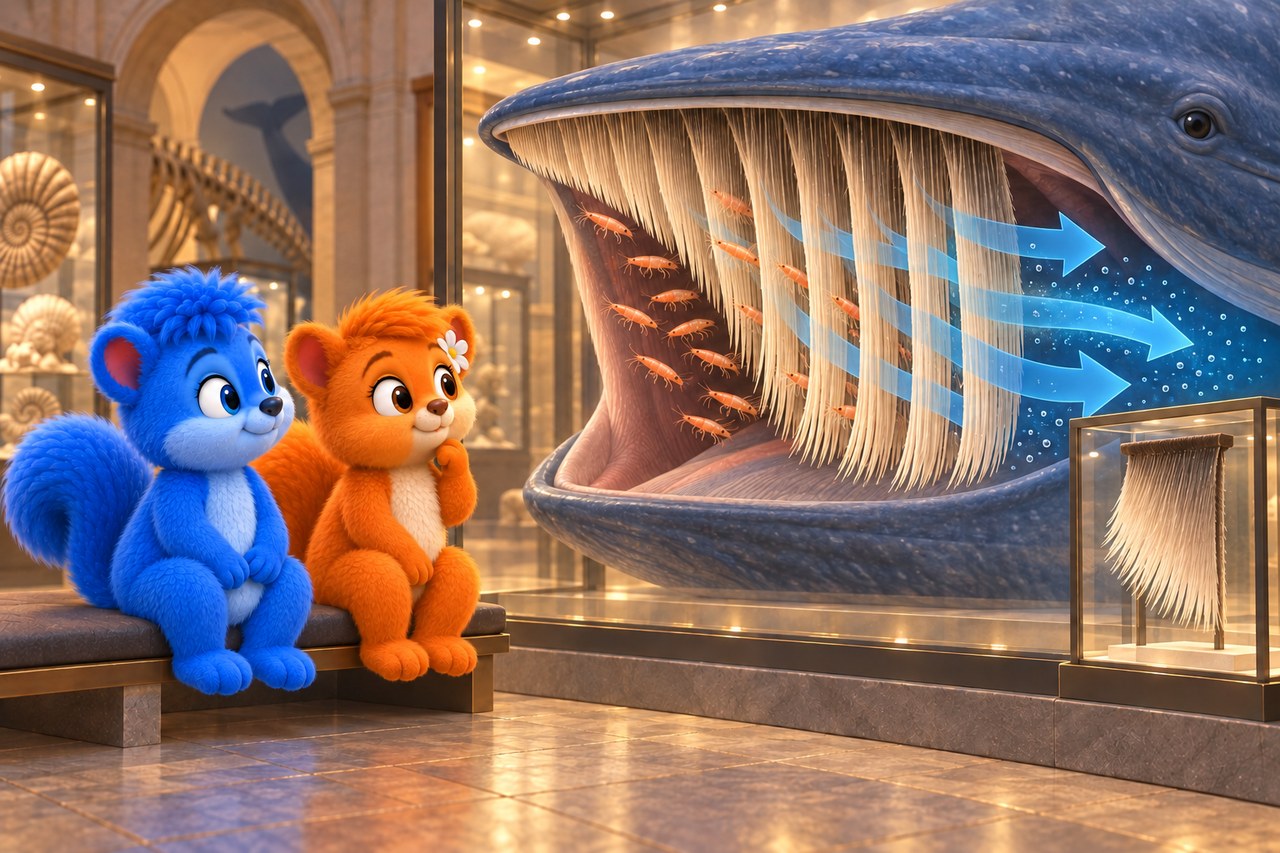
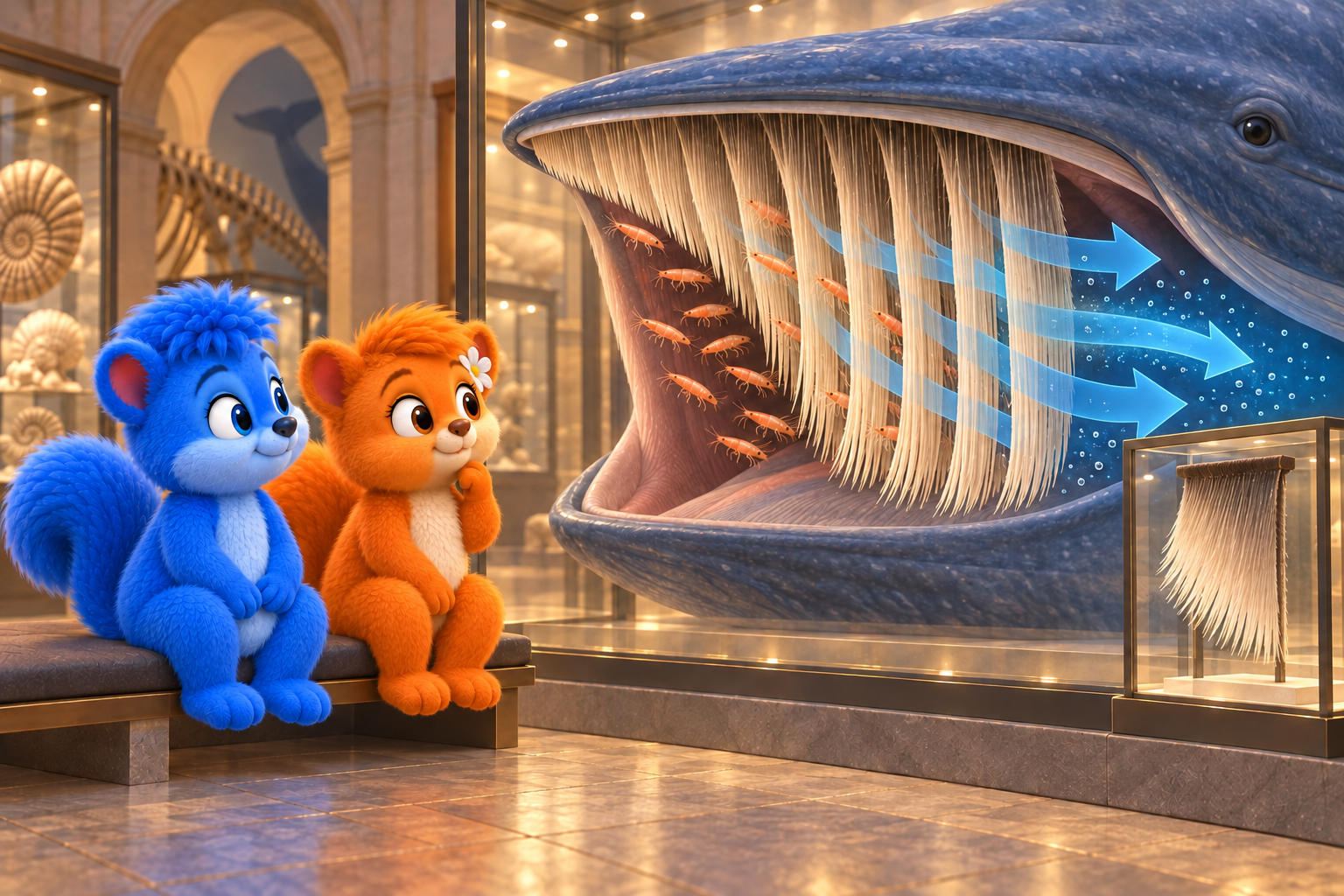
Puschel and Flauschi in the museum. Baleen model: water flows out through fringes while small prey stays inside. Enlarged filter model; not all whale species have baleen. AI-created illustration, not a photograph of nature.
Explained in three pictures
1 Water and krill come in
A blue whale takes in water with small prey, such as krill.
2 Water through baleen
Water flows out through the baleen fringes. Krill is retained.
3 Food stays behind
The whale swallows the retained food.
More about the picture
Baleen hangs from the upper jaw. Its fringes act as a filter: water goes out, while small prey is retained. This is a simplified mouth detail, not breathing through gills. Baleen species collect food differently; dolphins instead belong to the toothed whales.
An imagined Wusel scene
Puschel and Flauschi investigate
Puschel looks for teeth in the whale model and finds hanging plates. Flauschi shows the water path in the diagram. He follows what leaves and what remains. He labels it a baleen whale and keeps the toothed-whale card separate.
Look closely
Compare the museum model with the three picture steps. Water flows out through the baleen fringes. Krill is retained.
An example to help you understand
Examine the fringed baleen replicas in the museum case. On permitted paper draw an original sieve symbol: small dots remain on one side, while water arrows pass through. This explains only the basic idea of retaining something. The drawing is no whale mouth or scale model. Exhibits stay behind glass.
Try explaining it
What does baleen retain in the mouth?
Choose a), b) or c), then explain your choice.
- a)Air, while food is taken in through the blowhole.
- b)Food while water flows out.
- c)Water, while food flows out between the baleen plates.
Show the explanation
Correct: b): Food while water flows out.
Baleen whales have rows of baleen instead of teeth. They take in water with food and let water out while small prey remains trapped. Not every whale has baleen: toothed whales exist too.
Word help
- baleen
- Fringed plates in baleen whales' mouths that trap food.
- toothed
- The edge has little points like tiny teeth. A leaf has no real teeth.
Explore in more detail
Here you will find longer explanations and further details. You can explore them together.
1. Whales need air
Whales are mammals and breathe with lungs. Their blowholes sit on top of the head. Baleen whales have two breathing openings there. They surface to breathe. Air breathing and filtering food inside the mouth are different processes; whales do not obtain breathing air from water with gills.
Checked against: [1]
2. Baleen works like a sieve
Baleen hangs from the upper jaw into the mouth. It consists of keratin, also a basic material of our hair and nails. Fringes help retain food while water is pushed out. Blue whales mainly eat krill, small crustaceans. Different baleen whale species gather food in different ways. When a blue whale opens its mouth, folds in its throat region expand, temporarily creating a large space for water and krill. It then pushes water out through the baleen while food remains. The whale does not swallow all the collected seawater with its meal.
Checked against: [2]
3. Not all whales have baleen
Baleen whales include blue and humpback whales. Toothed whales have teeth instead: sperm whales and dolphins belong to this group. Depending on the species, toothed whales eat fish, squid or other marine animals. The word “whale” therefore does not describe only enormous animals or mean they all eat the same food.
4. A large body does not prevent danger
Blue whales can be injured by ships or become entangled in fishing gear. Protection requires cooperation: experts study important areas and develop ways to reduce risky encounters. Size alone does not protect an animal from human impacts. We learn from the exhibit without disturbing real animals.
Checked against: [4]
An optional question for further exploration
You can use the longer explanation above. This is extra, not needed for the first quiz.
An extra question
Do dolphins have baleen too?
Discover the answer
No. Dolphins belong to the toothed whales. Baleen whales such as blue whales have baleen to filter their food instead. Different whale species feed in different ways.
Pictures and sources for adults
Sources for further reading
Facts checked against the specialist sources below on 12 October 2026. The Wusel scene is fictional; comparisons and simplified models are explicitly explained. Sources are in English.