What do T. rex teeth tell us?
A big head, strong teeth and small arms: clues to how T. rex lived.
The short answer
T. rex's large serrated teeth and powerful jaws fit meat-eating and breaking tough food. Tooth marks on bones provide more clues. One tooth does not reveal every hunting event.
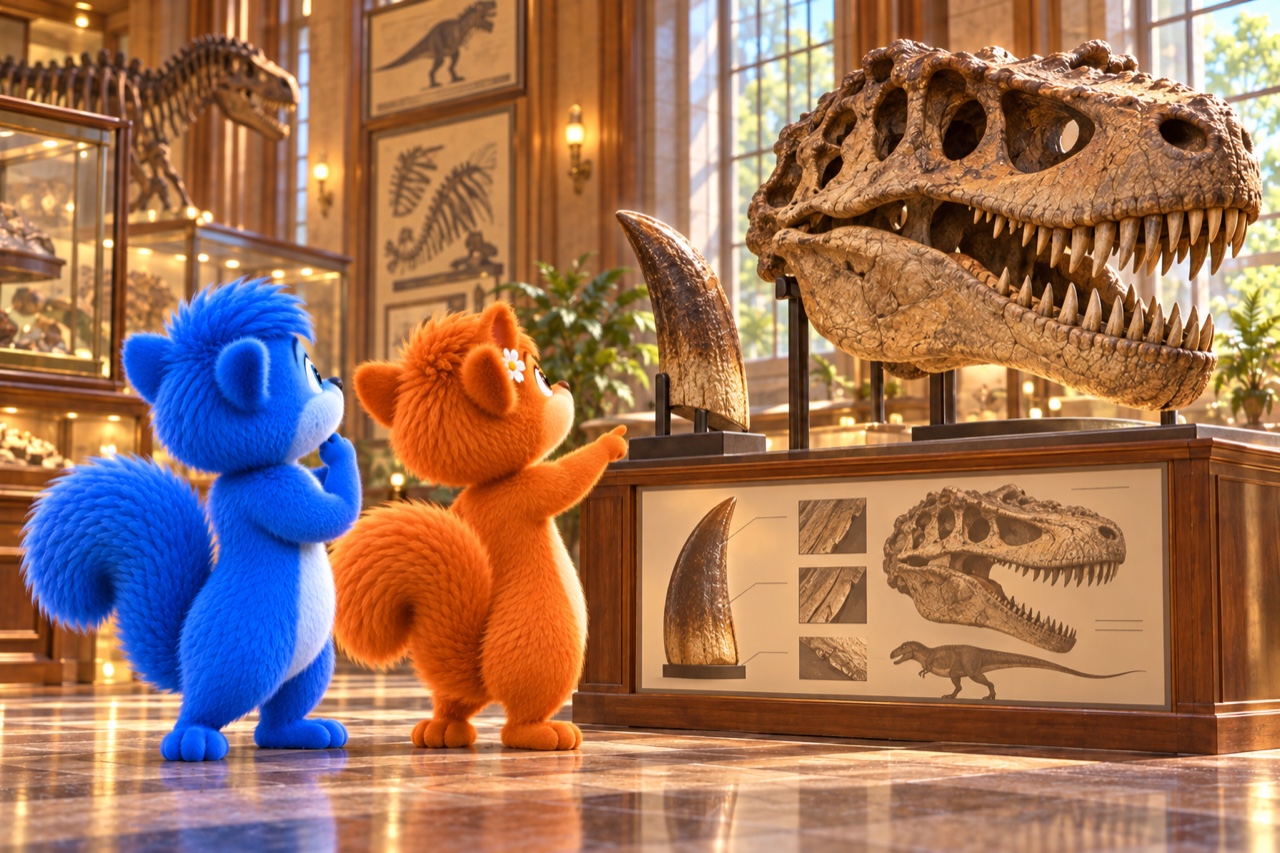
Puschel and Flauschi study a reconstructed T. rex skull and a separate enlarged tooth cast in a museum. These are artistic reconstructions, not precise measurements of a particular fossil. The separate tooth is enlarged for viewing. AI-created museum illustration, not a photograph of a real exhibit.
An imagined Wusel scene
Puschel and Flauschi investigate
Puschel treats one model tooth as a whole hunting story. Flauschi adds the jaw drawing and trace pictures. They separate visible evidence from their imagined scene. He can now explain meat-eating without claiming every past hunting step.
Look closely
Find the separate tooth. What shape can you see? Then read why researchers need other clues too.
An example to help you understand
Imagine two tooth models: one pointed with a serrated edge, the other broad and flat. Different shapes can suit different jobs, like differently shaped kitchen tools. This is only a comparison, not a claim that teeth are knives. T. rex teeth suit a meat diet, but researchers also check other evidence, such as bite marks.
Try explaining it
What food fits the large serrated teeth of T. rex?
Choose a), b) or c), then explain your choice.
- a)Meat and tough animal food.
- b)Tough plants ground by these teeth like flat millstones.
- c)Small food particles filtered from water by the teeth.
Show the explanation
Correct: a): Meat and tough animal food.
Serrated teeth and powerful jaws helped break up animal food. They do not reveal every step of a hunt.
Word help
- fossil
- A preserved remain or trace of life from past geological times.
Explore in more detail
Here you will find longer explanations and further details. You can explore them together.
1. An animal from the distant past
T. rex is short for Tyrannosaurus rex. It lived roughly 68 to 66 million years ago in what is now western North America. There were no humans then. An adult could be about twelve metres long, from its head to the tip of its tail, not twelve metres tall.
Checked against: [1]
2. Teeth are clues
T. rex ate other animals. Its strong, pointed teeth had serrated edges: edges with little tooth-like notches. They helped it remove flesh. Its jaws, the bones around its mouth, could bite powerfully. Researchers study these features in fossils, preserved remains and traces from the distant past, rather than watching a living T. rex.
Checked against: [2]
3. Hunter and scavenger
A fossil bone from another dinosaur was found with a T. rex tooth embedded in it. New bone had grown around the injury, showing that the attacked animal survived. This is evidence of an attack on a living animal. T. rex also ate carrion, animals that were already dead. Living meat-eaters can do both too.
Checked against: [3]
4. Small arms, big questions
T. rex walked on two strong hind legs. Its much shorter forearms each had two clawed fingers. Their exact use is still uncertain. Small arms do not mean that the entire animal was weak: its head, legs and tail were parts of a body very different from ours.
An optional question for further exploration
You can use the longer explanation above. This is extra, not needed for the first quiz.
An extra question
Why is a T. rex tooth in a healed bone a useful clue to hunting?
Discover the answer
The attacked dinosaur lived after the injury, so its bone could heal around the tooth. This supports an attack on a living animal rather than feeding only on one that was already dead.
Pictures and sources for adults
Sources for further reading
The factual content was checked against these specialist sources on 10 October 2026. The Wusel scene is fictional. Sources are in English.