Why did Triceratops have three horns?
Horns, a neck frill and a beak: discover a large plant-eater.
The short answer
Triceratops had three conspicuous horns and a large neck frill. These may have mattered for defence or encounters with its own species. Researchers infer their roles from fossils and comparisons.
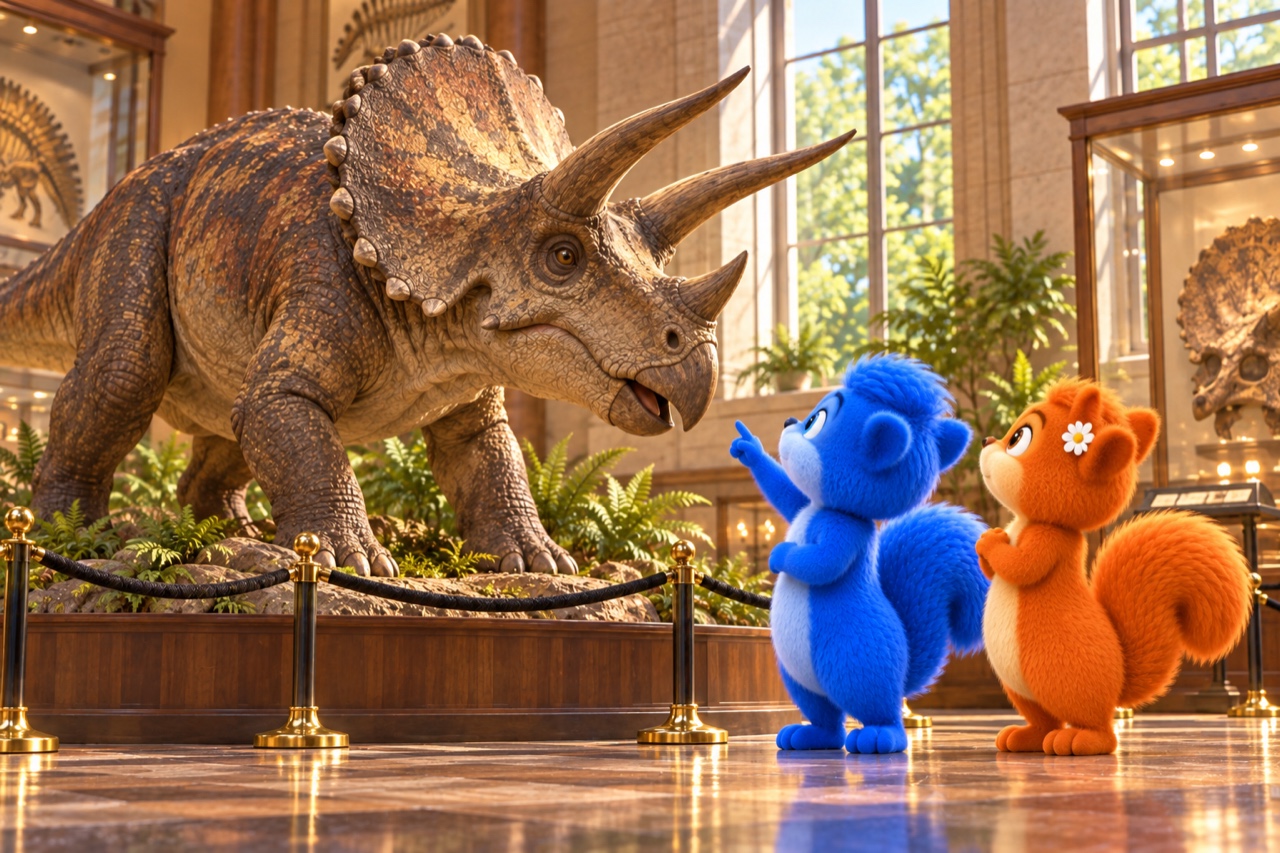
Both Wusels look at the three facial horns and beak of a Triceratops model behind a museum barrier. The model shows characteristic features. Colour and exact posture are artistic choices, not observations of a living animal. AI-created museum illustration, not a photograph of a real exhibit.
An imagined Wusel scene
Puschel and Flauschi investigate
Puschel labels the model's horns “defence only.” Flauschi shows that encounters with its own species are another possibility under study. They organise clues and leave room for questions. Three visible horns do not supply one certain instruction manual.
Look closely
Count the three facial horns. Then find the beak and neck frill. Which part helped with eating?
An example to help you understand
Compare the beak and horns in the picture. The beak is part of the mouth and helped with feeding. The horns are above it and are not teeth. A body can have different tools for different jobs. Researchers examine many features and injury marks rather than only the most striking feature.
Try explaining it
What stands out about the head of Triceratops?
Choose a), b) or c), then explain your choice.
- a)A long beak without horns or a neck frill.
- b)One horn and no neck frill.
- c)Three horns and a large neck frill.
Show the explanation
Correct: c): Three horns and a large neck frill.
Three horns and the neck frill are recognisable features. Their exact roles are studied by researchers.
Word help
- fossil
- A preserved remain or trace of life from past geological times.
Explore in more detail
Here you will find longer explanations and further details. You can explore them together.
1. Three horns on its face
Triceratops means roughly “three-horned face”. Two long horns grew above its eyes and a shorter one on its nose. A broad bony frill extended behind its head. It walked on four legs and lived about 68 to 66 million years ago in what is now North America.
Checked against: [1]
2. A beak for plants
Despite its horns, Triceratops ate plants. Its beak at the front of its mouth helped cut vegetation; teeth further back helped slice the food. Horns alone tell us little about a meat or plant diet. Features of the mouth are especially useful clues.
Checked against: [1]
3. What were the horns used for?
Horns could play a part in clashes. Researchers compared injuries on fossil skulls. Some patterns fit the idea that Triceratops used its horns against other members of its own species. A species is a particular kind of animal. This does not mean that every Triceratops fought every day.
Checked against: [2]
4. One discovery cannot tell us everything
A Triceratops horn with Tyrannosaurus bite marks showed healing, so the animal survived that injury. Horns might also have helped in defence. One fossil cannot reveal every job of the horns and frill. The exact skin colour of this museum animal is also an artistic choice.
An optional question for further exploration
You can use the longer explanation above. This is extra, not needed for the first quiz.
An extra question
Why do three horns alone not reveal what Triceratops ate?
Discover the answer
Horns are not feeding tools. Triceratops ate plants, using its beak and teeth. Its mouth and other fossil evidence help us understand its diet, not just its horns.
Pictures and sources for adults
Sources for further reading
The factual content was checked against these specialist sources on 10 October 2026. The Wusel scene is fictional. Sources are in English.