How can a footprint become a trace fossil?
An animal is long gone but leaves clues behind.
The short answer
A footprint in soft ground can be quickly covered and preserved. Under suitable conditions the material hardens and retains the trace in rock. Many footprints are destroyed before that happens.
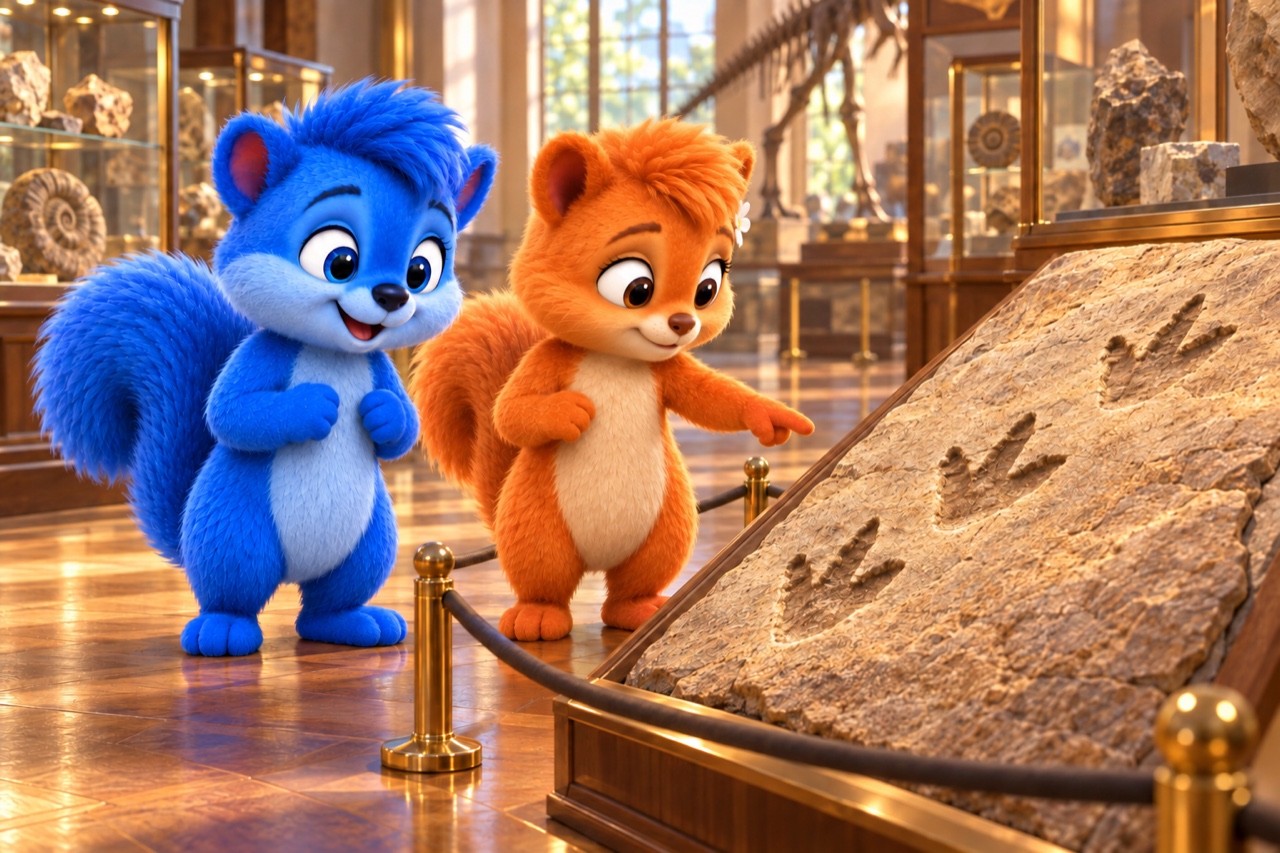
Puschel and Flauschi examine three recessed footprints in a stone slab displayed at an angle. The depressions depict traces, not body parts. Their shape alone does not identify an exact animal species or age here. AI-created museum illustration, not a photograph of a real exhibit.
An imagined Wusel scene
Puschel and Flauschi investigate
Puschel presses a large model foot into soft material. Flauschi smudges a second print and leaves the first protected. They compare which survives. For real fossil formation they add cards for covering, hardening and a long time.
An example to help you understand
Find the three depressions in the displayed slab. This is one way a preserved trace may look. Imagine an animal walking through soft mud and moving on: it took its feet with it and left its prints behind.
Try explaining it
What can survive as a fossil footprint?
Choose a), b) or c), then explain your choice.
- a)The mark a foot left in the ground.
- b)The entire sole of the foot itself left in the rock.
- c)A bone that later takes the shape of a footprint.
Show the explanation
Correct: a): The mark a foot left in the ground.
The foot moves on. Its mark can be covered and later preserved in rock.
Word help
- fossil
- A preserved remain or trace of life from past geological times.
Explore in more detail
Here you will find longer explanations and further details. You can explore them together.
1. The trace is not the animal
A foot presses into soft mud and leaves an impression, not a bone. Preserved bones are body fossils. An ancient preserved footprint can be a trace fossil: evidence of an animal’s activity.
2. The trace must survive
Water or other footsteps destroy many impressions. Sometimes new material covers a trace before it disappears. Under suitable conditions the material can become rock over a long time and preserve the impression. Not every step becomes a fossil.
Checked against: [2]
3. A trackway tells more
A series of matching impressions can form a trackway. Shape and spacing provide clues about movement. Specialists examine them alongside the rock. A single print does not automatically reveal its maker’s name, colour or exact age.
Checked against: [1]
4. A modelling-clay comparison
With an adult, press a clean toy foot into soft modelling clay and lift it away. Its trace remains after the toy leaves. This explains an object versus its impression. The clay is not an ancient fossil and pressing it does not turn it into stone.
Keep learning: How do fossils form?
An optional question for further exploration
You can use the longer explanation above. This is extra, not needed for the first quiz.
An extra question
Is a fossil footprint a petrified foot?
Discover the answer
No. It is a preserved trace of movement, not the body part itself.
Pictures and sources for adults
Sources for further reading
The factual content was checked against these specialist sources on 10 October 2026. The Wusel scene is fictional.