Earth & Space
How do fossils form?
A spiral in stone tells of a living thing from long ago.
The short answer
Remains or traces can survive if quickly covered under suitable conditions. Over long times they become fossils. This is rare: most living things leave no preserved fossil trace.
An imagined Wusel scene
Puschel and Flauschi investigate
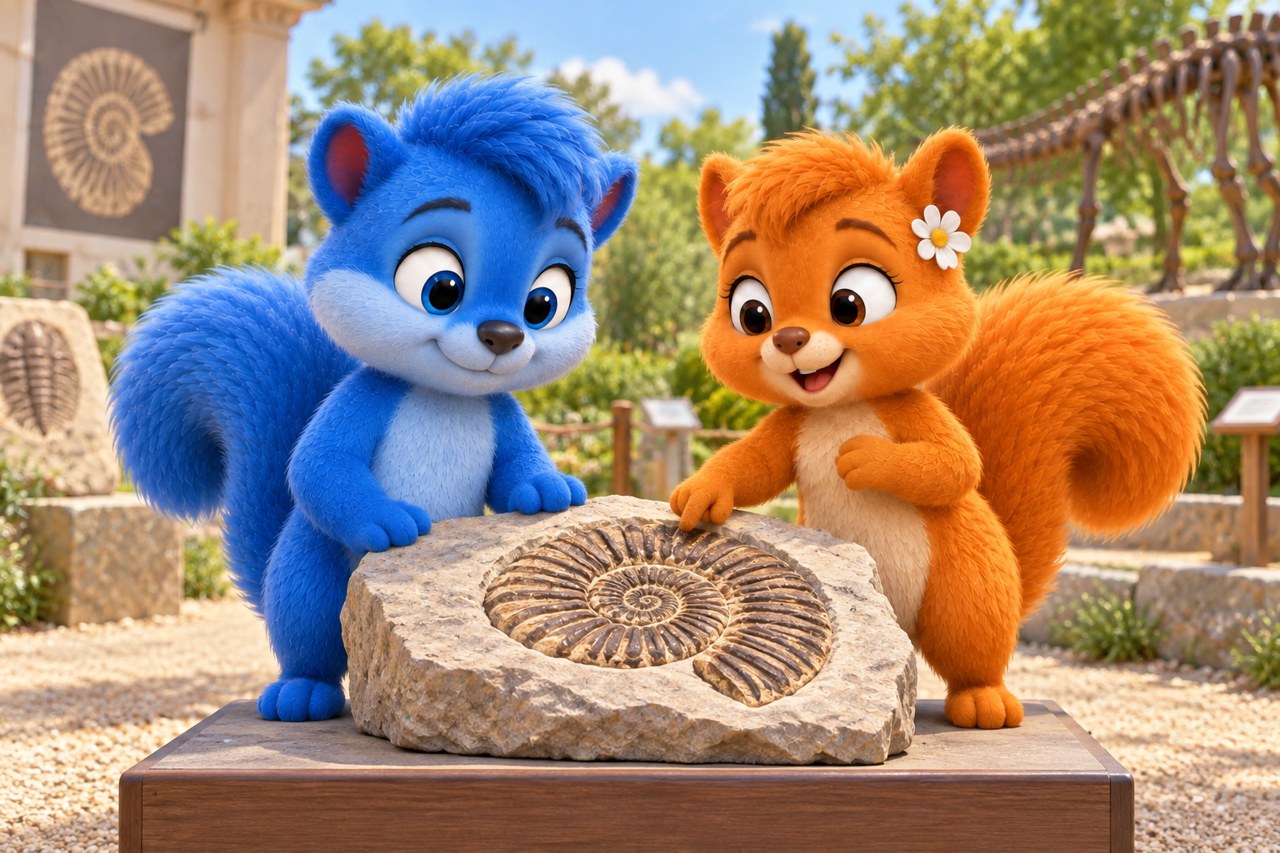
A stone with a spiral lies on the teaching table. Puschel“Has someone rolled up a snail?”
Flauschi“It is an ammonite fossil. Ammonites were sea animals that no longer live today. The spiral is a trace from a very ancient time.”
Puschel keeps his paws beside the stone. Puschel“Does every animal have to turn into stone?” Flauschi“No. Fossils are rare preserved remains or traces.”
Puschel remembers an impression in clay. Puschel“So my leaf impression is a learning model.” Flauschi“Exactly. Models help, but are not real fossils.”
They examine the spiral again. This journey into the past needs neither a hammer nor a dangerous cliff.
Little Wusel quiz
Can an ancient footprint be a fossil?
Choose one answer: a), b).
- a)Yes, traces can be preserved.
- b)No, only bones count.
Show answer
Correct answer: a): Yes, traces can be preserved. Yes. Fossils can also be traces.
Is a clay impression made today a real fossil?
Choose one answer: a), b).
- a)Yes.
- b)No, it is a model.
Show answer
Correct answer: b): No, it is a model. No. The clay impression is a model.
Word help
- mineral
- A natural substance with a particular composition and ordered internal structure.
- fossil
- A preserved remain or trace of life from past geological times.
Explore in more detail
Here you will find longer explanations and further details. You can explore them together.
Understand step by step
How it works – simply explained
Remains or traces are left
An organism dies or leaves a mark. Usually many remains disappear before lasting preservation is possible.
Burial may protect
Rapid covering with sand or mud can protect remains or prints. More layers accumulate and may become rock over long periods.
Traces of the past develop
Minerals may change or replace remains. Some fossils are no longer original bone. Other formation routes exist; a fresh clay print is only a model.
Why an imprint can be a fossil
An animal may leave a track in soft ground. If suitably preserved and later held in rock, the track can become a fossil without containing the animal’s body. A clay imprint models this but is not itself an ancient fossil. Specialists distinguish body remains from traces; both can tell us about past life.
The key points again
Discovery 1
Fossils are preserved remains or traces of living things from earlier times in Earth’s history. An ancient footprint can also be a fossil.
Source: [2]
Discovery 2
If a dead organism is buried quickly by mud or sand, parts may be preserved. Over a long time rock can form; minerals – materials that make up rocks – may change or replace remains.
Source: [1]
Discovery 3
Fossils form in different ways. Most living things never become fossils. An impression made in clay today is a model, not a genuine ancient fossil.