Why did sabre-toothed cats have such long teeth?
Smilodon lived during the Ice Age. Its bones tell us more than a famous nickname.
The short answer
The extinct sabre-toothed cat Smilodon's long upper canines were part of its hunting adaptations. Powerful front limbs helped hold prey. Researchers infer how it used its teeth from bones and comparisons; nobody has observed a living Smilodon.
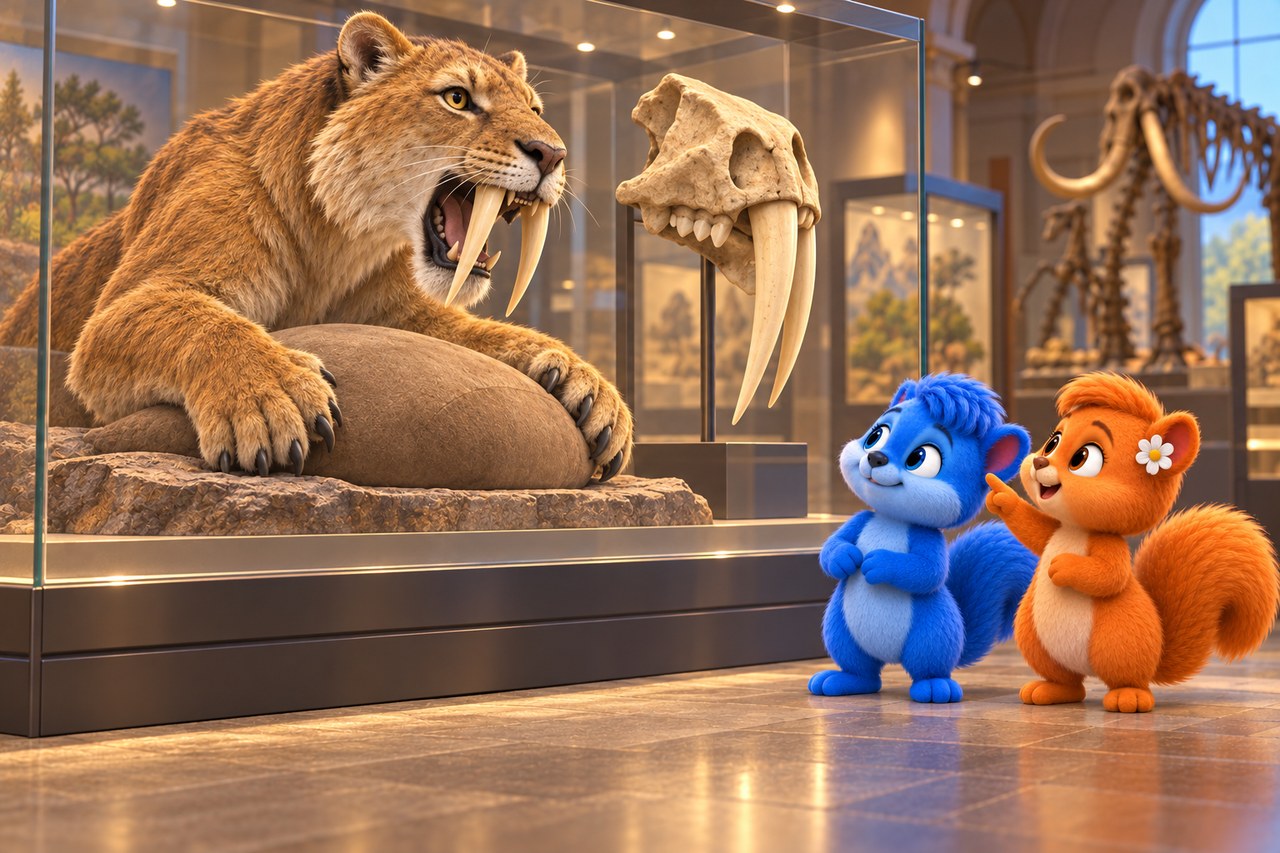
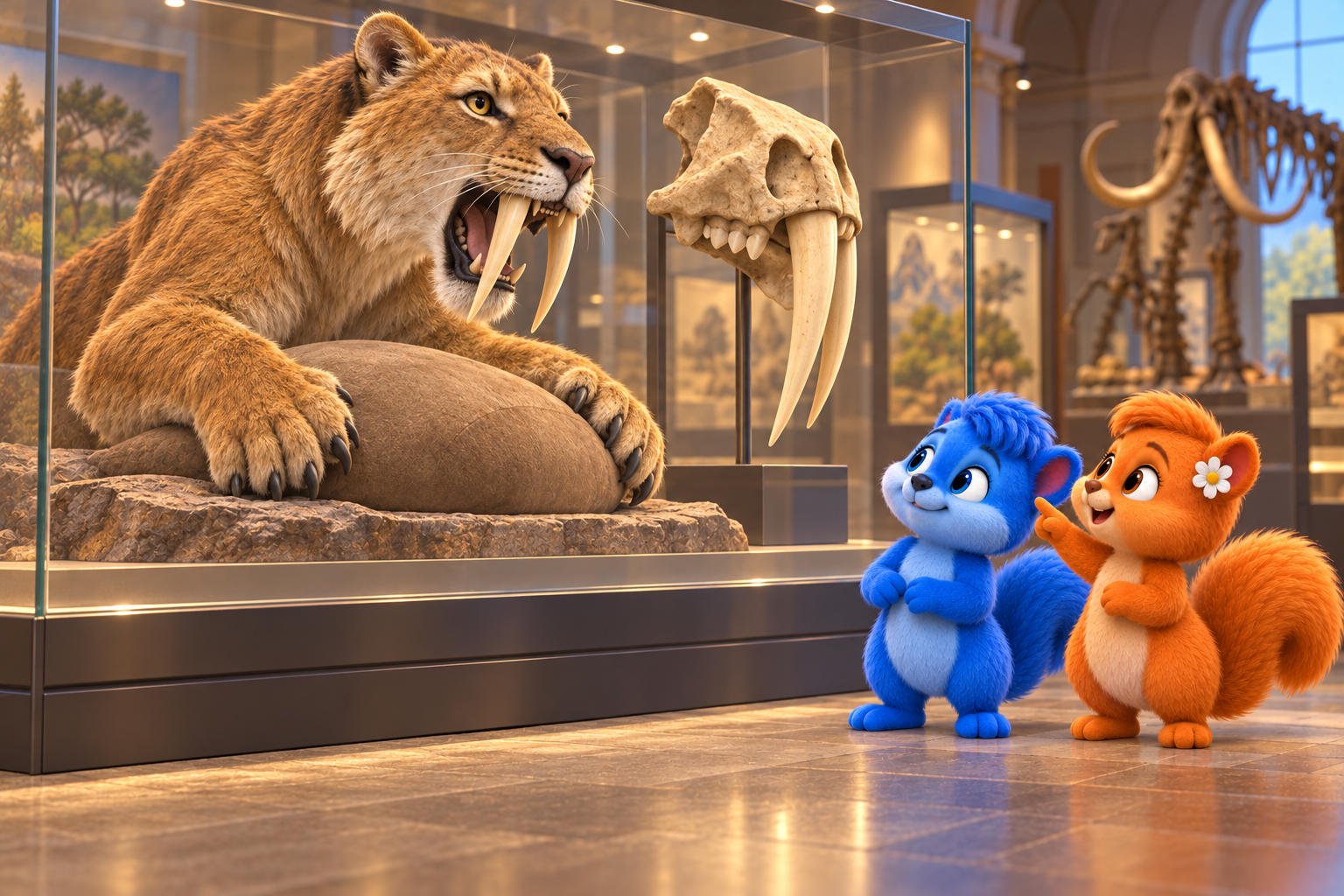
Puschel and Flauschi in the museum. Smilodon reconstruction with long canine teeth and strong forelegs. The coat colour is a reconstruction, not established by preserved fur. AI-created illustration, not a photograph of nature.
Explained in three pictures
1 Long upper canines
Long upper canines may have enabled a targeted bite.
2 Strong forelimbs
Strong forelimbs may have held prey still.
3 A targeted bite?
Bones provide clues. The exact action remains a reconstruction.
More about the picture
A supported reconstruction: forelimbs held prey, and long canines allowed a targeted bite. Bones and teeth provide clues, not a film. The exact action has not been directly observed.
An imagined Wusel scene
Puschel and Flauschi investigate
At the skeleton, Puschel draws only the long teeth. Flauschi points out the powerful front limbs. He adds them and notices how much he missed. They put a question mark beside their imagined hunt: a skeleton does not show every past action.
Look closely
Compare the museum model with the three picture steps. Strong forelimbs may have held prey still.
An example to help you understand
Look at the museum picture together. Draw two columns: “Can be checked in bones” and “Added in the picture”. Put the teeth and robust forelimbs in the first, coat colour and facial expression in the second. A reconstruction combines evidence with artistic choices.
Try explaining it
What were Smilodon's long canine teeth used for?
Choose a), b) or c), then explain your choice.
- a)They dug in soil for plant roots.
- b)They were part of hunting prey.
- c)They ground hard plants like molars.
Show the explanation
Correct: b): They were part of hunting prey.
The extinct sabre-toothed cat Smilodon's long upper canines were part of its hunting adaptations. Powerful front limbs helped hold prey. Researchers infer how it used its teeth from bones and comparisons; nobody has observed a living Smilodon.
Word help
- fossil
- A preserved remain or trace of life from past geological times.
Explore in more detail
Here you will find longer explanations and further details. You can explore them together.
1. A cat, but not a tiger
Smilodon was an extinct sabre-toothed cat. Extinct means no members of that group are alive today. The nickname “sabre-toothed tiger” is misleading: Smilodon was not a tiger. Smilodon fatalis lived in places including present-day Los Angeles. It had a robust body and especially long upper canine teeth, positioned beside the front teeth.
Checked against: [1]
2. Bones provide hunting clues
Smilodon ate meat. Its powerful forelimbs and injuries preserved in bones support the idea that it ambushed prey at close range and held it down. Its long canines had finely serrated edges, but their shape made them more vulnerable to breaking than the sturdier canines of other cats. La Brea researchers suggest that it pinned prey with its forelimbs and used the canines for a precise bite into softer tissue rather than pulling with them. Despite its large teeth, its bite force was weaker than a modern lion’s. Researchers reconstruct events by drawing conclusions from evidence. A fossil is not a film: not every hunt can be retold.
Checked against: [1]
3. The Ice Age was not snowy everywhere
During cold periods, great ice sheets spread farther than today. Warmer periods occurred between colder ones. Even during cold intervals, the whole Earth was not covered in ice. Ice-free landscapes supported plants and animals. An Ice Age animal therefore does not automatically belong in an always-snowy landscape. USGS describes repeated widespread glaciations: periods when large areas were covered by glaciers.
Checked against: [2]
4. Evidence is different from a possibility
Many La Brea bones were preserved in natural asphalt, a sticky petroleum-based material. One studied Smilodon hip shows severe changes caused by disease. The animal surviving with this condition suggests possible help from others. It does not prove every sabre-toothed cat always lived in a group. Researchers examine further evidence instead of treating an interesting idea as certainty.
An optional question for further exploration
You can use the longer explanation above. This is extra, not needed for the first quiz.
An extra question
Why is a museum model not proof of Smilodon’s exact coat colour?
Discover the answer
Bones reveal body shape and teeth. According to the museum source, no preserved Smilodon fur shows the exact colour. The model’s coat is therefore an artistic reconstruction.
Pictures and sources for adults
Sources for further reading
Facts checked against the specialist sources below on 12 October 2026. The Wusel scene is fictional; comparisons and simplified models are explicitly explained. Sources are in English.