Pocket money: plan a limited amount
What is available? What do I want to spend or set aside? A simple plan makes these choices visible.
The short answer
With a limited amount, you can plan what matters, what it costs and what to save. You cannot choose everything at once. Families arrange pocket money differently; money does not measure a person's value.
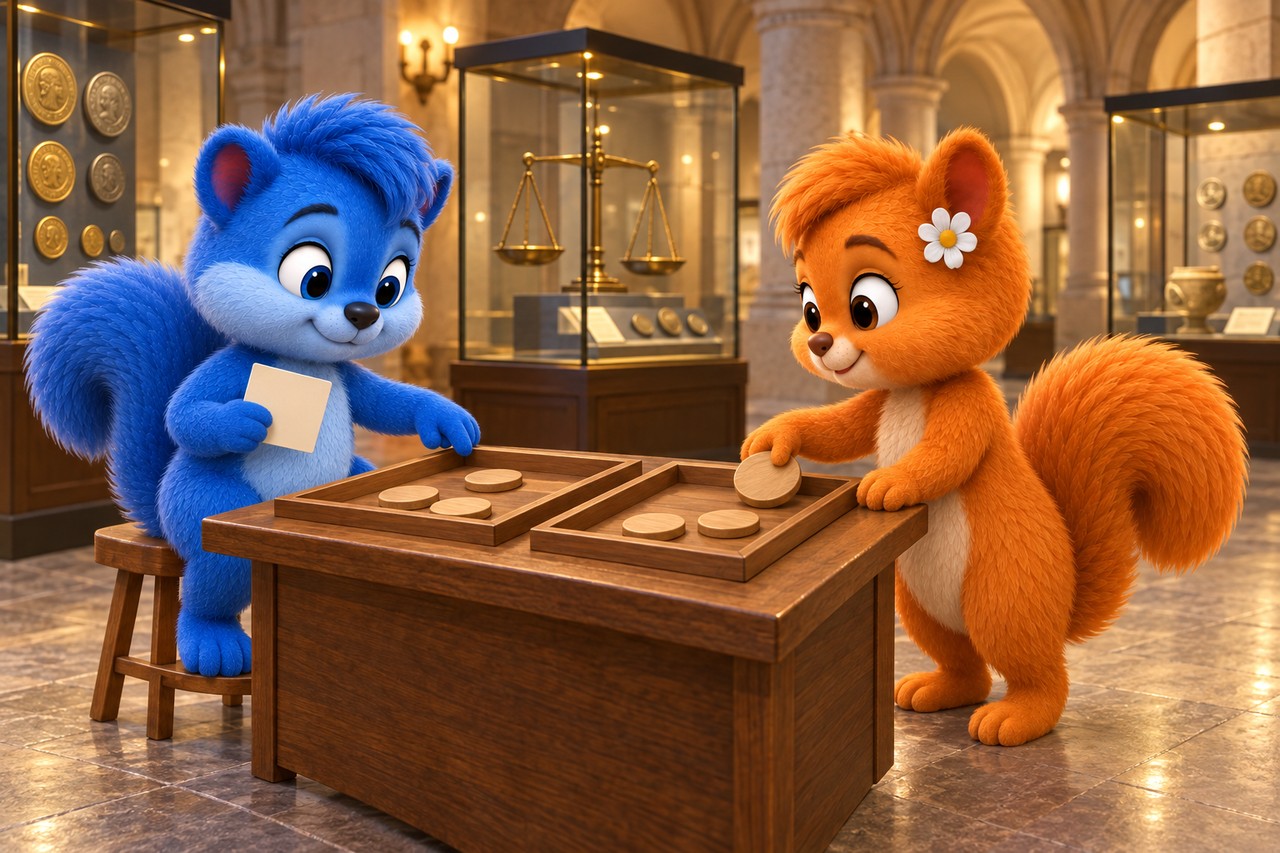
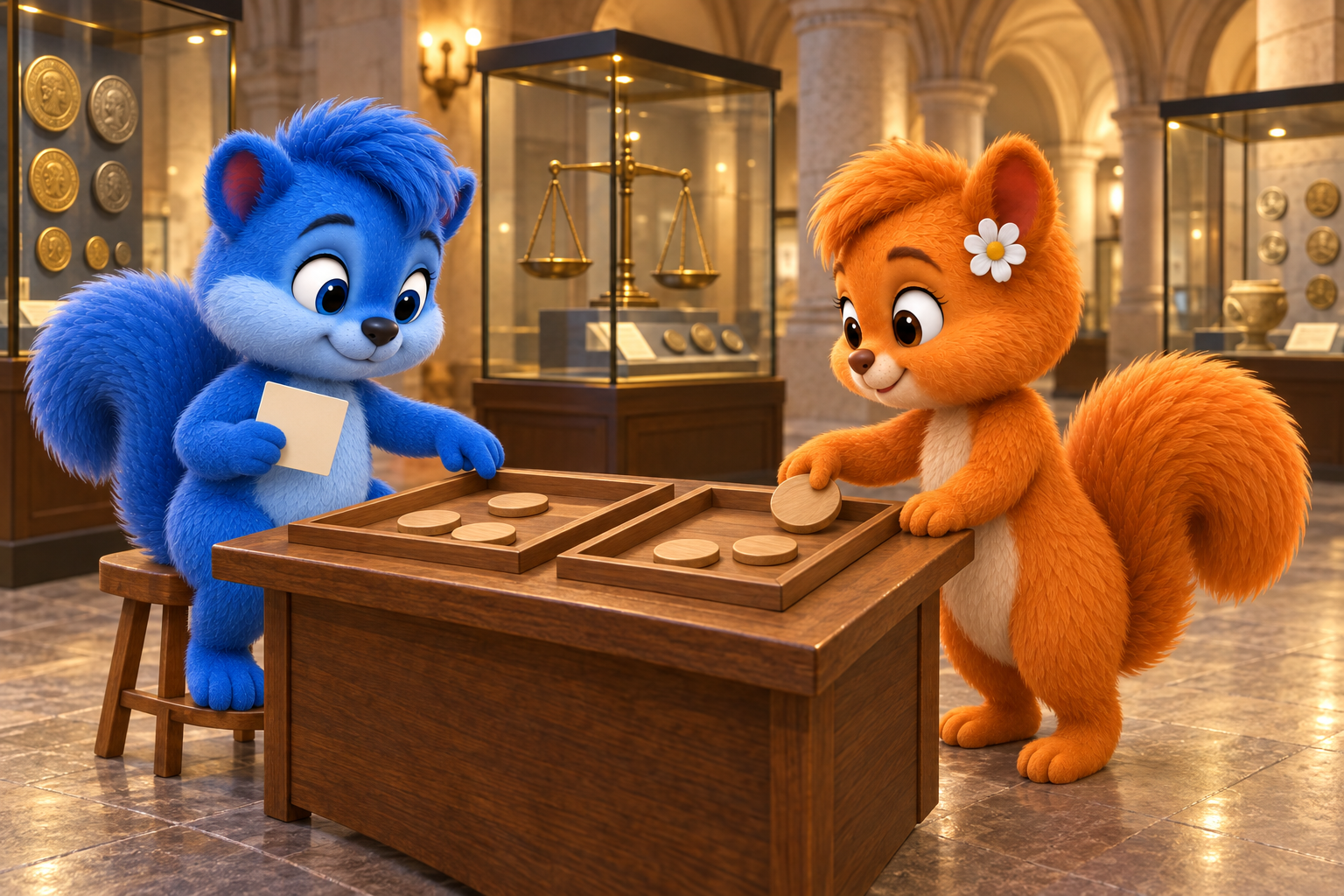
Puschel and Flauschi sort large practice counters at a money-museum station. Original learning scene with wooden counters, not real coins. Arithmetic numbers appear only in the separate model. AI-created illustration, not a photograph of nature.
What the diagram shows
The diagram simplifies the process. First compare its shapes and arrows. You can read its labels in larger text below.
Read the picture labels
These are the words and sentences from the diagram above. The full explanation follows below.
- Five available, three spent, two remaining
- 3 spent in the model
- 2 still available
- 5 − 3 = 2
- Divide the same two counters:
- 1 set aside
- 1 free to spend
- 2 = 1 set aside + 1 free. Count nothing twice.
- Original imaginary money units; no prices or allowance recommendation.
An imagined Wusel scene
Puschel and Flauschi investigate
Puschel puts two wish cards beside his limited pretend budget. Together they cost more than he has. Flauschi helps compare prices and priorities. He chooses a plan and leaves the other wish for later.
Look closely
In the money museum, Puschel and Flauschi sort large unmarked wooden counters into two trays. Puschel examines a small planning card while Flauschi places a counter. Historical coins and balances are protected behind glass.
An example to help you understand
Original arithmetic activity without actual money: five large counters represent five imaginary money units. Spend three in the model; two remain. If one of those two is set aside for later, one remains free for further planned spending. The reserved counter has not vanished or appeared as an extra. Write 5 − 3 = 2 and 2 = 1 set aside + 1 free. These are example numbers, not recommended allowance amounts or prices.
Try explaining it
What helps plan with a limited amount?
Choose a), b) or c), then explain your choice.
- a)Plan to use the same money for saving and buying.
- b)Compare prices, priorities and saving.
- c)Choose all desired items first and compare prices only after buying.
Show the explanation
Correct: b): Compare prices, priorities and saving.
With a limited amount, you can plan what matters, what it costs and what to save. You cannot choose everything at once. Families arrange pocket money differently; money does not measure a person's value.
Explore in more detail
Here you will find longer explanations and further details. You can explore them together.
1. Understand pocket money as practice
Pocket money can help children gain early experience with money. The German Youth Institute emphasises regular agreements and conversations about the family’s financial situation. Clarify what the agreed amount is intended for too. Our model does not prescribe one correct amount for every family.
Checked against: [1]
2. Record money coming in and going out
Income means amounts received; spending means amounts used. A simple notebook or table can help keep track. Record actual spending and compare it with the plan. This makes it easier to see where a limited amount goes.
Checked against: [2]
3. Distinguish a wish from a saving goal
Saving here means setting money aside for later. For a larger wish, consider what is already available and what is still missing. Discussing it together can help with planning and waiting. What a family can and wants to give varies; no amount suits everyone.
Checked against: [3]
4. Plan with available resources
A budget is our plan for a limited available amount. Money spent is no longer available for another wish. Money set aside still exists but is intended for later. In our paper plan, distinguish available, spent and reserved amounts without counting any twice.
Checked against: [2]
An optional question for further exploration
You can use the longer explanation above. This is extra, not needed for the first quiz.
An extra question
Why should a reserved counter not also be counted as free to spend?
Discover the answer
Because it is the same existing counter. Setting it aside does not create extra money. Reserving it for later in our plan means distinguishing it from the part still freely available.
Pictures and sources for adults
Sources for further reading
Facts checked against the specialist sources below on 12 October 2026. The Wusel scene is fictional; comparisons and simplified models are explicitly explained. Sources are in German and English.