Insect · Anoplotrupes stercorosus
Discover the forest dung beetle
A dark beetle gleams among the leaves. Quiet woodland workers deserve attention too.
The short answer
The dor beetle is a rounded dark beetle that may shine blue or violet. Its wing cases have lengthwise grooves. Six strong legs help it move and dig in soil.
An imagined Wusel scene
Puschel and Flauschi investigate
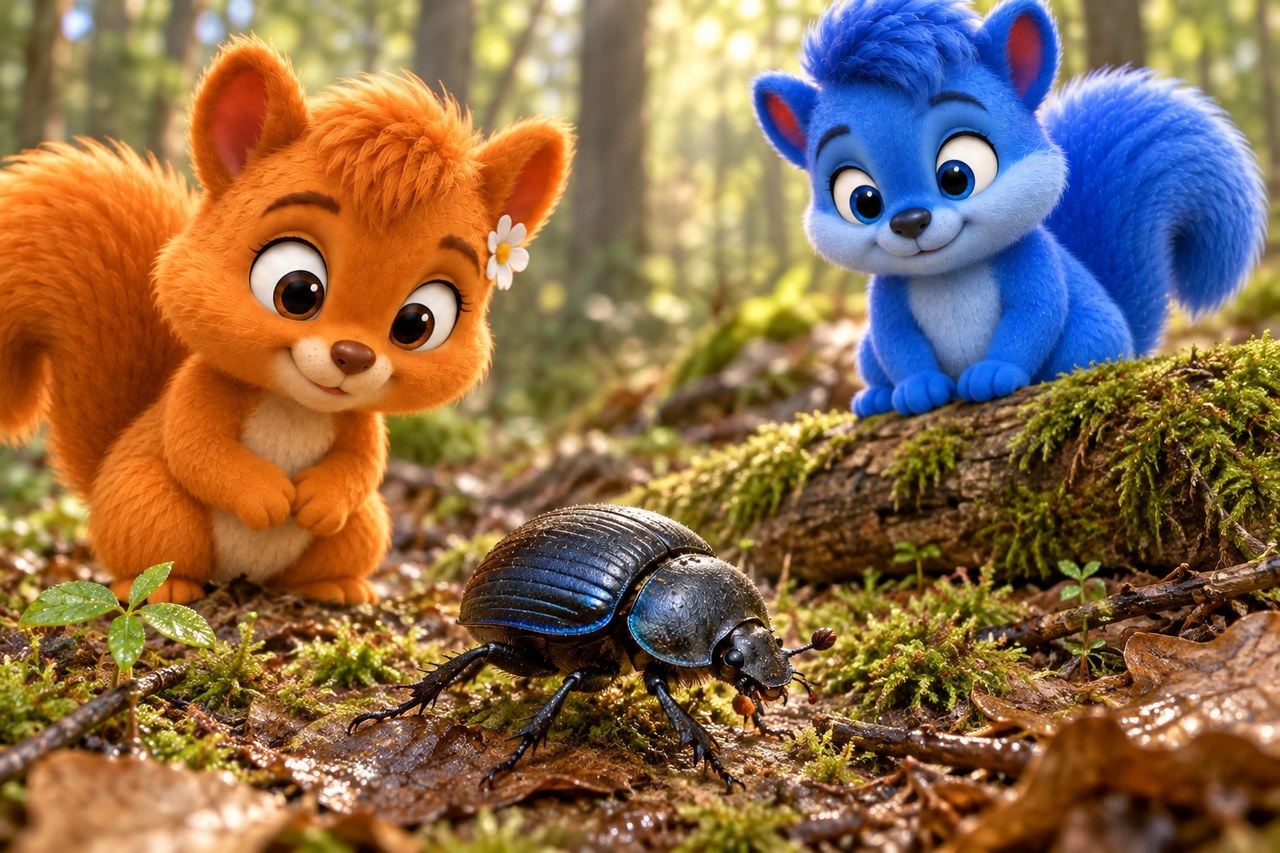
Puschel“Something is shining!” Puschel crouches. A dark beetle walks among damp leaves. Flauschi watches curiously.
Puschel wants to give it a lovely name. Flauschi“Forest dung beetle,” says Flauschi. Flauschi“Its work belongs in the woods just as much as flower visitors do.”
Puschel nods and leaves the route clear. Puschel“Not every important job smells of flowers.” Flauschi laughs softly. The beetle simply walks on.
What it looks like
This rounded beetle is dark and can gleam blue or violet. Its hard wing cases have lengthwise grooves.
How it lives
It is an insect with six legs. Its strong legs help it dig in the soil.
Good to know
Forest dung beetles use animal dung among other foods and dig soil tunnels. They help break down organic material; we leave them to their work.
Try explaining it
What does a dor beetle use to dig in soil?
Choose a), b) or c), then explain your choice.
- a)With its antennae instead of its legs.
- b)Its strong legs.
- c)With its wings instead of its legs.
Show the explanation
Correct: b): Its strong legs.
Strong legs help it dig. Its activity can also change the soil.
Explore in more detail
Here you will find longer explanations and further details. You can explore them together.
Understand step by step
How it works – simply explained
Remains are used
Dung still contains usable organic substances. For a dung beetle it is not worthless waste.
Digging connects jobs
The beetle digs with its legs. Its activity and dung processing contribute to breaking down organic material.
One part of a cycle
Many organisms contribute; the beetle does not do it alone. Leave soil, dung and animals undisturbed.
Explore animal sounds
The animal sound archive holds a recording of a male woodland dor beetle. Specialists call this sound production stridulation. With an adult, listen to the original recording. Do not handle outdoor beetles or make them produce sounds.
An optional question for further exploration
You can use the longer explanation above. This is extra, not needed for the first quiz.
An extra question
Why is animal dung part of nature’s cycle?
Show answer
Dung beetles and other living things break down organic material, making its substances available in nature’s cycle again.