Discover the European garden spider
Eight walking legs, two body sections and an orb web: look closely without disturbing a spider.
The short answer
A garden cross spider has eight legs and builds a catching web. A cross-shaped pattern on the abdomen can be a clue, but varies. Several features should match. Leave the spider and its web undisturbed.
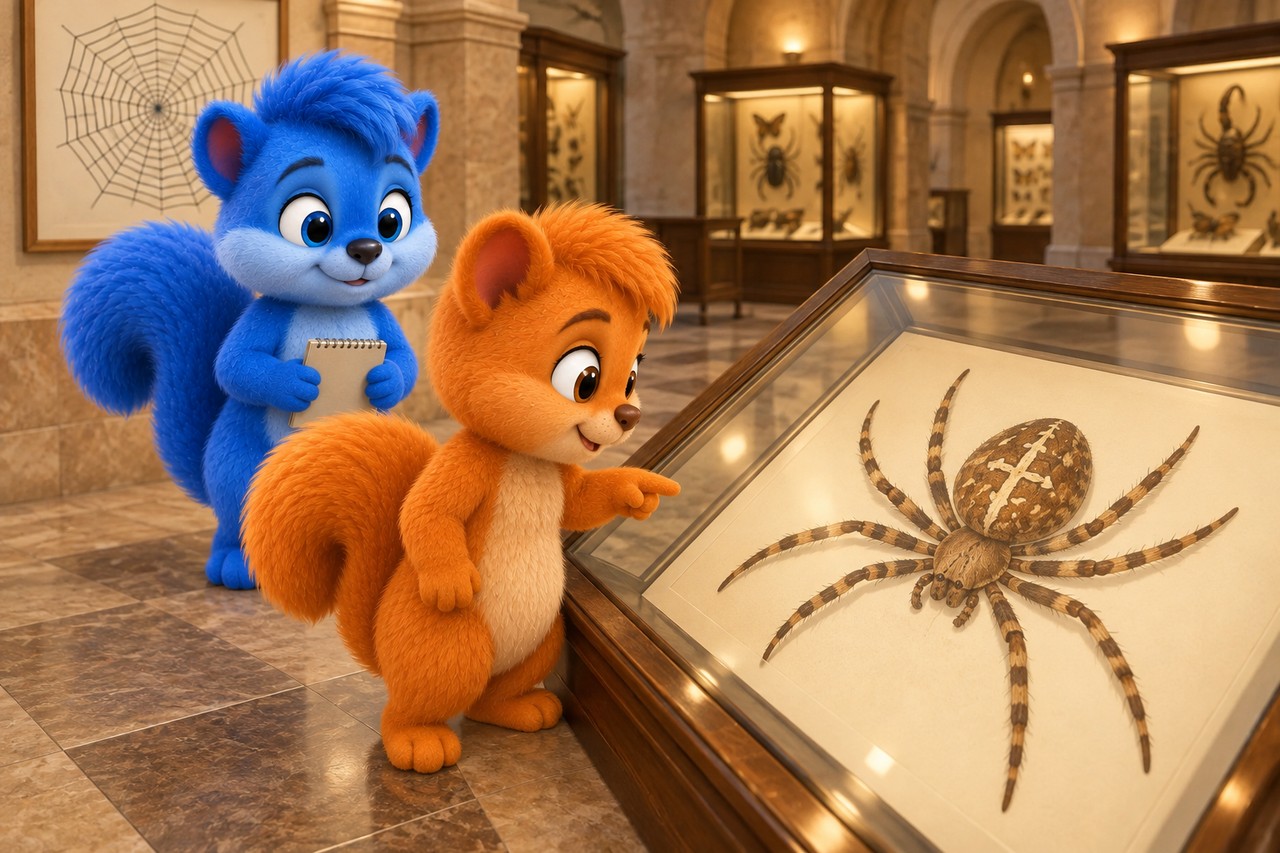
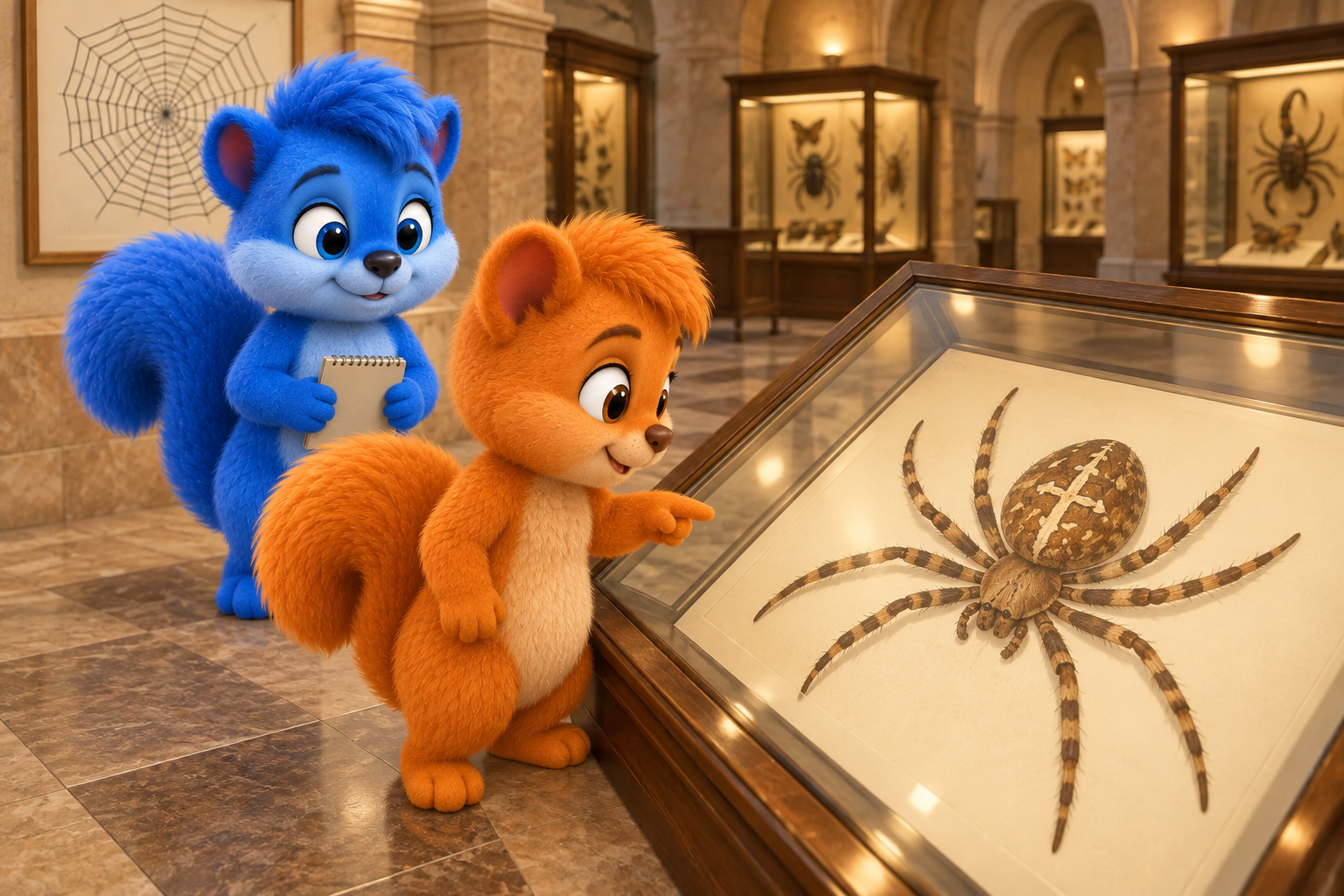
Flauschi points from outside towards a European garden spider teaching model under museum glass; Puschel watches with a notebook. Original inanimate teaching model and separate web sketch; no live spider or identification key. AI-created illustration, not a photograph of nature.
What the diagram shows
The diagram simplifies the process. First compare its shapes and arrows. You can read its labels in larger text below.
Read the picture labels
These are the words and sentences from the diagram above. The full explanation follows below.
- Walking legs attach to the cephalothorax
- Four walking legs on each side
- Together: eight walking legs
- Cephalothorax: legs attach here.
- Abdomen: second section
- The European garden spider builds an orb web.
- Not all spiders build prey-catching webs.
- Spider silk has other uses too.
- Leave real spiders and their webs undisturbed.
- Original simplified sketch: no mouth appendages, scale or identification key.
An imagined Wusel scene
Puschel and Flauschi investigate
Puschel counts only the clearly visible legs in the picture. Flauschi helps trace the partly hidden ones. They find eight and compare the abdominal pattern. Later they observe the real web without touching it for a better view.
Look closely
Flauschi stands at the front left and points towards a spider teaching model under the closed glass of a sloping museum console. Behind her, Puschel holds a small notebook. A separate orb-web sketch hangs on the museum wall.
An example to help you understand
Draw two connected body sections and eight walking legs, all attached to the cephalothorax. Beside it draw an original orb web using lines. Label them “spider” and “web”. These sketches simplify body structure and web shape; they are neither to scale nor guides to identifying species.
Try explaining it
How many walking legs does a garden cross spider have?
Choose a), b) or c), then explain your choice.
- a)Six.
- b)Four.
- c)Eight.
Show the explanation
Correct: c): Eight.
A garden cross spider has eight legs and builds a catching web. A cross-shaped pattern on the abdomen can be a clue, but varies. Several features should match. Leave the spider and its web undisturbed.
Word help
- cephalothorax
- In spiders, the front body section combining head and thorax. The walking legs attach here.
Explore in more detail
Here you will find longer explanations and further details. You can explore them together.
1. Count eight walking legs
Spiders have eight walking legs and two main body sections: the cephalothorax and abdomen. The legs attach to the cephalothorax. Other small appendages near the mouth may confuse counting; they are not extra walking legs. Count four legs on each side of our simplified paper drawing.
Checked against: [1]
2. Silk comes from spinnerets
Spider silk is a natural fibre made of proteins. Spinnerets sit on the abdomen, usually towards the rear on its underside. Threads emerge from them. Different kinds of silk serve different tasks. A thread does not come from a hand as in some fantasy stories.
Checked against: [2]
3. The European garden spider builds an orb web
The European garden spider typically has a pale cross marking on its abdomen. Its background colour varies. It builds an orb web. When prey gets caught, the strands carry a signal to the spider. A drawing alone cannot replace expert identification of a real spider. Outward-running threads form the scaffold, with a sticky capture spiral between them. The web therefore does not use identical threads everywhere. Many orb-weaving spiders eat damaged webs or webs that no longer stick well and reuse components of the silk.
4. Not every spider catches prey with a web
Not all spiders build prey-catching webs. Jumping spiders actively pursue prey; some crab spiders wait for it. Silk may also form retreats, egg coverings or safety lines. The garden spider’s orb web is therefore no blueprint for all spiders.
Checked against: [2]
An optional question for further exploration
You can use the longer explanation above. This is extra, not needed for the first quiz.
An extra question
Do all spiders build an orb web like the European garden spider?
Discover the answer
No. Some spiders build other prey-catching webs; others pursue prey or wait for it. Spider silk has other uses too, such as retreats, egg coverings and safety lines.
Pictures and sources for adults
Sources for further reading
Facts checked against the specialist sources below on 12 October 2026. The Wusel scene is fictional; comparisons and simplified models are explicitly explained. Sources are in German and English.