Insect · Aeshna cyanea
Discover the southern hawker dragonfly
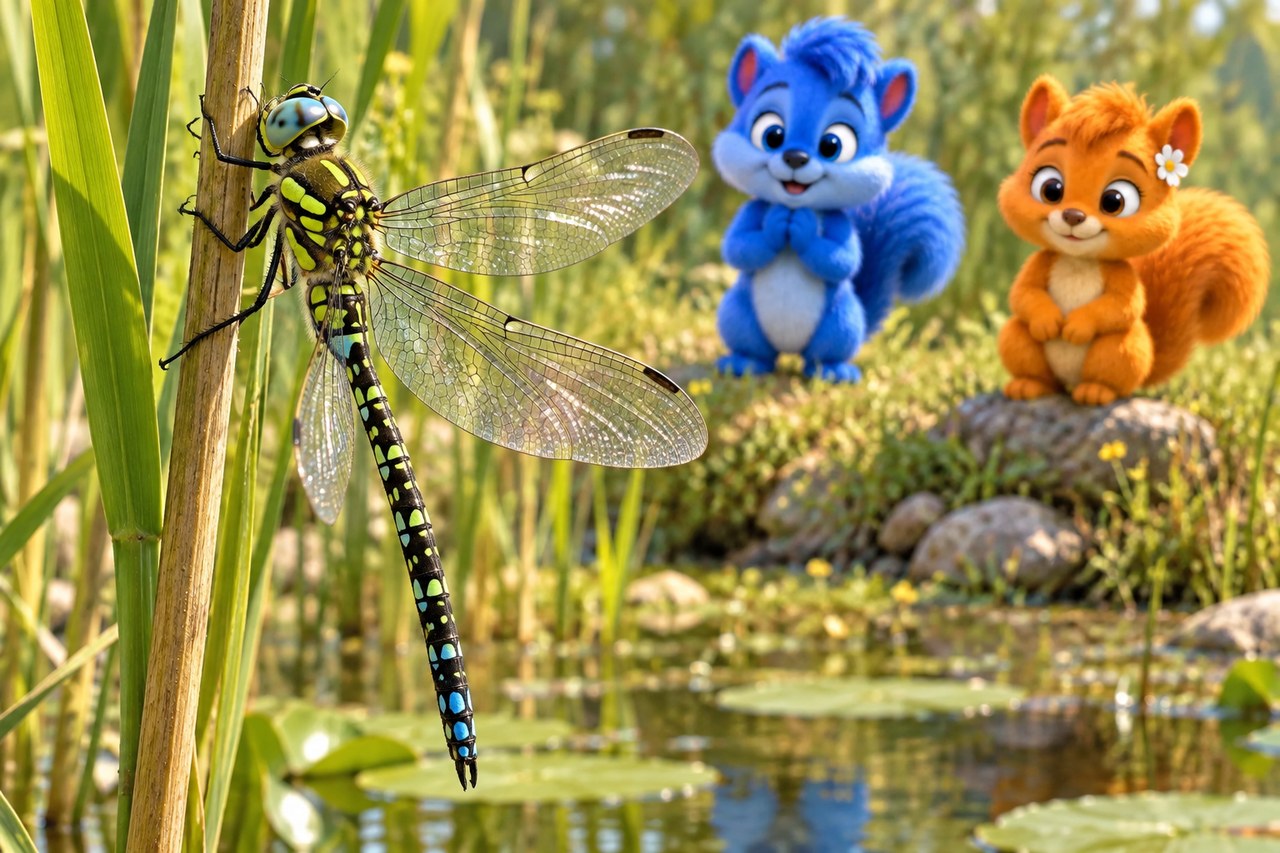
Four transparent wings shine beside the pond. Puschel discovers a flying expert.
The short answer
The southern hawker is a dragonfly. Its larvae live in water. After the final moult, adults fly with four wings and hunt other insects. The long abdomen is not a stinger. Observe without catching it.
An imagined Wusel scene
Puschel and Flauschi investigate
At the pond Flauschi spots a dragonfly on a stem. Puschel sits on the dry side of the bank. Puschel“It looks like a tiny flying machine.”
They study its fine wings. Puschel“Does it need an engine?” Flauschi smiles. Flauschi“No, it moves its wings itself.”
When the dragonfly takes off, both stay quietly seated. Puschel“Our watching spot was just right,” Puschel says. They need not go into the water to be amazed.
What it looks like
This dragonfly has a long abdomen, large eyes, six legs and four transparent wings. Males have striking green and blue markings.
How it lives
Adults hunt other insects. Dragonflies have no sting, but we still leave them untouched.
Good to know
Their larvae live in water. They leave it for their final moult; the adult dragonfly can then fly.
Try explaining it
How does a young dragonfly differ from an adult?
Choose a), b) or c), then explain your choice.
- a)The larva lives in water; the adult flies.
- b)The larva flies over water like the adult.
- c)The adult stays underwater while the larva flies.
Show the explanation
Correct: a): The larva lives in water; the adult flies.
The larva develops in water. After its final moult, the adult dragonfly flies.
Explore in more detail
Here you will find longer explanations and further details. You can explore them together.
Understand step by step
How it works – simply explained
Life begins underwater
Dragonfly larvae are active aquatic animals, not merely waiting little flying adults.
The final moult changes form
The larva leaves water and the adult emerges at its final moult, shedding the old covering.
A hunter flies
Adults hunt insects using four wings. The long abdomen is not a stinger, but the delicate animal is still left untouched.
References for this explanation: [1]
Explore animal sounds
We currently have no freely reusable recording reliably identified as this animal. That does not mean it is completely silent. Explore it in the picture and observe animals outdoors from a distance without touching or disturbing them.
More about this animal: NABU Insektentrainer: Blaugrüne Mosaikjungfer
An optional question for further exploration
You can use the longer explanation above. This is extra, not needed for the first quiz.
An extra question
How does the southern hawker’s habitat change when its larva becomes an adult?
Show answer
The larva lives in water. It leaves the water for its final moult; the adult lives outside the water and flies.