Crustacean · not an insect · Porcellio scaber
Discover the common rough woodlouse
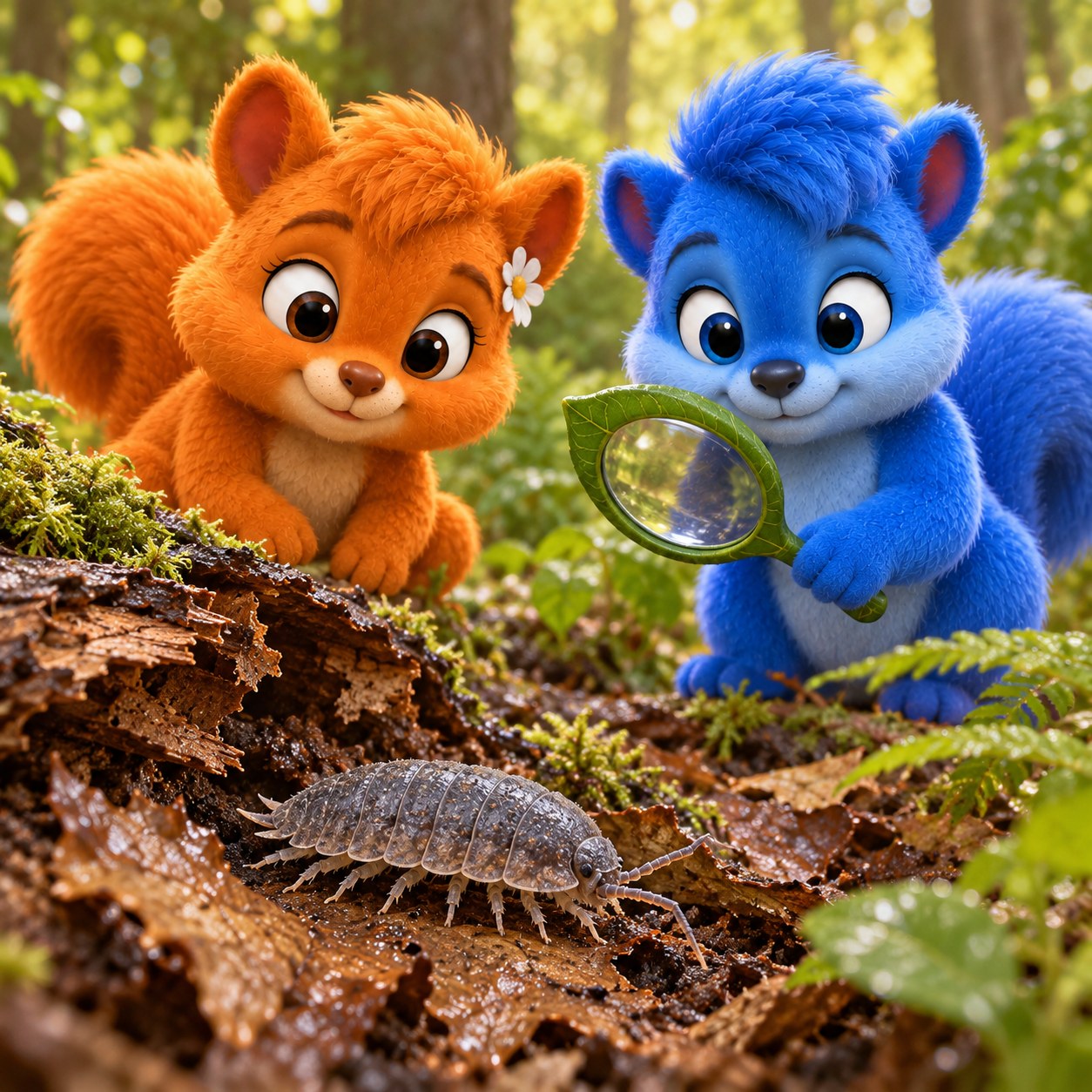
Many little legs in damp leaves: a woodlouse surprises the pair with its relatives.
The short answer
Woodlice are land-living crustaceans, not insects. Adults have fourteen walking legs under segmented armour. Damp hiding places prevent drying, so do not permanently remove their shelter.
An imagined Wusel scene
Puschel and Flauschi investigate
Flauschi spots a woodlouse beside a piece of bark. Puschel looks through his magnifier without covering the animal. Puschel“That is far more than six legs!”
Flauschi“An adult rough woodlouse has fourteen walking legs,” explains Flauschi. Flauschi“And it is a crustacean.” Puschel looks at the woodland behind them in surprise.
Puschel“A crustacean without a sea view,” he says. They leave the bark and leaves in place. The little damp home should stay just as they found it.
What it looks like
An adult rough woodlouse has a flat grey to brownish body, a segmented back and seven pairs of walking legs: fourteen legs altogether.
How it lives
Woodlice are crustaceans, not insects. Rough woodlice live on land and need damp hiding places to avoid drying out.
Good to know
They eat dead plant remains among other foods and help with decomposition. Not every woodlouse can roll into a ball.
Little Wusel quiz
The woodlouse lives on land. Why does it still need a damp hiding place?
Show answer
To avoid drying out. It is a land-dwelling crustacean and is left undisturbed in damp leaf litter.
Explore in more detail
Here you will find longer explanations and further details. You can explore them together.
Understand step by step
How it works – simply explained
Many legs carry one body
Adult woodlice have seven pairs, fourteen walking legs on one animal, not two hidden insects.
Relationship extends beyond water
Woodlice are crustaceans despite living on land. Habitat alone does not define the group. Damp shelters matter.
Remains become food
Dead plant material supplies food and is broken down. Woodlice and other decomposers work together on organic remains.
References for this explanation: [1]
Explore animal sounds
A sound researcher recorded rough woodlice feeding with a contact microphone. These are amplified feeding noises, not singing. Open the article with an adult and choose Porcellio scaber specifically; the other recording features a different woodlouse species.
Antony Hall: Porcellio scaber feeding – Kontaktmikrofonaufnahme / contact-microphone recording →