Insect · Apis mellifera
Discover the honeybee
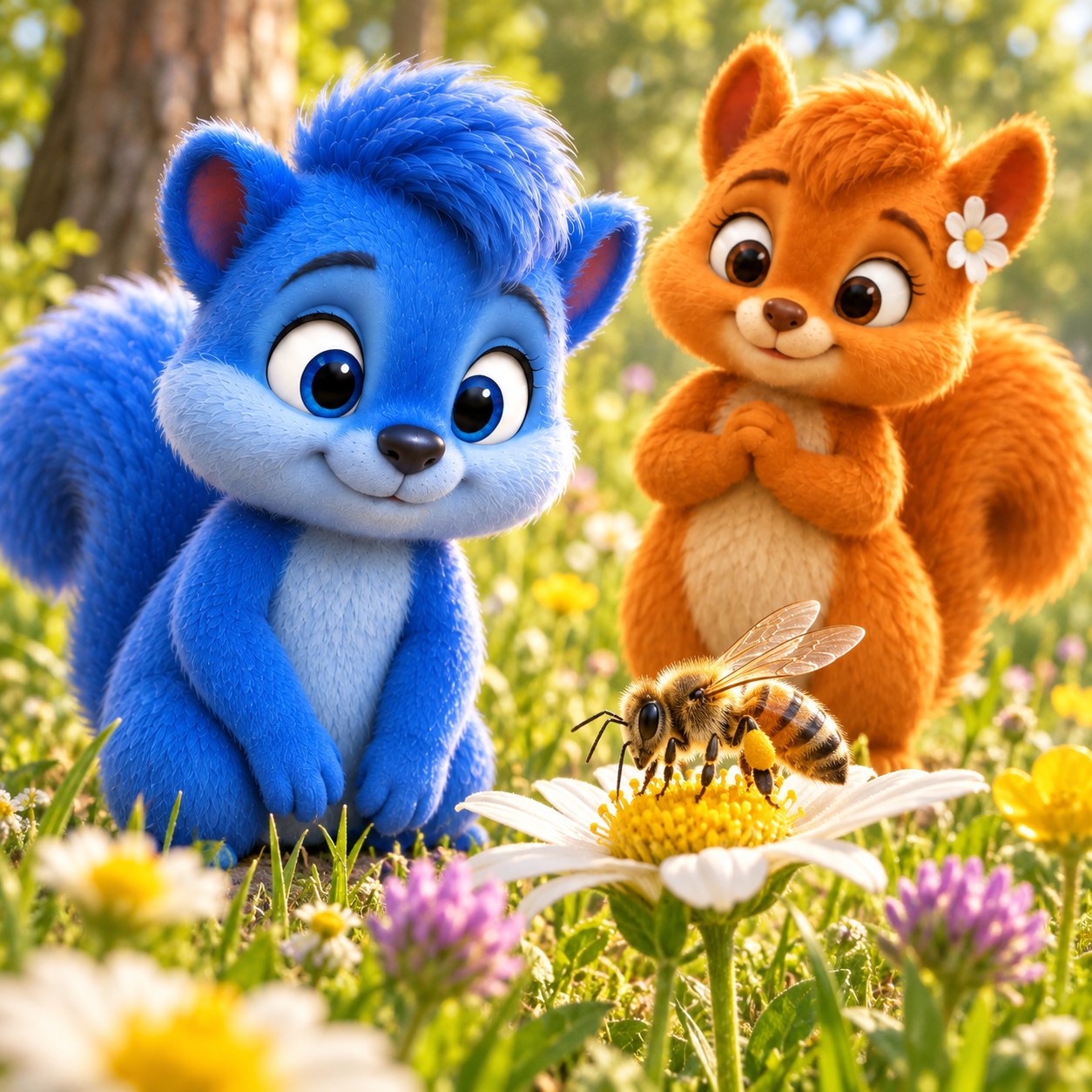
A quiet buzz and yellow pollen: Puschel waits for the little visitor to finish.
The short answer
An adult honeybee has six legs and two antennae. Workers collect nectar, a sweet flower liquid, and pollen. They can pollinate plants by carrying pollen between flowers.
See the connection
Simplified drawings, not to scale. Not a guide for identifying species.
An imagined Wusel scene
Puschel and Flauschi investigate
Puschel kneels beside a flower. Puschel“Our visitor has yellow parcels!” Flauschi watches from a distance. Flauschi“That is collected pollen.”
Puschel keeps his paws in the grass. The bee continues working without anyone shaking the flower. Puschel“Today I will be the waiting helper,” he whispers.
When the bee flies away, Flauschi smiles. Flauschi“Helping can mean making room.” Puschel nods. His best helping trick needed no tools today.
What it looks like
An adult honeybee has six legs, two antennae and two pairs of wings. Its body is usually brownish with paler abdominal bands.
How it lives
Workers collect nectar and pollen. On flower visits they can carry pollen between flowers and pollinate them.
Good to know
Honeybees live together in a colony. Many other bee species exist; not all live in large communities.
Little Wusel quiz
Puschel sees a yellow pollen parcel. How can the visit also help another flower?
Show answer
The bee can carry pollen from one flower to another and pollinate it.
Word help
- nutrient
- A substance a living thing needs to grow and live.
- pollen
- Fine powder from flowers. Pollination carries it to a suitable flower’s receiving surface. It is not a plant seed.
- nectar
- A sugary liquid offered by many flowers and eaten by some animals.
- pollination
- Pollen reaches a flower’s receiving surface, the stigma. Further processes can then lead to seeds.
Explore in more detail
Here you will find longer explanations and further details. You can explore them together.
Understand step by step
How it works – simply explained
Collect food
Workers visit flowers for nectar and pollen, providing different nutrients. Not every pictured bee has the same role.
Connect flowers
Pollen can cling and transfer to another suitable flower, helping pollination during feeding.
Distinguish communities
Honeybees live in colonies, but other bee species live differently. Six legs identify an insect, not necessarily a honeybee.
References for this explanation: [1]
Explore animal sounds
Bees buzz at a flowering plum tree. The source describes bees but does not identify every individual species; this recording is not a reliable species identification.
Bees buzzing at flowers
Recording: Serg Childed · Original: Buzzing bees.ogg · CC BY-SA 4.0 · Wikimedia MP3 conversion; no trimming or content changes by us.
Listen quietly. Do not play animal recordings outdoors to attract animals.