Insect · Bombus terrestris
Discover the buff-tailed bumblebee
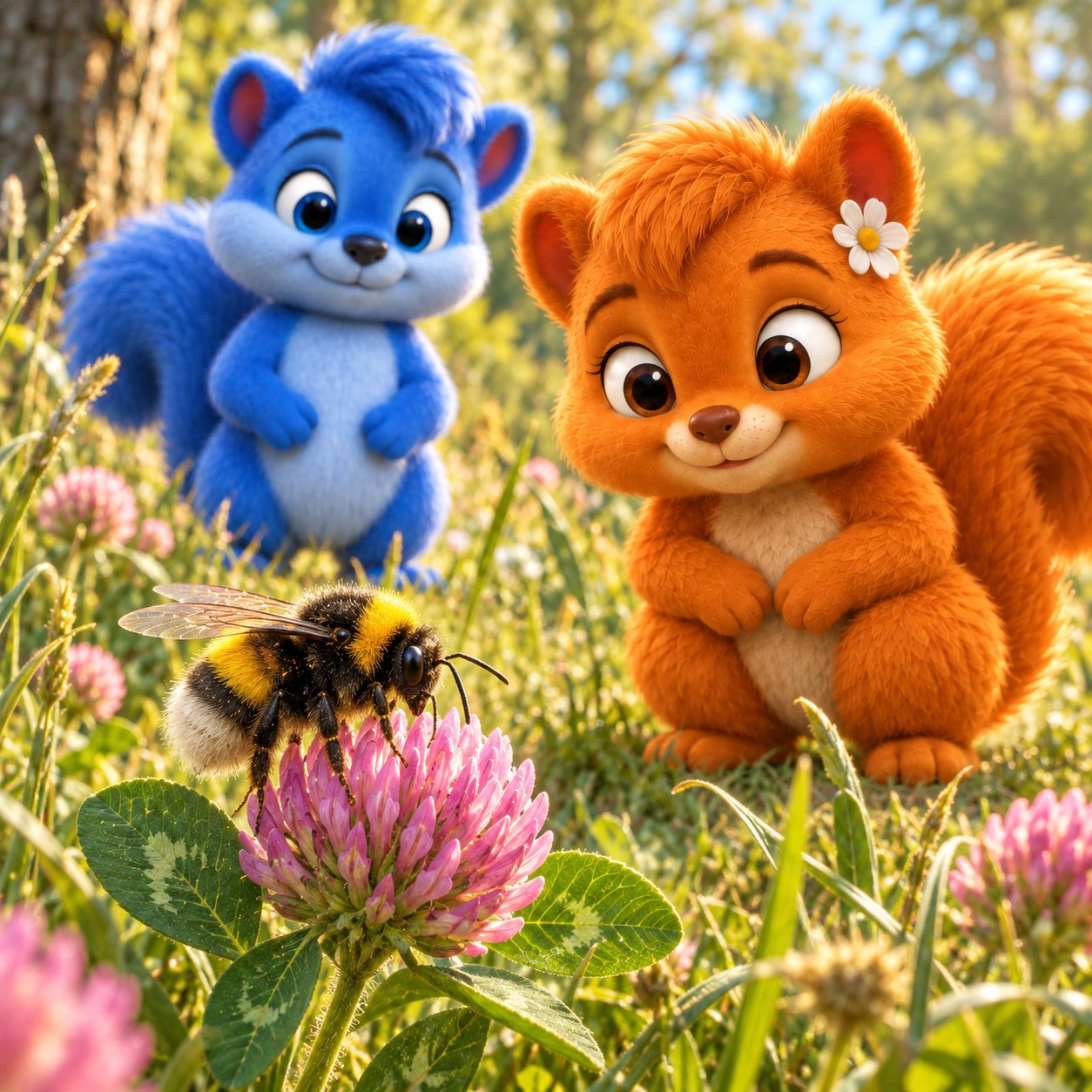
A fuzzy buzzer visits the clover. Flauschi discovers that bumblebees are bees too.
The short answer
Bumblebees of the buff-tailed group look rounded and hairy, often with yellow bands and a pale tail. They are bees with six legs. Similar species look alike; colour bands alone cannot ensure identification.
An imagined Wusel scene
Puschel and Flauschi investigate
Flauschi watches a bumblebee on the clover. Flauschi“What a fluffy visitor!” Puschel looks at his own tail. Puschel“Does that make me a bumblebee too?”
Flauschi giggles. Flauschi“Being fluffy is not enough. Bumblebees belong to the bees.” Puschel keeps his paws on his knees and watches the buzzer.
They wait until the flower is free again. Puschel“My tail can stay a tail,” Puschel says happily. Flauschi“And the bumblebee gets some peace,” adds Flauschi.
What it looks like
Buff-tailed bumblebees look round and hairy, with yellow bands and a pale abdominal tip. Similar bumblebee species can look almost identical.
How it lives
Bumblebees belong to the bees and are insects. Adults have six legs. Workers and nest-founding queens collect nectar and pollen; males do not collect pollen for the nest.
Good to know
Their nests are often underground, for example in abandoned mouse burrows. Leave entrances clear and undisturbed.
Try explaining it
Which animal group do bumblebees belong to?
Choose a), b) or c), then explain your choice.
- a)Wasps.
- b)Hoverflies.
- c)Bees.
Show the explanation
Correct: c): Bees.
Bumblebees are bees. Adults have six legs; their hair does not make them mammals.
Word help
- pollen
- Fine powder from flowers. Pollination carries it to a suitable flower’s receiving surface. It is not a plant seed.
- pollination
- Pollen reaches a flower’s receiving surface, the stigma. Further processes can then lead to seeds.
Explore in more detail
Here you will find longer explanations and further details. You can explore them together.
Understand step by step
How it works – simply explained
Understand flower visits
Food gathering varies with sex and life stage. Workers help supply the nest; males do not gather pollen for young.
A hairy body
Hairiness and rounded shape suggest a bumblebee, but yellow bands cannot reliably identify every species.
Classify correctly
Bumblebees are bees and adult insects with six legs. A fluffy body does not make them mammals.
Explore animal sounds
A research laboratory presents a buff-tailed bumblebee recording during flight and buzz pollination. Open the source page with an adult and click its sound image.
An optional question for further exploration
You can use the longer explanation above. This is extra, not needed for the first quiz.
An extra question
A bumblebee visits a flower. Do all adult bumblebees collect pollen for the nest?
Show answer
No. Workers and nest-founding queens collect pollen; males do not collect pollen for the nest.