Insect · Aglais io
Discover the peacock butterfly
Four striking eyespots cause a surprise, but the real eyes are on the head.
The short answer
A peacock butterfly has large eye-like spots on its upper wings that can startle predators. Adults drink nectar; caterpillars eat nettle leaves. Caterpillar and butterfly are stages of the same species.
See the connection
Simplified drawings, not to scale. Not a guide for identifying species.
An imagined Wusel scene
Puschel and Flauschi investigate
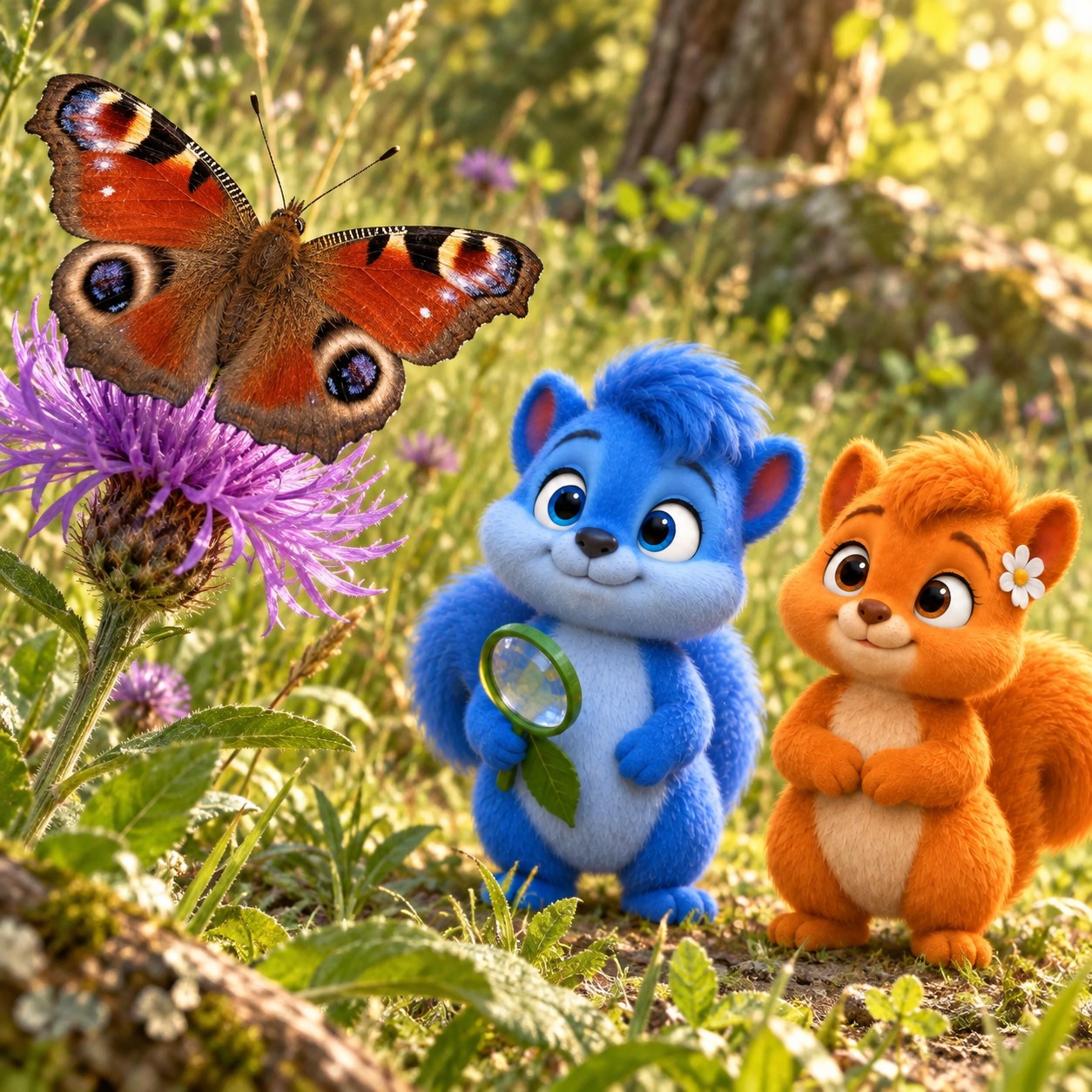
Puschel“That butterfly is looking at me with its wings!” Puschel whispers. Flauschi looks more closely. Flauschi“Those are patterns, not real eyes.”
The butterfly opens its wings on a flower. Puschel lowers his explorer magnifier to avoid disturbing it. Puschel“Four little surprises,” he says quietly.
Flauschi nods. Flauschi“And we only look.” As they leave, Puschel glances back. A pattern can tell a lot without saying a word.
What it looks like
Each upper wing surface has a striking eyespot. These patterns can startle predators.
How it lives
The adult drinks nectar. Its caterpillars eat nettle leaves; the butterfly later emerges from a pupa.
Good to know
A peacock butterfly is an insect with six legs. The front pair is small and held against the body, so often only four walking legs are visible.
Try explaining it
What do peacock butterfly caterpillars eat?
Choose a), b) or c), then explain your choice.
- a)Nettle leaves.
- b)Only flower nectar.
- c)Tree bark as their main food.
Show the explanation
Correct: a): Nettle leaves.
Caterpillars eat nettle leaves. Adult butterflies drink nectar instead.
Word help
- nectar
- A sugary liquid offered by many flowers and eaten by some animals.
- metamorphosis
- A transformation of the body during a life cycle, such as from caterpillar through pupa to butterfly.
Explore in more detail
Here you will find longer explanations and further details. You can explore them together.
Understand step by step
How it works – simply explained
The caterpillar lives differently
Young peacock butterflies are caterpillars feeding on nettle leaves, not miniature finished butterflies.
Transformation changes the body
The body develops within the pupa. The winged adult later emerges; a pupa is not an empty pebble.
Adults feed differently
Adults drink nectar. Wing eyespots may startle predators but are not real eyes. Small front legs explain why six legs are not always obvious.
Why a caterpillar need not practise flying
A caterpillar has no completed butterfly wings. It grows and later becomes a pupa, where transformation into the adult occurs. Caterpillar and butterfly are stages of the same species, not unrelated namesakes. This complete transformation is called metamorphosis. Not all insect species have a pupal stage.
References for this explanation: [1]
Explore animal sounds
We currently have no freely reusable recording reliably identified as this animal. That does not mean it is completely silent. Explore it in the picture and observe animals outdoors from a distance without touching or disturbing them.
More about this animal: NABU Insektentrainer: Tagpfauenauge
An optional question for further exploration
You can use the longer explanation above. This is extra, not needed for the first quiz.
An extra question
Puschel sees only four walking legs on a peacock butterfly. Why is it still an insect?
Show answer
It has six legs. The front pair is small and held against the body.