How can you find a way through a maze?
Remember junctions, test a path and return deliberately when it reaches a dead end.
The short answer
A plan and marks for checked routes help in a maze. At a dead end, return to the last junction. This makes the search systematic instead of trying the same paths again.
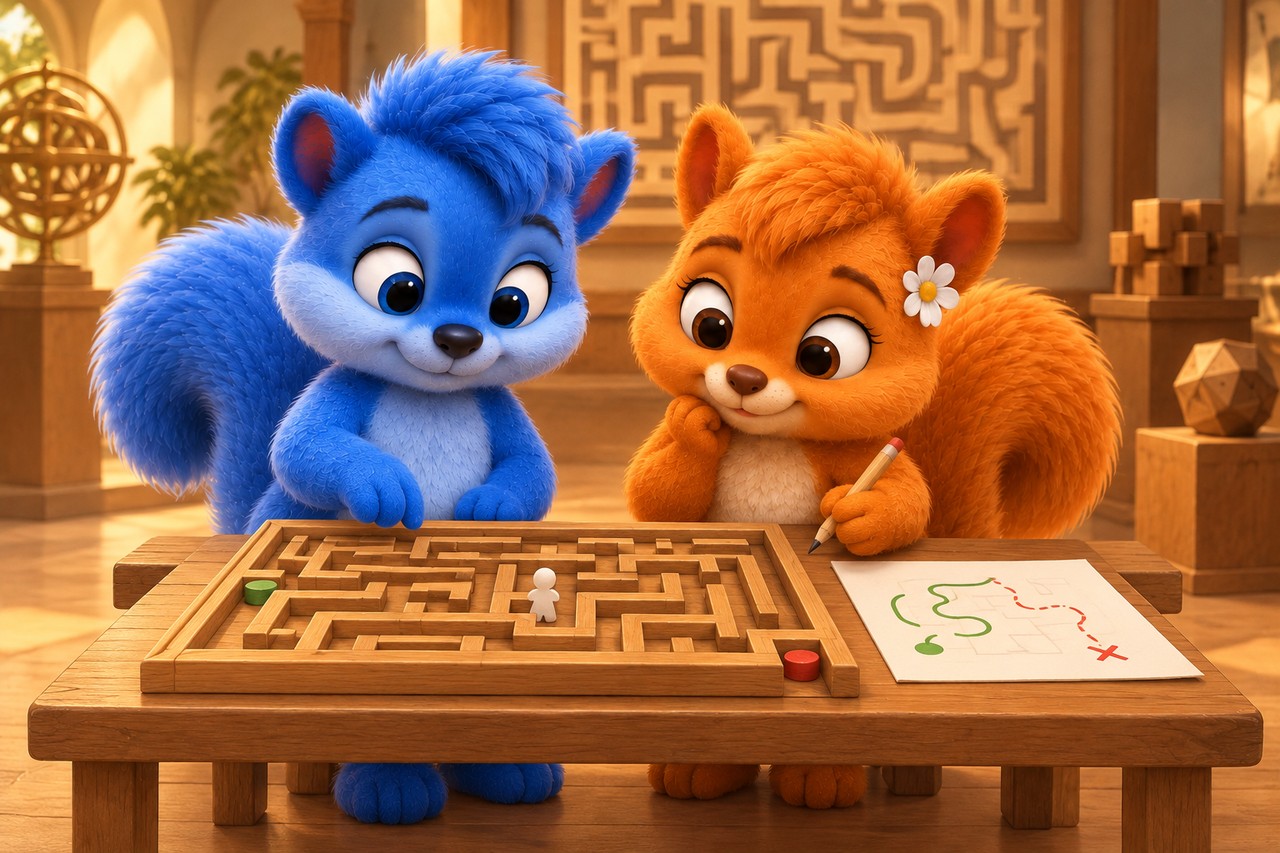
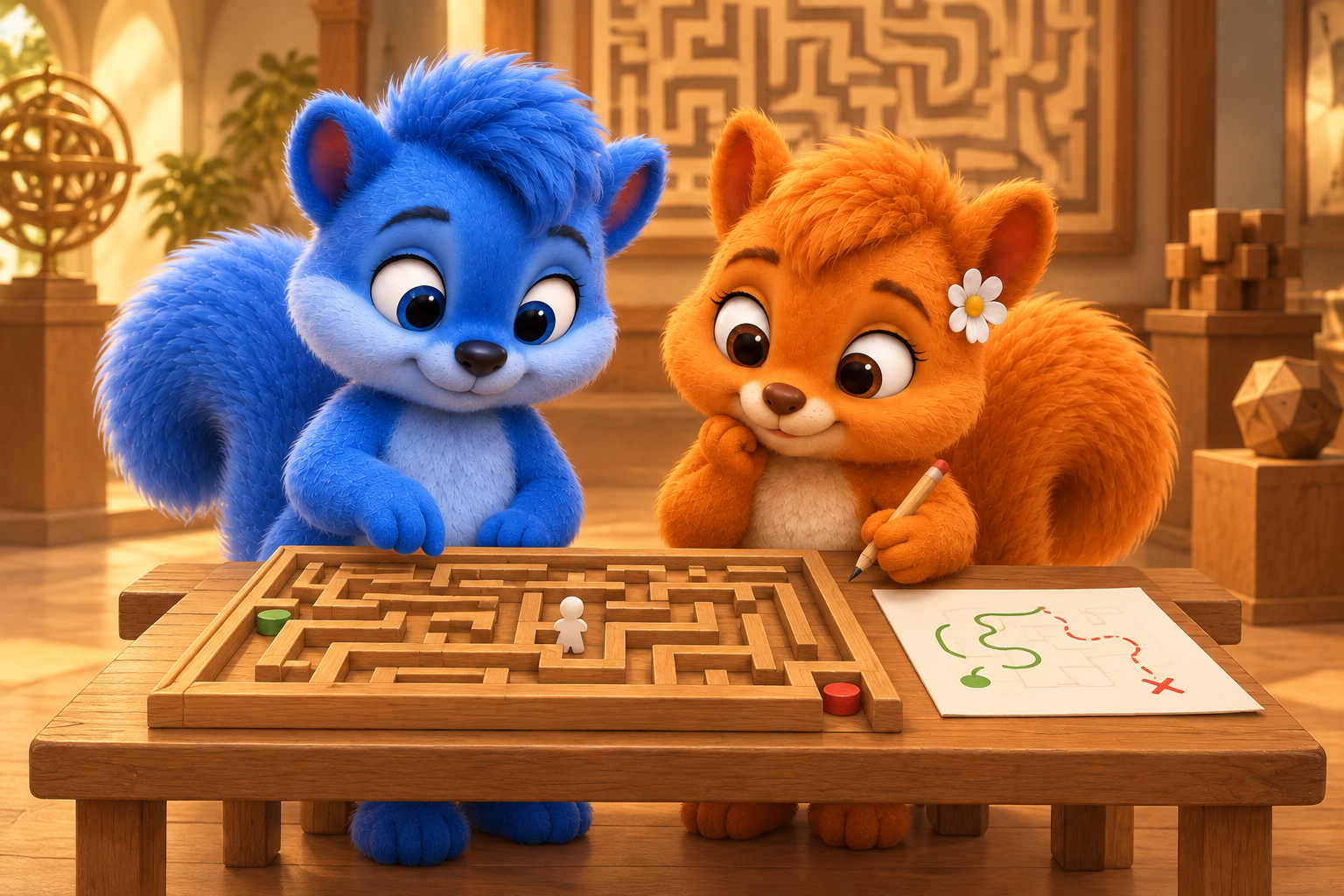
Equal-sized Wusels compare a wooden maze with a drawn route plan. Imagined museum puzzle. Decorative wooden paths are not a verified task layout; the native diagram shows a clearly solvable network. AI-created illustration, not a photograph of nature.
What the diagram shows
The diagram simplifies the process. First compare its shapes and arrows. You can read its labels in larger text below.
Read the picture labels
These are the words and sentences from the diagram above. The full explanation follows below.
- Record a dead end and test another branch
- Start
- Junction
- Dead end
- Goal
- Test upper branch → return → test lower branch → reach goal
- Small network: the upper branch ends; the lower one leads to the goal.
An imagined Wusel scene
Puschel and Flauschi investigate
Puschel reaches the same paper-maze dead end for the third time. Flauschi marks the checked route. At the next junction they deliberately choose another. Their marks keep track longer than his memory alone could.
Look closely
Find the white token in the wooden maze and different paper paths. The large museum scene is decorative; the labelled diagram contains the clearly checkable example route.
An example to help you understand
The diagram begins at Start. At the first junction, the upper branch ends in a dead end. Return and try the lower branch towards Goal. Draw a similar small network on paper and mark tested branches. First check that your goal is reachable. This illustrates a search method, not safe navigation in unknown real terrain.
Try explaining it
What helps after a dead end in a paper maze?
Choose a), b) or c), then explain your choice.
- a)Mark the route and return to the last junction.
- b)Start over without recording paths already checked.
- c)Stay at the dead end and look ahead on the paper.
Show the explanation
Correct: a): Mark the route and return to the last junction.
A plan and marks for checked routes help in a maze. At a dead end, return to the last junction. This makes the search systematic instead of trying the same paths again.
Explore in more detail
Here you will find longer explanations and further details. You can explore them together.
1. Paths and decisions
Our maze is a network with a start and a goal. Junctions offer different directions. A dead end has no onward path. Here maze means a branching puzzle; historical places bearing related names are not all designed alike.
Checked against: [1]
2. Check one direction carefully
Choose an untested path at a junction. Record the choice on paper. Follow it without crossing walls. A dead end teaches you that this branch does not reach the goal. Running faster would not change it.
Checked against: [1]
3. Return to an open possibility
Follow the same path back to the last junction that still has an untested option. Try that option next. In search methods this is called backtracking: returning from a choice and investigating another possibility. Marks help avoid repeatedly testing the same unsuccessful branch.
Checked against: [1]
4. A route is not always the shortest
A finite network with suitable records allows systematic exploration of reachable paths. If a connection to the goal exists, this method can find it. If none exists, careful searching cannot cross a wall. When several routes exist, the first one found need not be the shortest.
Checked against: [1]
An optional question for further exploration
You can use the longer explanation above. This is extra, not needed for the first quiz.
An extra question
What should you do when your tested route reaches a dead end?
Discover the answer
Mark the unsuccessful branch, return to the last junction with an untested option, and try that option. A dead end provides useful information.
Pictures and sources for adults
Sources for further reading
Facts checked against the specialist sources below on 12 October 2026. The Wusel scene is fictional; comparisons and simplified models are explicitly explained. Sources are in English.