How do lightning and thunder happen?
A lightning flash suddenly heats the air. Why do we usually hear the thunder afterwards?
The short answer
Lightning heats the air very suddenly. The air expands rapidly, producing thunder. Light travels much faster than sound. The flash therefore reaches us first and thunder later. Thunder does not wait until after the flash before setting off.
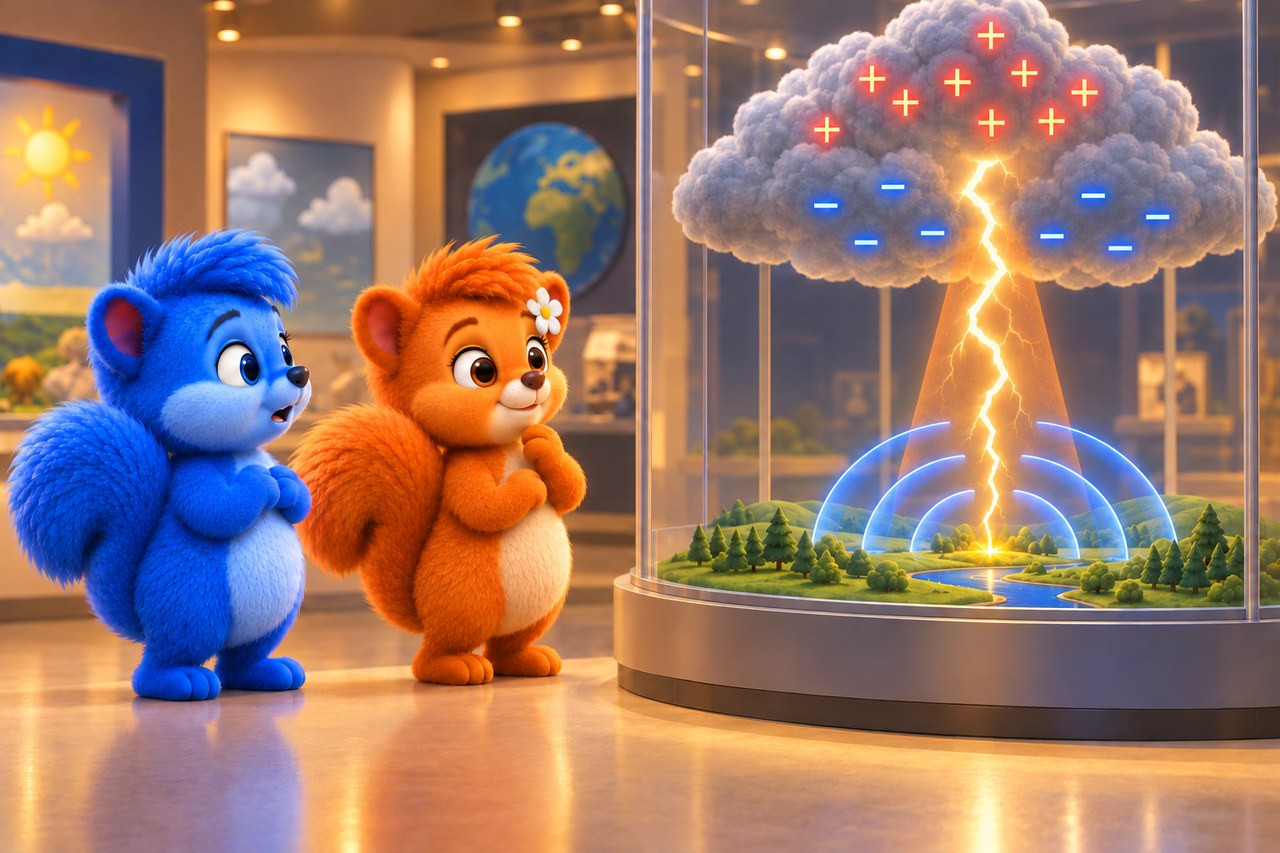
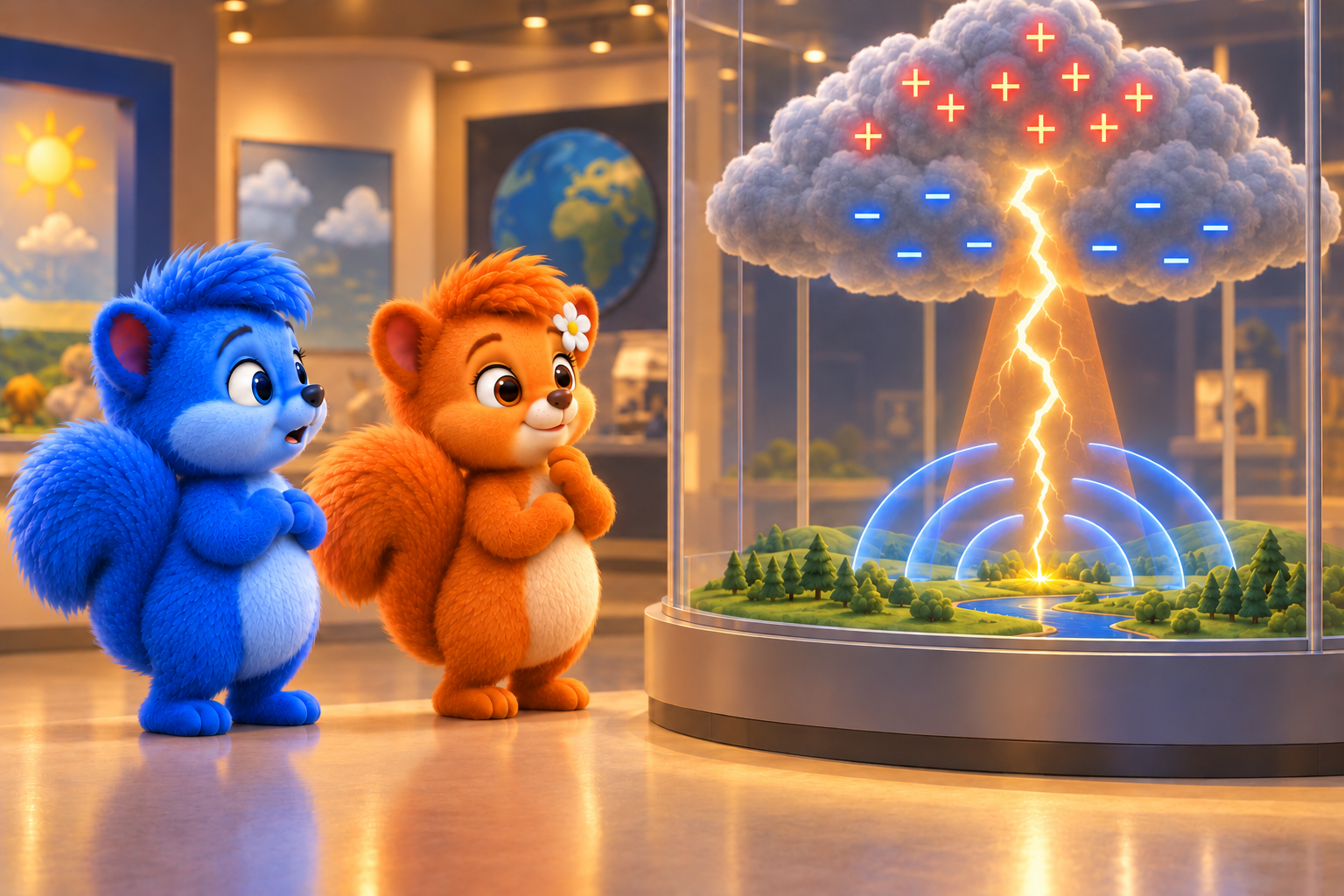
Puschel and Flauschi in the museum. Cloud charges, lightning and pressure waves in a museum model. Simplified inanimate museum model; arrows and colours help explain it. AI-created illustration, not a photograph of nature.
Explained in three pictures
1 Charges separate
Particles in the cloud separate electric charges.
2 Lightning current
Lightning heats the air. It suddenly expands.
3 Thunder
We hear the pressure wave as thunder.
More about the picture
Lightning and thunder belong together: current heats air, which suddenly expands. Light reaches us much faster than sound, so we usually see lightning before hearing thunder.
An imagined Wusel scene
Puschel and Flauschi investigate
In the museum, Flauschi starts the storm recording. Puschel points first to the flash and later to the thunder. They arrange two cards along the route to an observer figure.
On the next replay he explains why things produced together arrive at different times.
Look closely
Compare the museum model with the three picture steps. Lightning heats the air. It suddenly expands.
An example to help you understand
Imagine a film where you see someone clap but hear the sound late. The picture and sound belong together but reach you at different times. In a thunderstorm the delay comes from the different speeds of light and sound. This comparison explains only the delay: a loudspeaker and lightning produce sound differently. Watch storms only from a safe indoor place.
Try explaining it
Why do we see lightning before hearing thunder?
Choose a), b) or c), then explain your choice.
- a)The storm makes light first and waits before making sound.
- b)Light reaches us faster than sound.
- c)The bright light initially hides the thunder from our ears.
Show the explanation
Correct: b): Light reaches us faster than sound.
Lightning heats the air very suddenly. The air expands rapidly, producing thunder. Light travels much faster than sound. The flash therefore reaches us first and thunder later. Thunder does not wait until after the flash before setting off.
Word help
- crystal
- A solid with tiny building blocks arranged in a regular pattern.
Explore in more detail
Here you will find longer explanations and further details. You can explore them together.
1. Lots of movement inside a cloud
Strong air currents in a thunderstorm cloud move water droplets, small ice crystals and graupel, little ice pellets. Collisions can transfer electric charge between particles. Their different movements separate charges within the cloud. Charge is a property of tiny particles; it can be positive or negative. This is a simplified explanation: a real cloud is not a neatly sorted box.
Checked against: [1]
2. Lightning is an electrical discharge
At first, air prevents the separated charges from easily balancing out. When the difference becomes large enough, a conducting path can form. A very strong electric current briefly flows along it: lightning. Some flashes stay inside a cloud; others occur between clouds or between cloud and ground. Not every flash reaches the ground.
Checked against: [1]
3. Lightning makes air move
The current heats air along its path very quickly. That air suddenly expands and pushes against neighbouring air, creating a strong pressure wave that spreads. Your ears detect this as sound: thunder. The flash and its thunder belong to the same event. Thunder is not the noise of two clouds bumping together. Why can thunder rumble for a while? The lightning channel is long. Sound from a nearer section reaches you before sound from a more distant section. One flash can therefore produce an extended rumble rather than just a short bang.
Checked against: [2]
4. Light travels faster than sound
The flash reaches your eyes much sooner than its sound reaches your ears. That is why you usually see lightning first. Sound from a more distant flash takes longer. Light and sound do not set off one after the other: they arrive at different speeds. Thunder also warns you of danger, even when a storm sounds distant.
An optional question for further exploration
You can use the longer explanation above. This is extra, not needed for the first quiz.
An extra question
Why is thunder not a second explosion that starts several seconds after the flash?
Discover the answer
Lightning heats air and produces thunder immediately. The sound takes longer to reach us than the light. The wait is mainly due to the journey to our ears, not a later second explosion.
Pictures and sources for adults
Sources for further reading
Facts checked against the specialist sources below on 12 October 2026. The Wusel scene is fictional; comparisons and simplified models are explicitly explained. Sources are in English.