What is a giant squid?
Eight arms, two long feeding tentacles and large eyes: an unusual animal from deep in the ocean.
The short answer
A giant squid is a large marine animal without a backbone. It has eight arms and two especially long feeding tentacles for catching prey. Large eyes help it in the faint light of the deep.
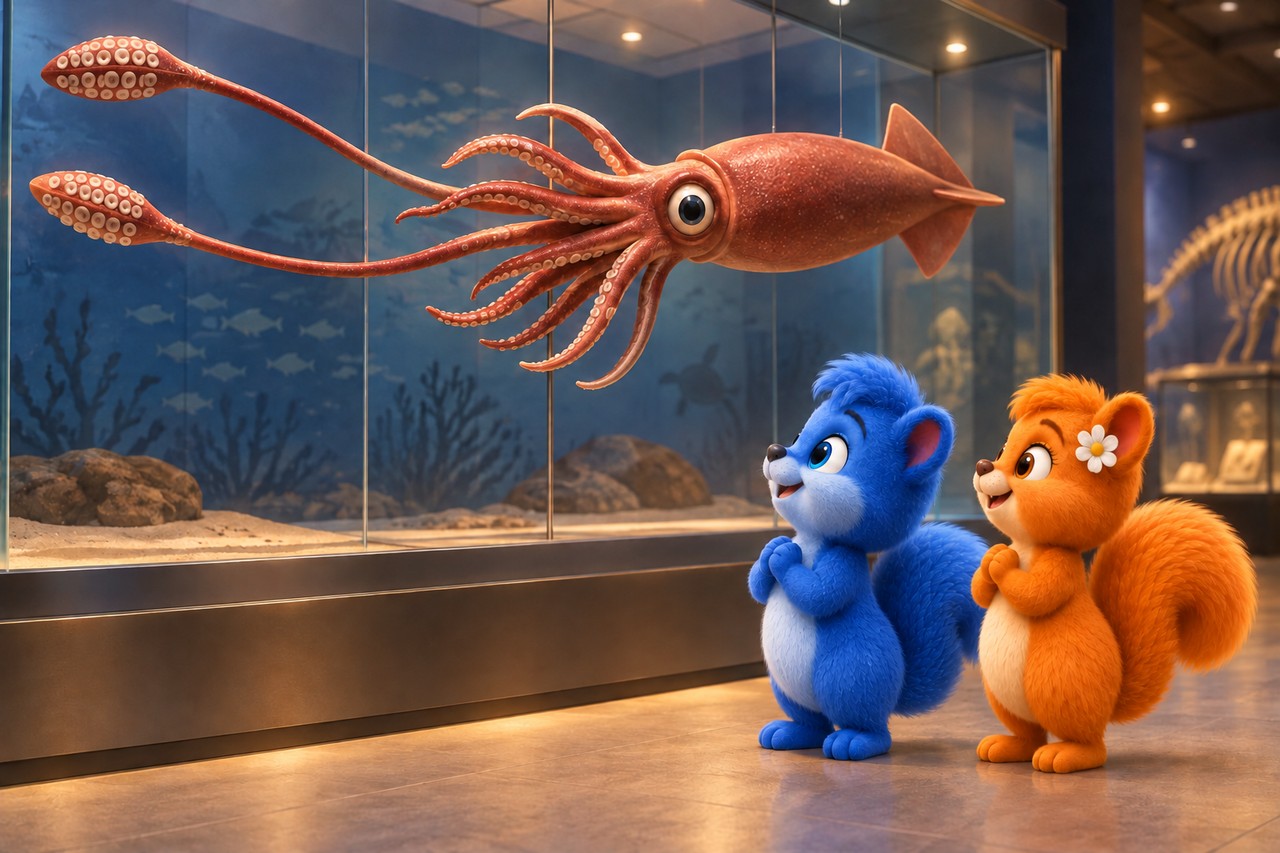
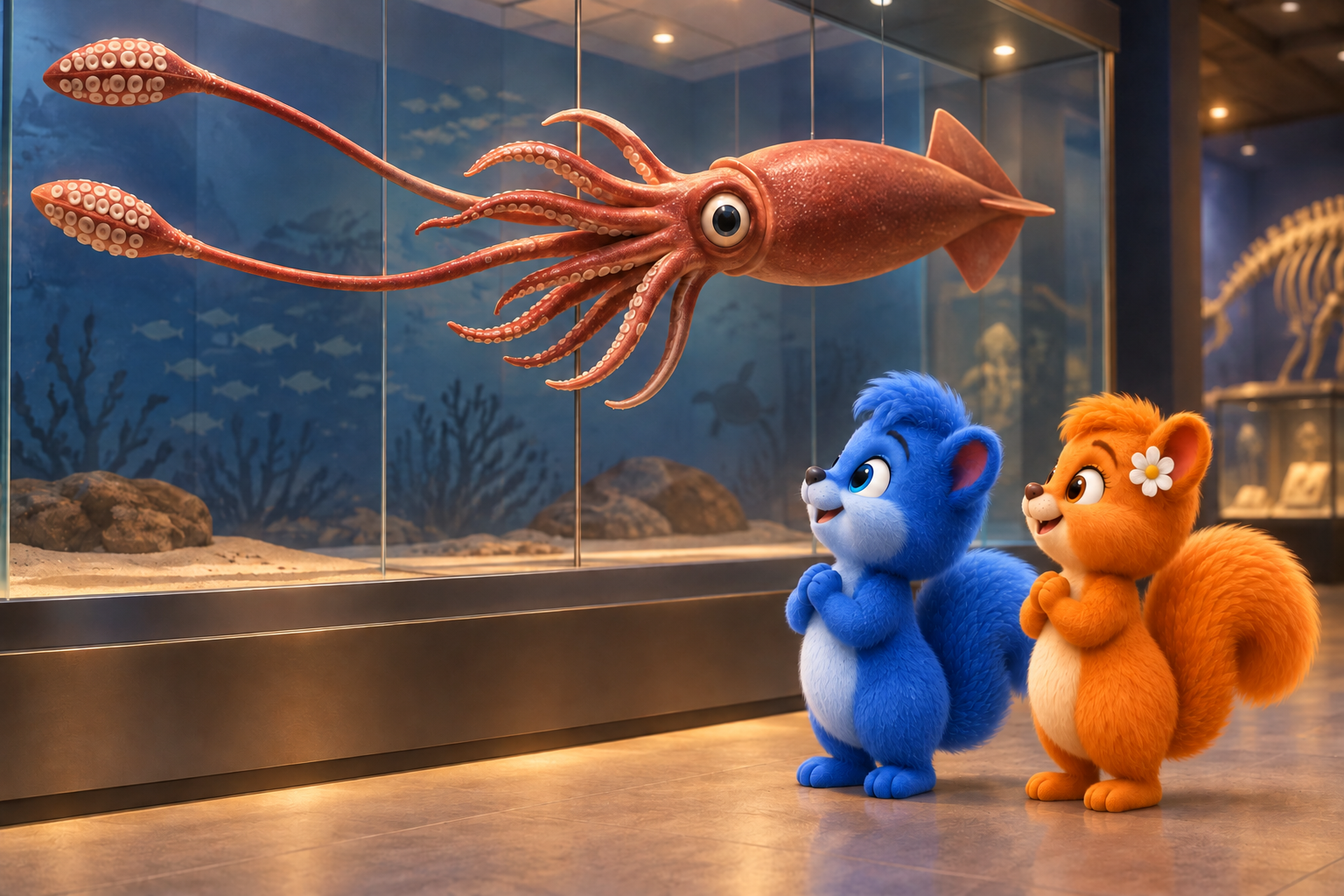
Equal-sized Puschel and Flauschi examine a reduced giant-squid model in an ocean museum. The museum model is reduced and artistically simplified. The extra body diagram explains eight arms and two feeding tentacles; it is explicitly schematic. AI-created illustration, not a photograph of nature.
What the diagram shows
The diagram simplifies the process. First compare its shapes and arrows. You can read its labels in larger text below.
Read the picture labels
These are the words and sentences from the diagram above. The full explanation follows below.
- Eight arms plus two feeding tentacles
- 1 2 3 4 5 6 7 8
- Body without extensions
- 2 feeding tentacles
- Total length: body, arms and feeding tentacles
- Diagram: spread apart for counting, not to scale.
An imagined Wusel scene
Puschel and Flauschi investigate
Puschel counts ten equal arms on the model. Flauschi places the enlarged drawing beside it. Two parts are especially long and differently shaped. He counts again and draws eight arms plus two feeding tentacles instead of ten identical lines.
Look closely
Find the elongated body, group of shorter arms and two long feeding tentacles in the museum model. The extra body diagram shows eight plus two separately so you can count them.
An example to help you understand
Thirteen metres is twenty-six half-metre lengths in a row. An adult can mark a start and finish with large paper markers on a suitable open space. Walk between them together. This compares the total length of a very large animal, not its width. The learning picture separates body length from total length: the two long feeding tentacles account for much of the difference.
Try explaining it
What distinguishes the two feeding tentacles from the eight arms?
Choose a), b) or c), then explain your choice.
- a)They move the body forward like fins.
- b)They break up captured prey like teeth.
- c)They are especially long and help catch prey.
Show the explanation
Correct: c): They are especially long and help catch prey.
A giant squid is a large marine animal without a backbone. It has eight arms and two especially long feeding tentacles for catching prey. Large eyes help it in the faint light of the deep.
Explore in more detail
Here you will find longer explanations and further details. You can explore them together.
1. A squid is not a fish
Giant squid are molluscs, the large animal group that also includes snails and mussels. They have no backbone like a fish. Their scientific name is Architeuthis dux. A squid is different from an octopus: an octopus has eight arms, while a squid also has two feeding tentacles, especially long extensions used to catch prey.
2. Ten extensions have different jobs
A giant squid has eight shorter arms and two much longer feeding tentacles. The tentacles have suckers on their widened ends. They help the squid reach prey. The arms bring it towards the mouth, which has a hard beak. Large eyes detect faint light. Its arms are not legs for walking on the seabed.
Checked against: [1]
3. What is thirteen metres long?
Very large documented giant squid reach roughly thirteen metres in total length, including their long feeding tentacles. The main body is much shorter. Not every individual grows this large. Some reports exaggerate size, and damaged or stretched tentacles make measurements difficult. Always ask which body parts a measurement includes. The longest mantle documented in the Smithsonian source is about 2.25 metres. The mantle is the main body without the head, arms and feeding tentacles. Compare this with 13 metres of total length: a measurement needs clearly defined endpoints.
4. Researchers look for evidence
Giant squid live in the ocean and are difficult to observe in their natural habitat. For a long time researchers mainly examined dead specimens and body parts. There is now footage of living animals in the deep sea too, offering clues about their behaviour. Much remains unknown. They are real animals, not proven sea monsters that deliberately attack ships. Its movement is remarkable too: the squid takes water into its mantle cavity and forces it out through a funnel. The jet pushes the animal in the opposite direction. It does not swim only by moving its arms.
An optional question for further exploration
You can use the longer explanation above. This is extra, not needed for the first quiz.
An extra question
Why does “thirteen metres long” not tell you the length of the squid’s main body?
Discover the answer
Total length includes the long feeding tentacles. The main body is much shorter. A useful size comparison must say which parts are included in the measurement.
Pictures and sources for adults
Sources for further reading
Facts checked against the specialist sources below on 12 October 2026. The Wusel scene is fictional; comparisons and simplified models are explicitly explained. Sources are in English.