How does a drone fly without a person aboard?
A drone’s pilot is not inside the aircraft. Motors, sensors and a computer work together.
The short answer
On a multirotor drone, motors turn propellers. They move air downwards, producing an upward force. Different rotor speeds help it tilt and steer. Sensors and controls help keep it stable.
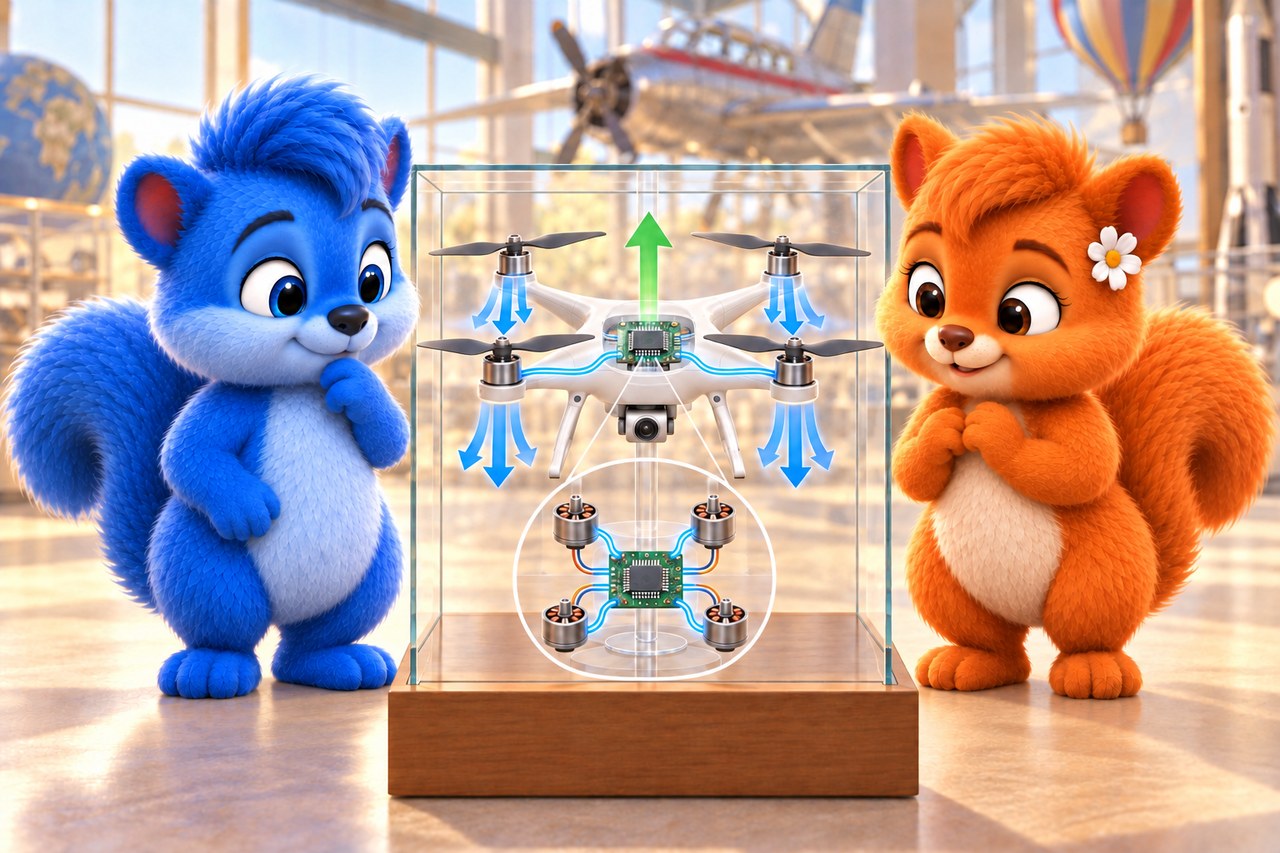
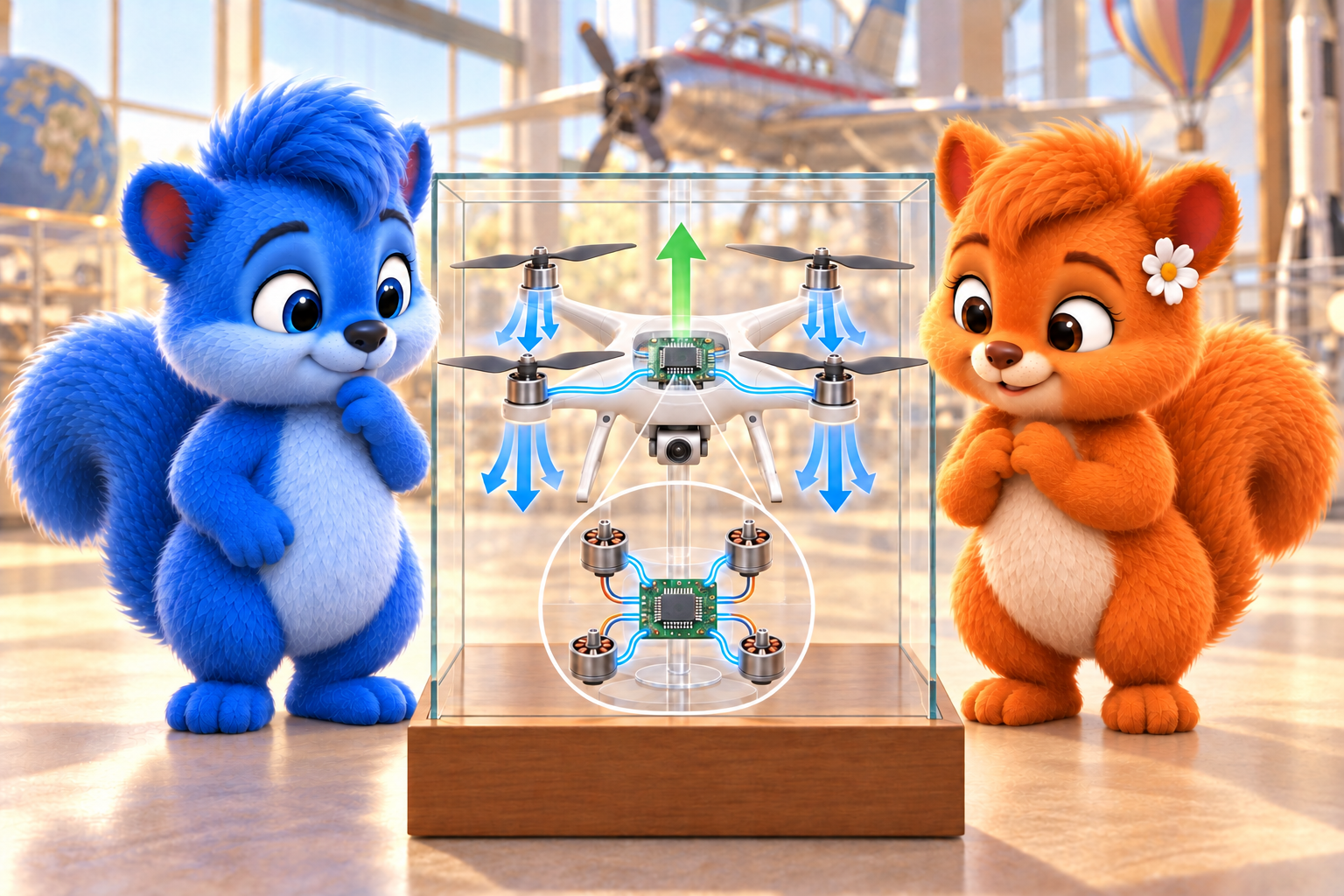
Puschel and Flauschi in the museum. Drone model with downward airflow and connections between control and motors. Simplified inanimate museum model; arrows and colours help explain it. AI-created illustration, not a photograph of nature.
Explained in three pictures
1 Rotors move air
Spinning rotors push air downwards.
2 Air provides support
Air exerts an upward force that supports the drone.
3 Control without a seat
A computer and sensors control motors. A person need not fly aboard.
More about the picture
Rotors and air explain how a drone is supported. A person need not sit on board: commands and measurements are processed by the onboard computer, which adjusts motor commands. This drawing is not a flight program and promises no automatic obstacle detection.
An imagined Wusel scene
Puschel and Flauschi investigate
At the drone model, Puschel draws an upward arrow above each propeller. Flauschi asks about the air beneath it. He adds the downward-moving air. They then compare rotor speeds during tilting: not all need to turn equally fast.
Look closely
Compare the museum model with the three picture steps. Air exerts an upward force that supports the drone.
An example to help you understand
Draw three boxes: command, onboard computer, motors. Connect them with arrows. Add a sensors box below the computer, with an arrow pointing toward it. Now try a thinking game without a device: the command is “stay here”, but a sensor reports a changed attitude, or tilt. The program must use the reading to calculate suitable motor commands. Your drawing shows information flow, not electrical wires or a complete flight program. It does not mean every drone can detect every obstacle.
Try explaining it
What produces an upward force in a multirotor drone?
Choose a), b) or c), then explain your choice.
- a)Propellers move air downwards.
- b)Propellers pull the body upward without moving air.
- c)Propellers push air upward to lift the body.
Show the explanation
Correct: a): Propellers move air downwards.
On a multirotor drone, motors turn propellers. They move air downwards, producing an upward force. Different rotor speeds help it tilt and steer. Sensors and controls help keep it stable.
Word help
- rotor
- A part of a machine that rotates.
- sensor
- A device part that measures something, such as light or distance.
Explore in more detail
Here you will find longer explanations and further details. You can explore them together.
1. Drones come in different shapes
Drones are uncrewed aircraft: their pilot is not aboard. Some resemble small airplanes; others have several rotors. Here a rotor is a rotating arrangement of blades. Our model has four; this design is a quadcopter. The name refers to four rotors, not four people or cameras. Not every drone looks like this. Professionals can use drones, for example, for overview images during rescue exercises.
2. Rotating blades move air
Rotor blades are small wings. Air flows around them as they rotate. They deflect air downward, while air exerts force on the rotors. A force is a push or pull. Level means parallel to imagined flat ground. In still, level hovering, the upward force balances weight, which pulls the aircraft toward Earth. It does not need to move forward along a runway first, as an airplane does.
3. Motors and sensors make adjustments
Many small drones use rechargeable batteries for electrical energy. Electric motors turn their rotors. A sensor is a measuring device that can detect, for example, how the aircraft is tilted. The onboard computer, inside the aircraft, processes these readings and adjusts individual motor speeds. Tilting a quadcopter can give its rotor force a sideways component, allowing forward or sideways movement.
4. Radio commands and automatic tasks
Radio carries commands from a controller to the aircraft. Radio waves carry information without wires. Like visible light, they are electromagnetic waves, but our eyes cannot see radio waves. An antenna on the aircraft receives the signals. Suitable drones can also follow planned waypoints, fixed locations along a route. Automatic means a program carries out steps using instructions and measurements. It is not human understanding. Functions and limits vary; wind, obstacles or missing sensor data can cause problems.
An optional question for further exploration
You can use the longer explanation above. This is extra, not needed for the first quiz.
An extra question
Why does the onboard computer need readings as well as commands?
Discover the answer
The onboard computer also needs suitable readings, such as the aircraft’s attitude or tilt, to adjust motor commands. A planned task does not guarantee safety from wind, sensor problems or obstacles.
Pictures and sources for adults
Sources for further reading
Facts checked against the specialist sources below on 12 October 2026. The Wusel scene is fictional; comparisons and simplified models are explicitly explained. Sources are in German and English.