Drawing comics: what happens between pictures?
Three pictures can tell a small story. A clear sequence and suitable clues help readers follow it.
The short answer
A comic tells a story through a sequence of pictures. Characters, speech balloons and framing provide clues. Readers imagine movement and events between the pictures. A clear order helps.
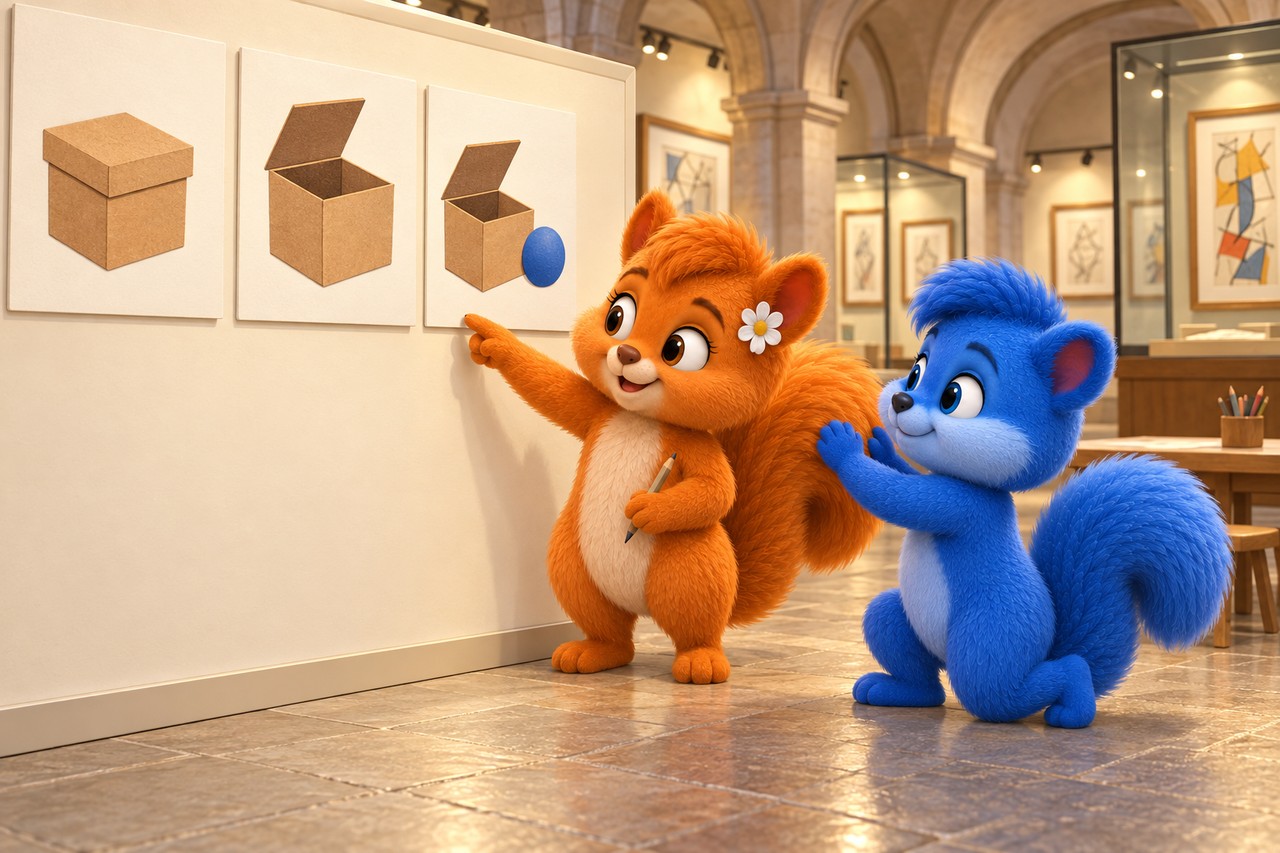
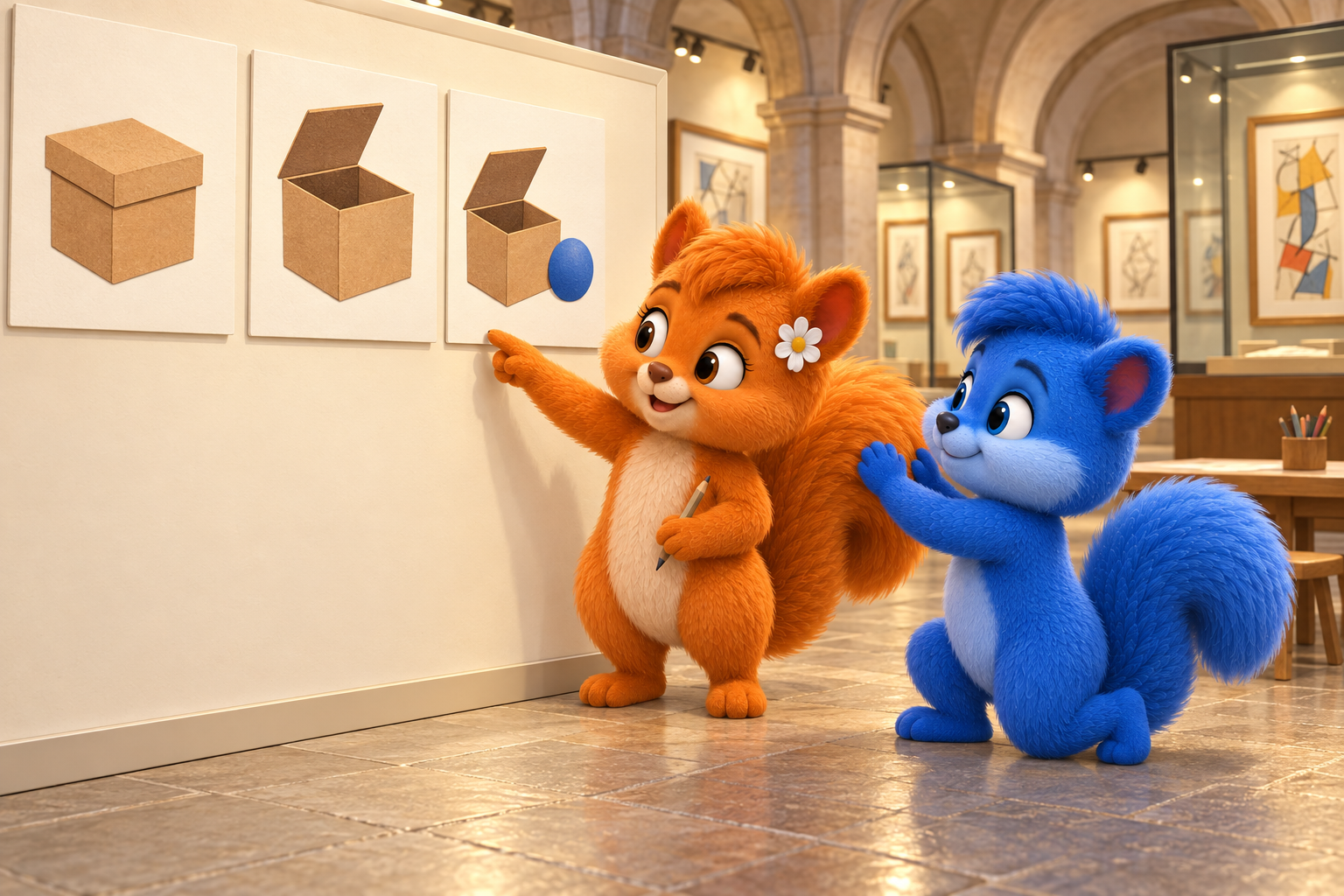
Flauschi examines three picture cards on an interactive museum wall; Puschel kneels on the right to examine the sequence. Original three-panel strip with box and ball. The scene shows a permitted interactive museum wall. AI-created illustration, not a photograph of nature.
What the diagram shows
The diagram simplifies the process. First compare its shapes and arrows. You can read its labels in larger text below.
Read the picture labels
These are the words and sentences from the diagram above. The full explanation follows below.
- Our three-panel strip: left to right
- Box closed
- Lid opened
- Ball taken out
- Between pictures, readers infer a sequence of events.
- Taking the ball out is not drawn separately here.
- Check: is your original story understandable?
- Original picture sequence; selected moments, no copied comic page.
An imagined Wusel scene
Puschel and Flauschi investigate
Between two panels, Puschel has made the ball disappear without explanation. Flauschi cannot follow the action. He adds a clear throwing clue and reorders the pictures. Now she can explain what happened between them.
Look closely
At an interactive museum wall the Wusels arrange three original picture cards. Flauschi points towards the final card with the open box and ball; Puschel kneels on the right and examines the sequence. All pictures stay in the approved exhibition area.
An example to help you understand
Our original three-panel strip: the first picture shows a closed box. In the second its lid opens. The third shows a ball beside the open box. Readers infer that the ball was taken out; that movement is not drawn separately. Invent a character and a short speech bubble. Try a different order and compare what remains understandable.
Try explaining it
What do readers often imagine between comic panels?
Choose a), b) or c), then explain your choice.
- a)That every panel must show exactly the same instant.
- b)Movements or events.
- c)Actual sounds stored in the printed paper.
Show the explanation
Correct: b): Movements or events.
A comic tells a story through a sequence of pictures. Characters, speech balloons and framing provide clues. Readers imagine movement and events between the pictures. A clear order helps.
Explore in more detail
Here you will find longer explanations and further details. You can explore them together.
1. Plan a small story
First consider who wants something and what happens next. An imaginary character’s qualities can help plan their behaviour. A short story can have a beginning, an event and an ending. Our box example is original; it is no compulsory rule for comics.
Checked against: [1]
2. Distinguish panels and gaps
A panel is an individual picture frame. The space between panels is often called a gutter. Readers infer how one shown moment leads to the next. Not every small movement needs a separate picture. For our three-panel strip, we specify reading from left to right.
Checked against: [2]
3. Use words appropriately
A speech bubble can show what a character says; its tail points towards the speaker. A caption box may contain narration. Pictures, gestures and symbols carry information too. Some panels need no words. Leave enough space for readable words in your own draft.
Checked against: [2]
4. Check before and after
A single picture often shows just part of a larger story. Ask what might have happened before and afterwards. A drawing activity at Krannert Art Museum invites learners to invent more pictures around a scene. Show someone your own draft and listen to how they understand its sequence.
Checked against: [3]
An optional question for further exploration
You can use the longer explanation above. This is extra, not needed for the first quiz.
An extra question
Must comics show every movement in a separate picture?
Discover the answer
No. Pictures can show selected moments. Readers use clues to infer what happens between them. The sequence needs enough understandable clues; a gap does not explain itself automatically.
Pictures and sources for adults
Sources for further reading
Facts checked against the specialist sources below on 12 October 2026. The Wusel scene is fictional; comparisons and simplified models are explicitly explained. Sources are in English.