Garden and orchard · Pyrus communis
Discovering pear
A round belly and a narrow neck: the pear gives Puschel a funny idea. Can you spot its special shape?
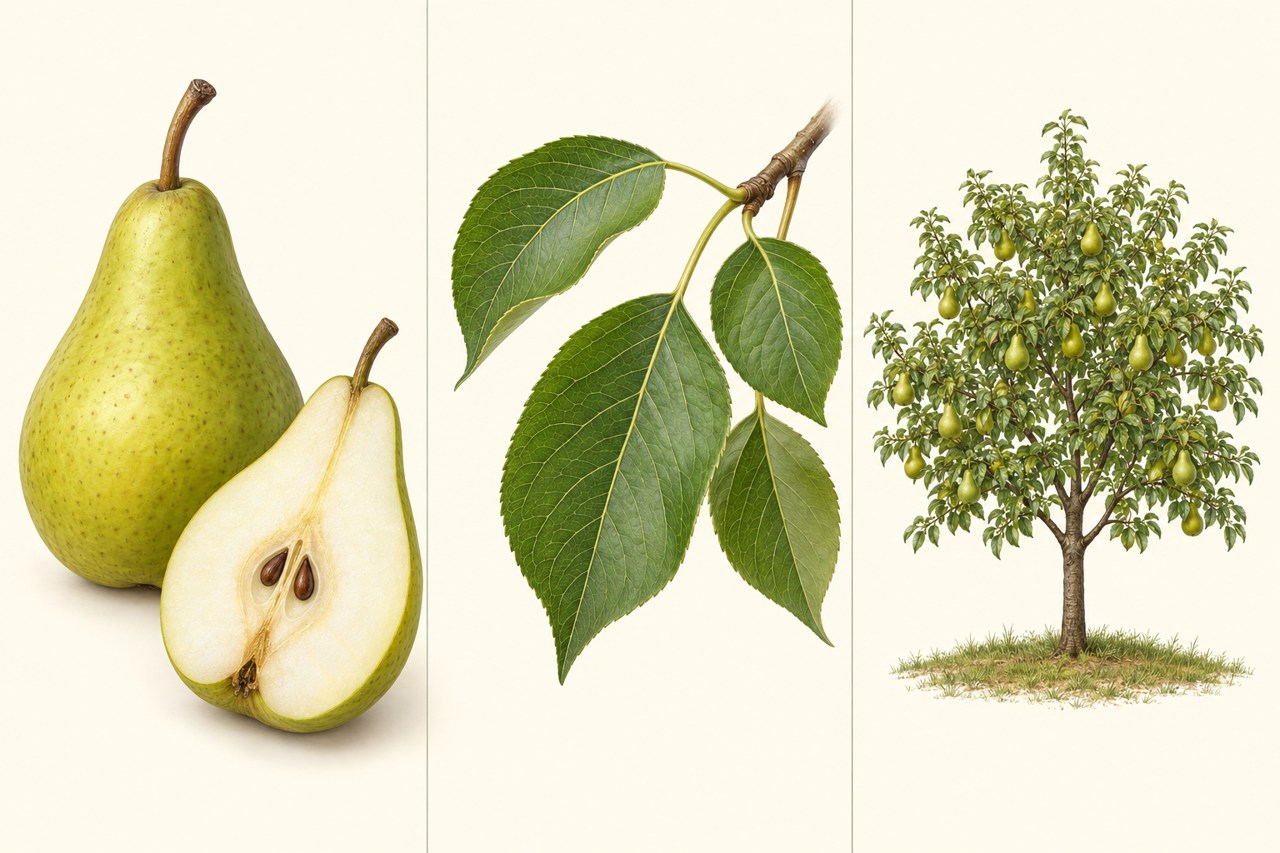
The short answer
Many pears are narrow near the stalk and wider below. Some varieties are rounder. Pears grow on trees. Their leaves are usually oval, often with fine teeth along the edge.
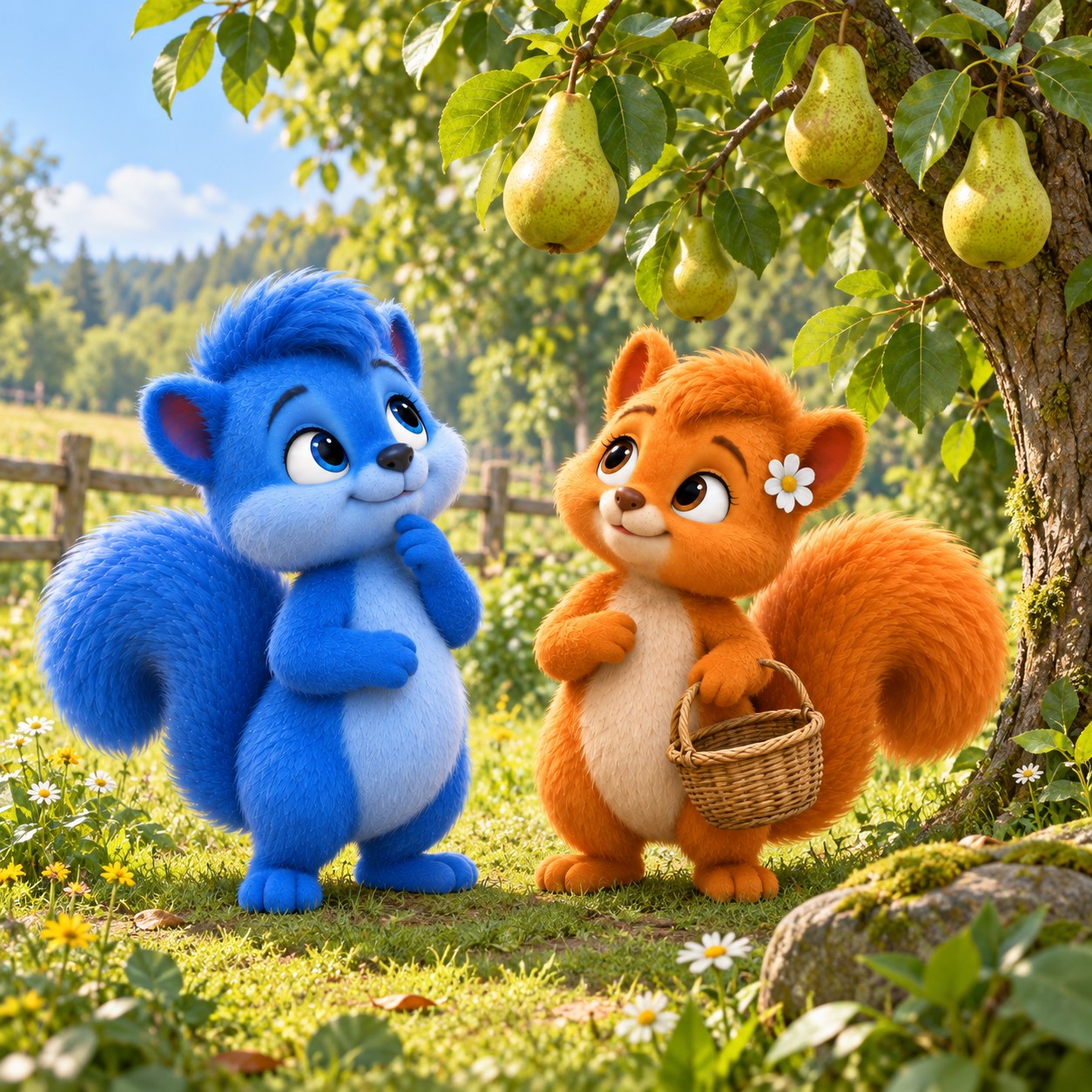
An imagined Wusel scene
Puschel and Flauschi investigate
Puschel tilts his head. Puschel“This fruit has a round tummy. A bit like mine after breakfast!”
Flauschi holds an empty basket. Flauschi“It is a pear. See how it narrows at the top? Not every pear looks exactly the same.”
Puschel counts three fruits with his eyes. Puschel“Before making our pear cooler, we ask which ones we may harvest.”
The fruit
Many pears are narrow near the stalk and wider below. Some varieties are rounder.
Leaf and plant
Pears grow on trees. Their leaves are usually oval, often with fine teeth along the edge.
What makes it special
Like apples, pears have a central core containing several small seeds.
Try explaining it
Must all pears be narrow at the top?
Choose a), b) or c), then explain your choice.
- a)Yes, every pear has the same shape.
- b)Yes, round fruit cannot be a pear.
- c)No, some varieties are rounder.
Show the explanation
Correct: c): No, some varieties are rounder.
Many pears are narrow near the stalk and wider below. Some varieties are rounder. Pears grow on trees. Their leaves are usually oval, often with fine teeth along the edge.
Word help
- cell
- A tiny living unit. Living things are made of cells.
- pollen
- Fine powder from flowers. Pollination carries it to a suitable flower’s receiving surface. It is not a plant seed.
- pollination
- Pollen reaches a flower’s receiving surface, the stigma. Further processes can then lead to seeds.
- stigma
- The part of a flower where pollen can land.
- fertilisation
- A male reproductive cell joins an egg cell. This is a different step from moving pollen.
- core
- Here, the central part of an apple or pear that holds the seeds.
Explore in more detail
Here you will find longer explanations and further details. You can explore them together.
Why is a pear not just an apple of another shape?
Pears and apples are both pome fruits, with a core that can contain several seeds. Nevertheless, they are different plants. Some pear varieties are nearly round, so a narrow upper half is not a feature every pear must have. Pollination transfers pollen to a flower’s stigma. Fertilisation joins a male reproductive cell with an egg cell. Reproductive cells are special cells involved in producing offspring.
Compare and understand
Compare known fruits cut by an adult: where are seeds, core and flesh? Fruits develop after the flowers. Many pear varieties crop better with pollen from another compatible pear flowering at the same time. Two trees alone are not enough if their flowering times do not overlap.
Sources for this explanation
An optional question for further exploration
You can use the longer explanation above. This is extra, not needed for the first quiz.
An extra question
What connects a pear with an apple, even if its shape looks different?
Show answer
Both have a core inside containing several small seeds.
May we taste unknown berries based on a picture?
Show answer
No. Never taste unknown berries. Adults help identify known edible fruit safely.