Garden and orchard · Prunus avium (Süßkirsche)
Discovering cherry
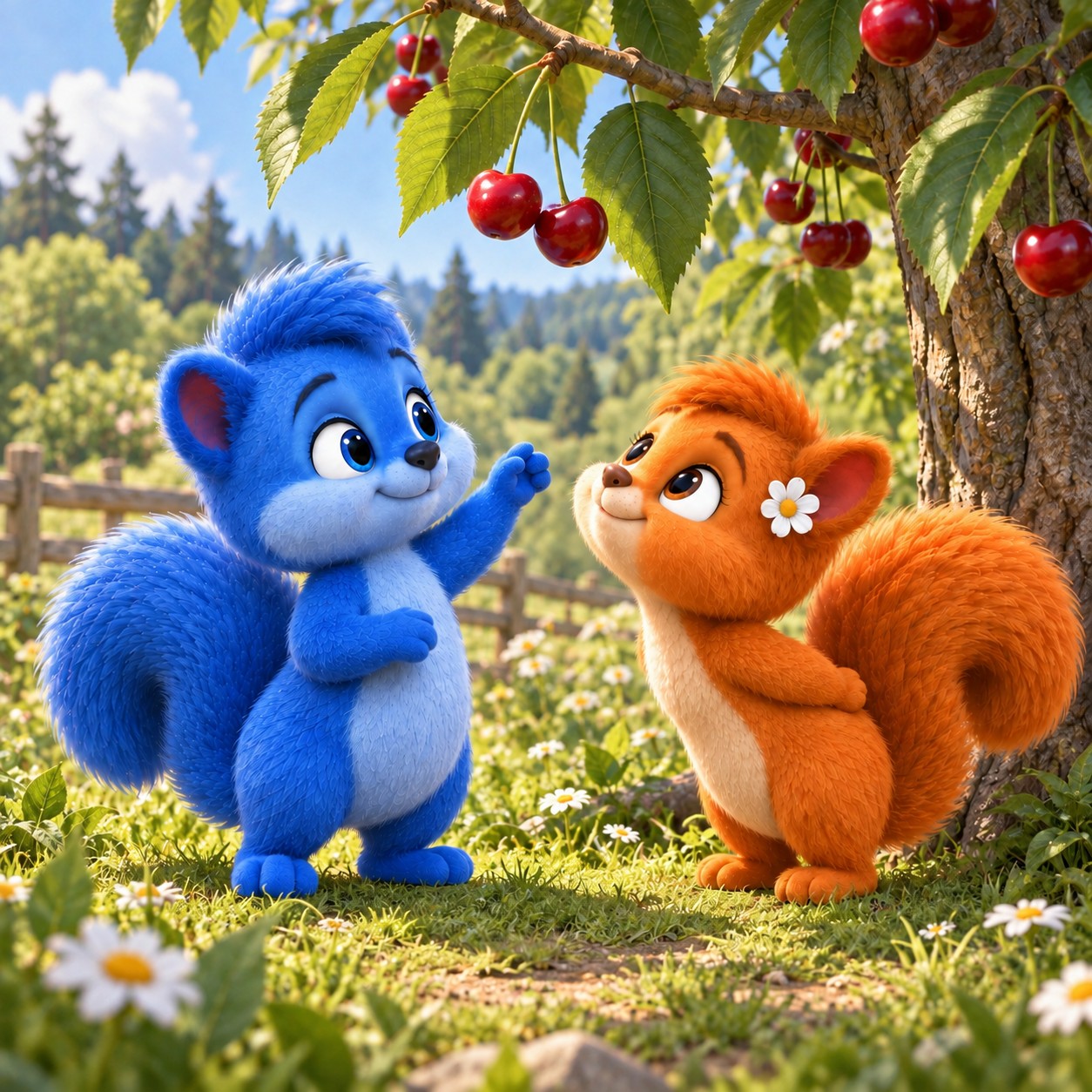
Two cherries on a branch look like a pair of friends to Puschel. Together, the Wusels explore fruit, leaf and stone.
The short answer
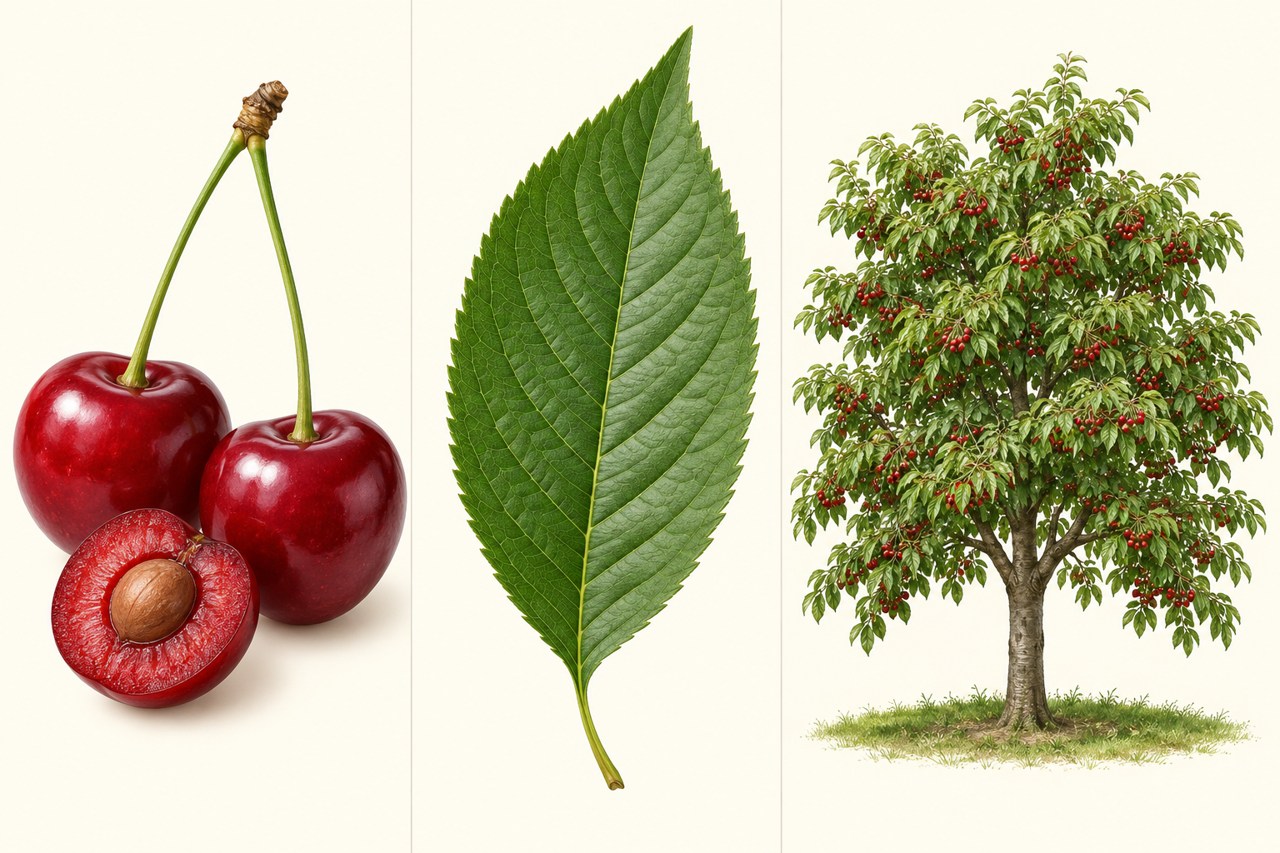
Sweet cherries are rounded fruits on slender stalks. Depending on the variety, colours range from yellowish to dark red. The elongated pointed leaves have toothed edges. Cherry trees blossom in spring.
See the connection
Simplified drawings, not to scale. Not a guide for identifying species.
An imagined Wusel scene
Puschel and Flauschi investigate
Puschel spots two cherries together. Puschel“They are travelling as a pair, just like us!”
Flauschi leans forward to study the stalks. Flauschi“Several may grow close together. Look at the toothed leaves too.”
Puschel raises a paw in surprise. Puschel“Small fruits, big discovery!” They leave them on the tree and ask about harvesting later.
The fruit
Sweet cherries are rounded fruits on slender stalks. Depending on the variety, colours range from yellowish to dark red.
Leaf and plant
The elongated pointed leaves have toothed edges. Cherry trees blossom in spring.
What makes it special
Each cherry contains a hard stone enclosing a seed. Our cultivated sweet cherry varieties are forms of wild cherry and belong to the same species, Prunus avium.
Try explaining it
Are ripe sweet cherries always the same dark red?
Choose a), b) or c), then explain your choice.
- a)Yes, yellowish fruit is always unripe.
- b)No, colour also depends on variety.
- c)Yes, every variety has the same colour.
Show the explanation
Correct: b): No, colour also depends on variety.
Sweet cherries are rounded fruits on slender stalks. Depending on the variety, colours range from yellowish to dark red. The elongated pointed leaves have toothed edges. Cherry trees blossom in spring.
Word help
- cell
- A tiny living unit. Living things are made of cells.
- toothed
- The edge has little points like tiny teeth. A leaf has no real teeth.
- pollen
- Fine powder from flowers. Pollination carries it to a suitable flower’s receiving surface. It is not a plant seed.
- pollination
- Pollen reaches a flower’s receiving surface, the stigma. Further processes can then lead to seeds.
- stigma
- The part of a flower where pollen can land.
- fertilisation
- A male reproductive cell joins an egg cell. This is a different step from moving pollen.
Explore in more detail
Here you will find longer explanations and further details. You can explore them together.
What happens to a cherry blossom?
A flower has an ovary, the part that can develop into a fruit. After suitable pollination and fertilisation, it grows into a cherry. A seed develops inside a hard protective stone. The white petals usually fall away instead of becoming the red skin. Pollination transfers pollen to a flower’s stigma. Fertilisation joins a male reproductive cell with an egg cell. Reproductive cells are special cells involved in producing offspring.
Compare and understand
Flower, unripe fruit and ripe cherry are different moments. Not every blossom becomes a cherry: frost or a lack of suitable pollination can prevent development. Observe a known branch over several weeks. Adults select and pit fruit; stones must not be eaten or cracked open.
An optional question for further exploration
You can use the longer explanation above. This is extra, not needed for the first quiz.
An extra question
Is the hard cherry stone itself the seed?
Show answer
No. The hard stone encloses the seed.
May we taste unknown berries based on a picture?
Show answer
No. Never taste unknown berries. Adults help identify known edible fruit safely.