Garden and orchard · Malus domestica
Discovering apple
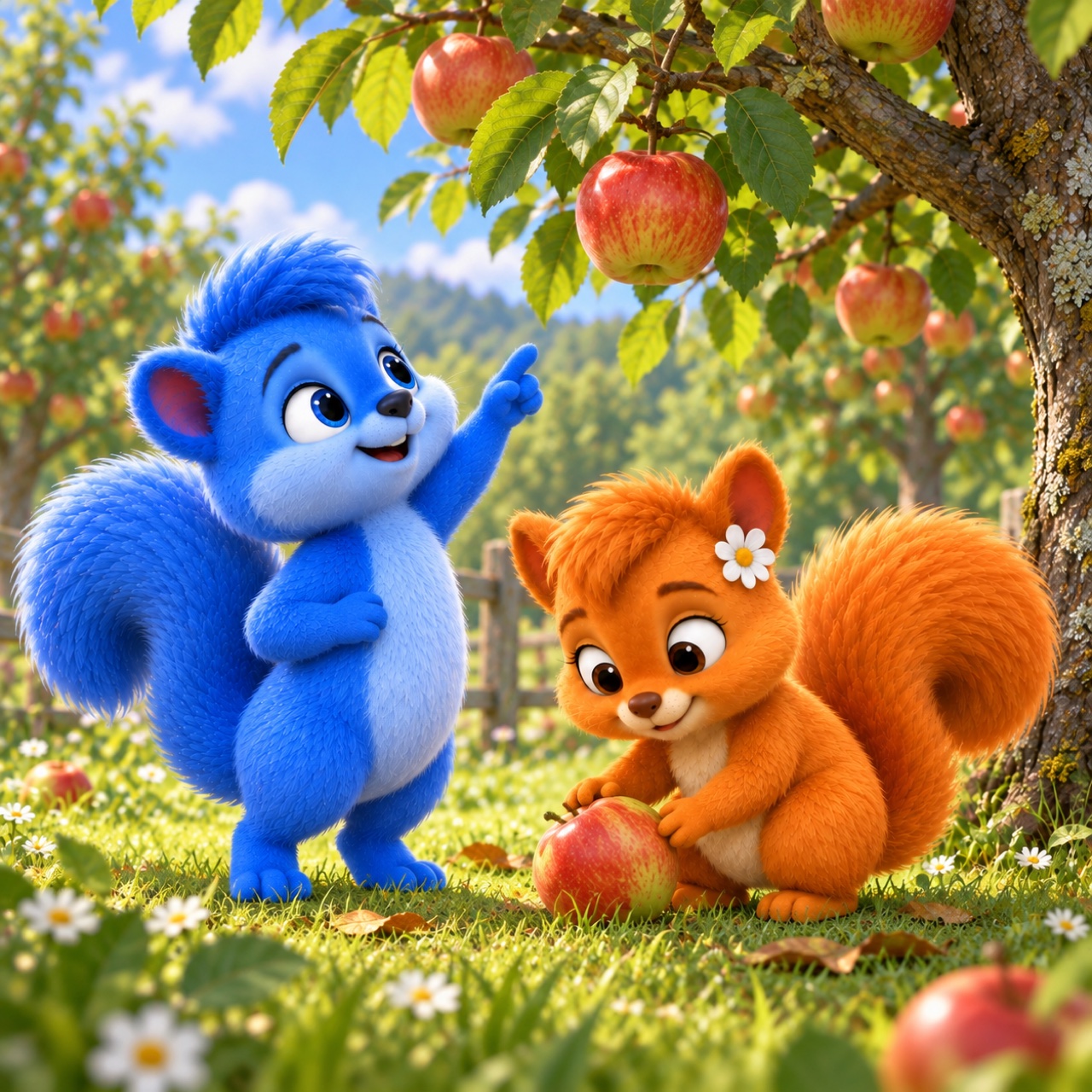
Red, green or yellow: Puschel marvels at the colourful fruit on the apple tree. Flauschi discovers what lies beneath the skin.
The short answer
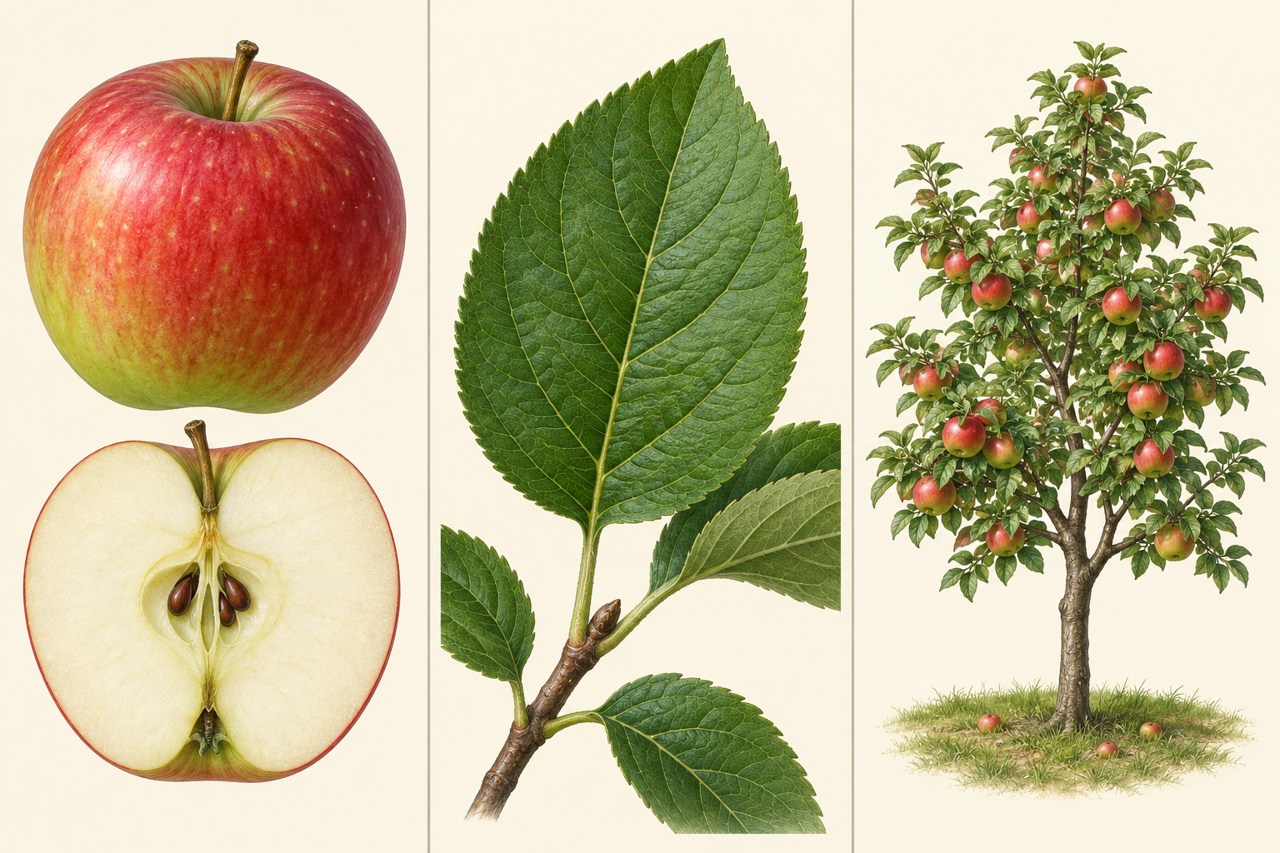
The round fruit may be red, yellow or green. Brown seeds sit inside a central core. Oval leaves have finely toothed edges. Apples grow on a tree.
An imagined Wusel scene
Puschel and Flauschi investigate
Puschel looks up at the apple tree. Puschel“Red and green balls! Does this tree have two favourite colours?”
Flauschi kneels beside a fallen apple. Flauschi“Apples can look very different. Colour alone does not tell us whether they are ripe.”
Puschel keeps his paws behind his back. Puschel“First we look and ask an adult. Maybe we can make apple splash later!”
The fruit
The round fruit may be red, yellow or green. Brown seeds sit inside a central core.
Leaf and plant
Oval leaves have finely toothed edges. Apples grow on a tree.
What makes it special
Fruit develops from spring flowers. Different varieties ripen at different times.
Try explaining it
Where are an apple’s seeds?
Choose a), b) or c), then explain your choice.
- a)As many tiny fruits on the outside as in a strawberry.
- b)Inside a central core.
- c)Inside one large stone as in a cherry.
Show the explanation
Correct: b): Inside a central core.
The round fruit may be red, yellow or green. Brown seeds sit inside a central core. Oval leaves have finely toothed edges. Apples grow on a tree.
Word help
- cell
- A tiny living unit. Living things are made of cells.
- toothed
- The edge has little points like tiny teeth. A leaf has no real teeth.
- pollen
- Fine powder from flowers. Pollination carries it to a suitable flower’s receiving surface. It is not a plant seed.
- pollination
- Pollen reaches a flower’s receiving surface, the stigma. Further processes can then lead to seeds.
- stigma
- The part of a flower where pollen can land.
- fertilisation
- A male reproductive cell joins an egg cell. This is a different step from moving pollen.
- core
- Here, the central part of an apple or pear that holds the seeds.
Explore in more detail
Here you will find longer explanations and further details. You can explore them together.
Will every apple seed grow the same variety?
An apple pip is a seed containing a tiny young plant. Seeds can develop after pollination and fertilisation. Inherited information influencing how a plant develops is mixed in this process. A tree grown from a pip therefore need not produce exactly the same apples as its parent. Pollination transfers pollen to a flower’s stigma. Fertilisation joins a male reproductive cell with an egg cell. Reproductive cells are special cells involved in producing offspring.
Compare and understand
To preserve a particular variety, nurseries often join a shoot from it to a suitable rooted plant. This is grafting, a job for skilled people. Examine an apple cut by an adult: the core and the flesh both belong to it but have different roles.
Sources for this explanation
An optional question for further exploration
You can use the longer explanation above. This is extra, not needed for the first quiz.
An extra question
Where are an apple’s seeds?
Show answer
In the core in the middle.
May we taste unknown berries based on a picture?
Show answer
No. Never taste unknown berries. Adults help identify known edible fruit safely.