Fungi to observe · Agaricus sylvaticus
Discover the woodland mushroom
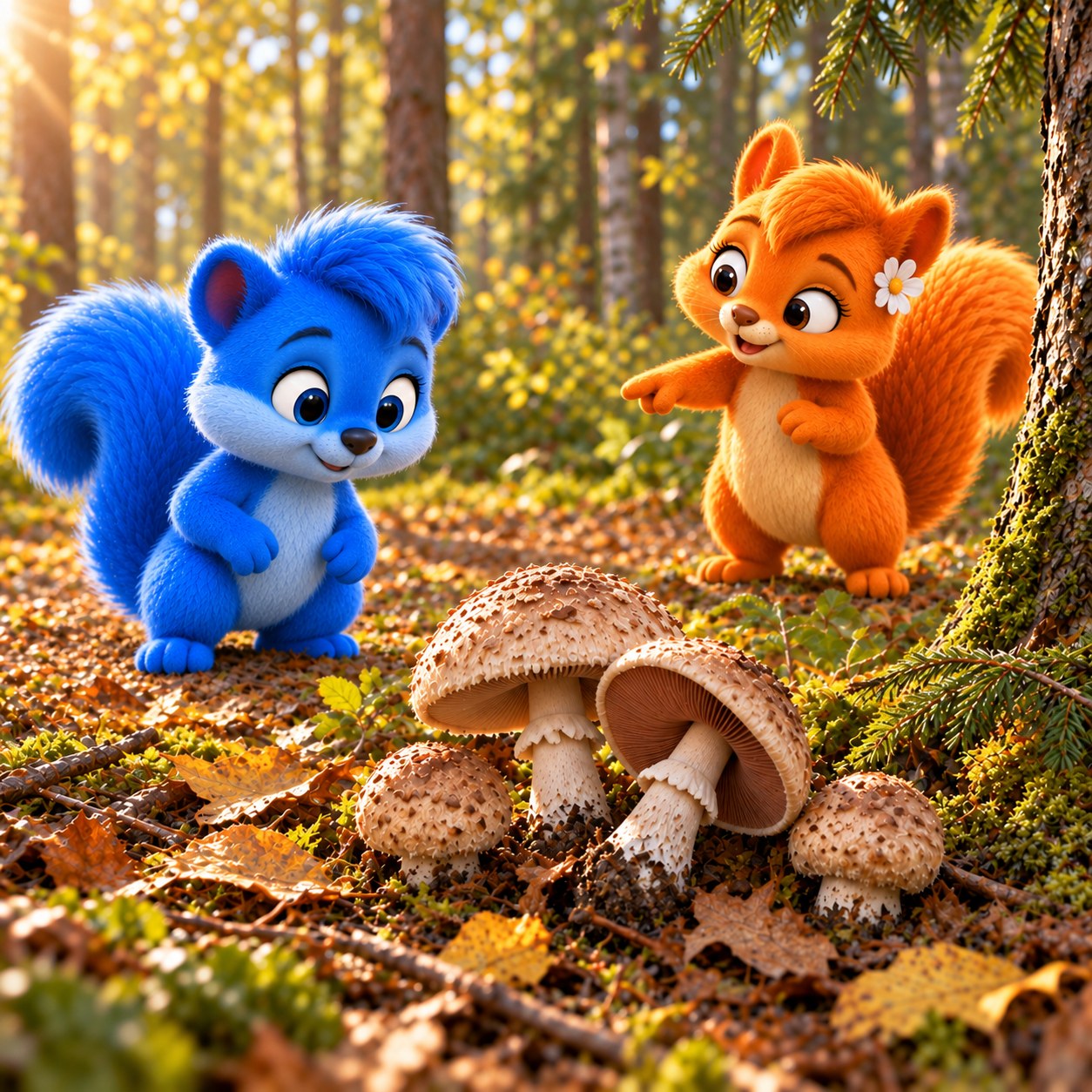
This brown cap has little scales! Flauschi shows Puschel the wood mushroom. Its name is no invitation to eat it: we leave all fungi growing.
The short answer
Brown scales may cover a wood mushroom's cap. Thin blade-like gills underneath darken with age. Similar and poisonous fungi can be confused. The illustration is not an eating guide.
See the connection
Simplified drawings, not to scale. Not a guide for identifying species.
An imagined Wusel scene
Puschel and Flauschi investigate
Puschel“A mushroom in the middle of the woods?” Puschel wonders, shading his eyes with a paw. Flauschi points out the brown scales on the caps. They watch from the path and leave every fungus in the leaf litter.
Fungus facts
Three things to notice
Shape
Some mushroom species grow in woodland. The woodland mushroom often has brown scales on its cap.
How it lives
Gills sit beneath the cap; in mushrooms they can darken as they mature.
In the forest
The woodland mushroom is a different species from the usual cultivated button mushroom. A picture can never identify a wild fungus safely.
Try explaining it
What are gills beneath a mushroom cap?
Choose a), b) or c), then explain your choice.
- a)Thick irregular ridges as in a chanterelle.
- b)Thin blade-like surfaces.
- c)Many small pore openings as in boletes.
Show the explanation
Correct: b): Thin blade-like surfaces.
Gills are thin surfaces under the cap where spores form. Their appearance cannot prove edibility.
Word help
- gills
- Thin blade-like surfaces under some mushroom caps; fish gills have a different role in breathing.
- mycelium
- A network of fine fungal threads, often hidden in soil or wood.
- gill
- A thin blade-like surface beneath some fungal caps. Spores can form on it.
Explore in more detail
Here you will find longer explanations and further details. You can explore them together.
Why is a woodland mushroom not a shop label?
The woodland mushroom is a different species from the usual cultivated button mushroom. A species is a particular group of organisms, not simply a similar shape. Its gills change colour as it matures, so young and old fruiting bodies may look different.
Compare and understand
Its threads use dead organic material in soil. Organic here means coming from organisms, such as old leaves. This decomposition helps recycle materials. Sharing a name with a shop mushroom does not make a found fungus safe to eat. Leave real fungi untouched during this activity.
An optional question for further exploration
You can use the longer explanation above. This is extra, not needed for the first quiz.
Mini quiz
An extra question
Can this picture safely identify a wild mushroom?
Show answer
No. A picture cannot show everything needed, so we leave wild fungi untouched.