Fungi to observe · Coprinus comatus
Discover the shaggy ink cap
First a white shaggy cap, later a black edge: the shaggy inkcap changes. The Wusels discover its unusual transformation.
The short answer
Young shaggy inkcaps have elongated white caps with raised scales. As they age they darken and may dissolve. Compare age too: the same fungus does not always look alike.
An imagined Wusel scene
Puschel and Flauschi investigate
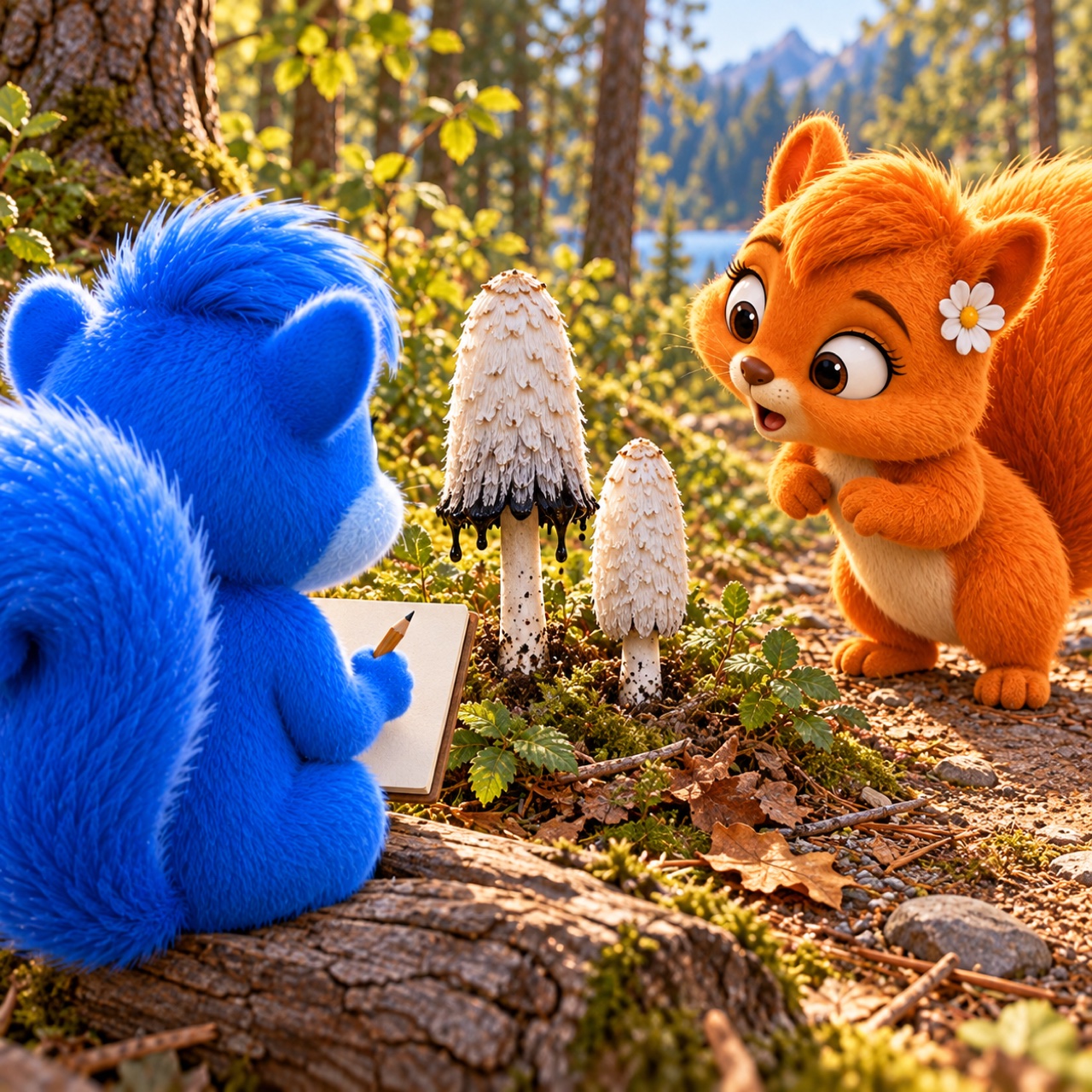
Puschel sits on a dry log with his sketchbook. Two pale, shaggy fungi stand in front of him. Flauschi spots a dark rim on the older cap. Puschel“It is changing!” Puschel says, continuing his sketch from a safe distance.
Fungus facts
Three things to notice
Shape
Young shaggy ink caps have long white caps with projecting scales.
How it lives
As they age, the cap and gills darken and eventually dissolve into dark liquid.
In the forest
Shaggy ink caps grow in nutrient-rich soil, including path edges.
Try explaining it
Why do young and old shaggy inkcaps look different?
Choose a), b) or c), then explain your choice.
- a)The cap stays white; only the ground becomes dark.
- b)The dark cap is a different fungus, not an ageing stage.
- c)As they age, the cap darkens and may dissolve.
Show the explanation
Correct: c): As they age, the cap darkens and may dissolve.
The cap and gills change with age. One picture cannot show every stage.
Word help
- gills
- Thin blade-like surfaces under some mushroom caps; fish gills have a different role in breathing.
- spore
- A tiny unit that helps fungi or ferns spread. In suitable conditions it can start further development. It is not a seed.
- mycelium
- A network of fine fungal threads, often hidden in soil or wood.
- fruiting body
- The spore-producing part of a fungus. A cap and stalk are one example, not the whole fungus.
- gill
- A thin blade-like surface beneath some fungal caps. Spores can form on it.
Explore in more detail
Here you will find longer explanations and further details. You can explore them together.
Why does the cap turn into black liquid?
As a shaggy inkcap ages, parts of its cap and gills dissolve. Gills are thin blade-like surfaces beneath the cap where spores form. The dark liquid belongs to this maturation and breakdown process. The fungus has not been painted and has no ink cartridge.
Compare and understand
A young white fruiting body can therefore look very different from an older black one of the same species. One picture shows only one moment. Compare photographs of different ages. Leave real fungi in place; do not make ink or food from them or touch the liquid for an experiment.
An optional question for further exploration
You can use the longer explanation above. This is extra, not needed for the first quiz.
Mini quiz
An extra question
What changes on an older cap?
Show answer
Its edge darkens and may dissolve.