Fungi to observe · Cantharellus cibarius
Discover the chanterelle
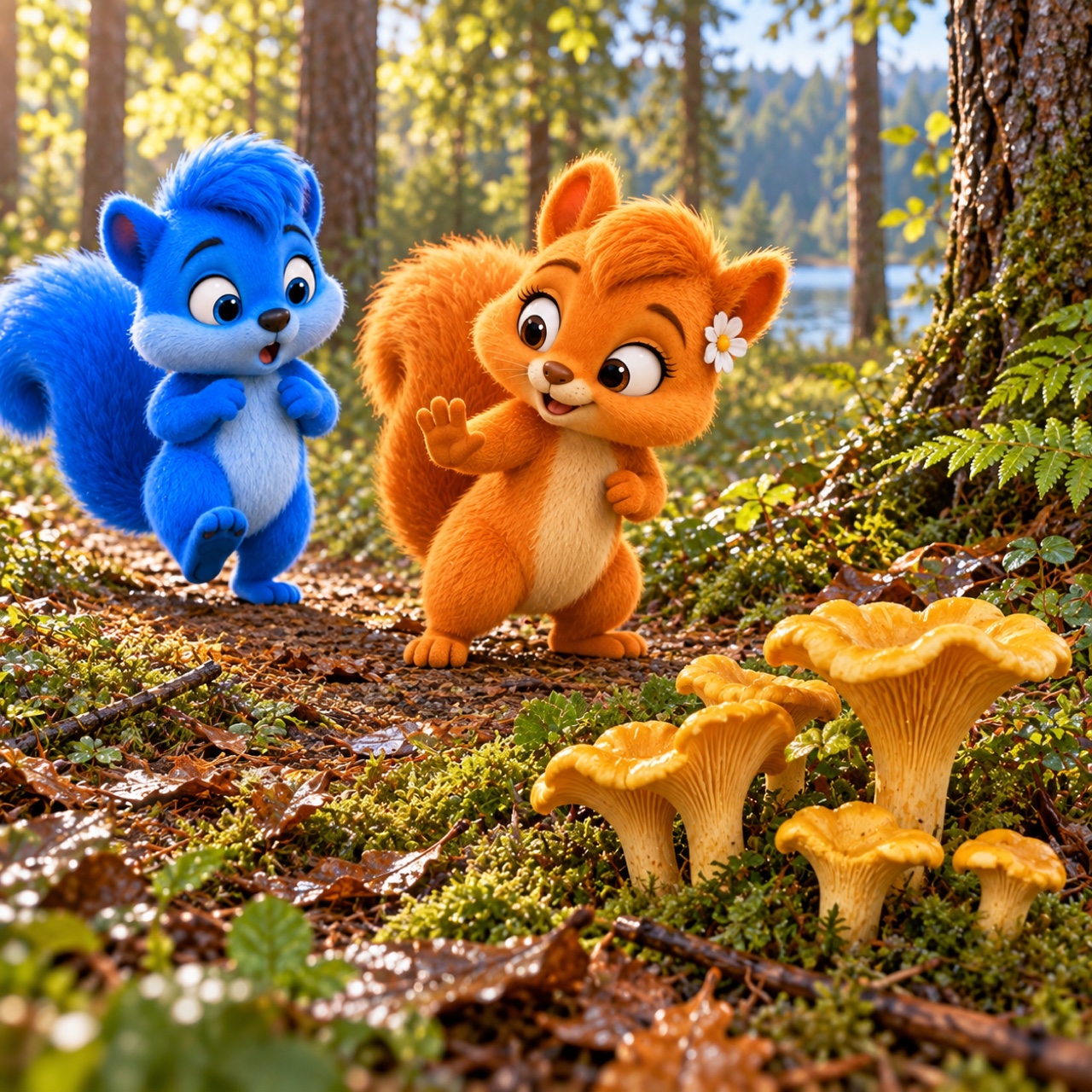
Yellow, wavy caps among moss and leaves: Puschel spots chanterelles. What does Flauschi see underneath? We look and leave them growing.
The short answer
Chanterelles may have yellow wavy caps. Blunt folds called ridges run down towards the stem underneath. Similar fungi complicate identification. A picture is not a safe collecting or eating guide.
See the connection
Simplified drawings, not to scale. Not a guide for identifying species.
An imagined Wusel scene
Puschel and Flauschi investigate
Puschel is about to take a big step between the leaves. Flauschi raises her paw. Flauschi“Look first!” Yellow fungi with wavy caps stand ahead. Puschel steps carefully around them, and both leave them untouched.
Fungus facts
Three things to notice
Shape
Chanterelles may have yellow, wavy, funnel-like caps.
How it lives
Blunt ridges run down from the underside towards the stem.
In the forest
They live in a close partnership with tree roots.
Try explaining it
What are the ridges beneath a chanterelle cap?
Choose a), b) or c), then explain your choice.
- a)Many small round pore openings as in a bolete.
- b)Long hanging teeth as in a tooth fungus.
- c)Thick folds running towards the stem.
Show the explanation
Correct: c): Thick folds running towards the stem.
Ridges look like thick folds on the underside. They are not thin gill blades.
Word help
- gills
- Thin blade-like surfaces under some mushroom caps; fish gills have a different role in breathing.
- spore
- A tiny unit that helps fungi or ferns spread. In suitable conditions it can start further development. It is not a seed.
- mycelium
- A network of fine fungal threads, often hidden in soil or wood.
- gill
- A thin blade-like surface beneath some fungal caps. Spores can form on it.
- ridge
- In this fungus description, a thick fold on the underside of the cap.
- mineral
- Here, a mineral nutrient such as potassium. Plants usually absorb these nutrients dissolved in water; they are not ready-made sugar.
- pollen
- Fine powder from flowers. Pollination carries it to a suitable flower’s receiving surface. It is not a plant seed.
Explore in more detail
Here you will find longer explanations and further details. You can explore them together.
How do ridges differ from gills?
Under a chanterelle cap, thick, often branching ridges run down towards the stalk. They look more like folds of the surface. Other fungi have thinner blade-like gills. Both can increase the surface where reproductive spores form. Spores are not flower pollen.
Compare and understand
That distinction alone cannot safely separate edible and poisonous fungi. Chanterelles associate with tree roots: fungal threads help with water and mineral uptake and receive sugar. Tree and fungus remain different organisms. A yellow cap alone cannot establish identity or edibility.
An optional question for further exploration
You can use the longer explanation above. This is extra, not needed for the first quiz.
Mini quiz
An extra question
What do chanterelles live in partnership with?
Show answer
Tree roots.