Fungi to observe · Imleria badia
Discover the bay bolete
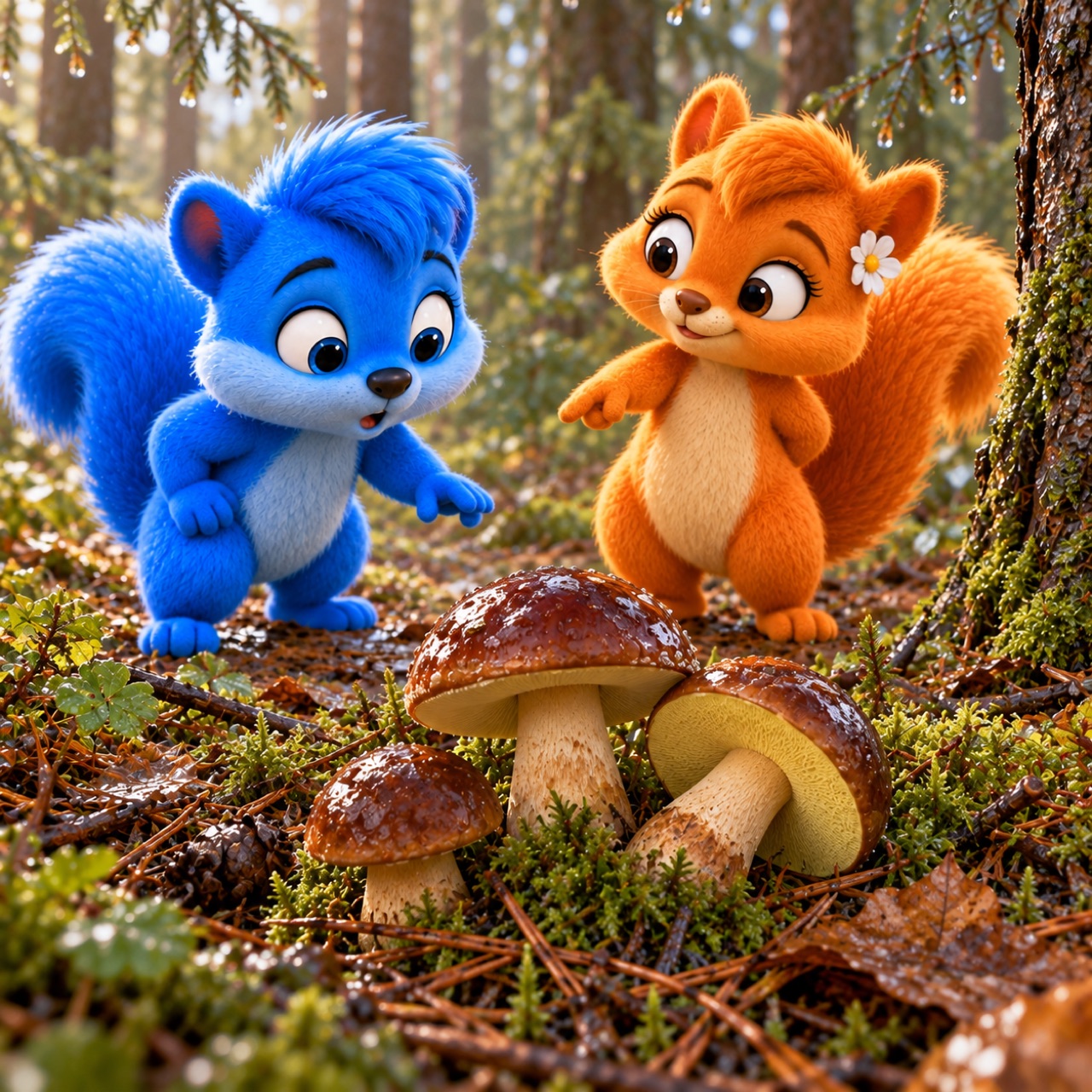
Chestnut-brown among the needles: Flauschi spots a bay bolete. Puschel learns about the little pores beneath its cap.
The short answer
Bay bolete has a chestnut-brown cap with many tiny tube openings underneath. Those clues alone do not ensure identification. We observe without deciding it is safe to eat.
See the connection
Simplified drawings, not to scale. Not a guide for identifying species.
An imagined Wusel scene
Puschel and Flauschi investigate
After the rain, Puschel spots three chestnut-brown fungi in the moss. Flauschi points out the yellowish underside of a slanting cap. Puschel“No gills,” Puschel notices. Then they carefully walk around the fungi.
Fungus facts
Three things to notice
Shape
A bay bolete has a chestnut-brown cap that may look shiny when wet.
How it lives
Fine tube openings under its cap look like a porous surface.
In the forest
It grows in woodland and lives in partnership with tree roots.
Try explaining it
Which underside fits a bay bolete?
Choose a), b) or c), then explain your choice.
- a)Thin gills arranged like book pages.
- b)Long hanging teeth like those of a lion's mane fungus.
- c)A surface with many tiny tube openings.
Show the explanation
Correct: c): A surface with many tiny tube openings.
Its cap has tiny tube openings underneath. The name describes colour, not a chestnut inside the fungus.
Word help
- spore
- A tiny unit that helps fungi or ferns spread. In suitable conditions it can start further development. It is not a seed.
- mycelium
- A network of fine fungal threads, often hidden in soil or wood.
- pore
- A tiny opening. In pore-bearing fungi, these openings lie underneath the fruiting body.
- mycorrhiza
- A partnership between particular fungi and plant roots. The partners can exchange water, nutrients and energy-rich substances.
Explore in more detail
Here you will find longer explanations and further details. You can explore them together.
What does this fungus share with a chestnut?
The name bay bolete describes its chestnut-brown cap. It is not a chestnut tree’s fruit and contains no chestnut. Tubes beneath the cap produce spores. Its threads form an association with tree roots called mycorrhiza, meaning fungus-root.
Compare and understand
Tree and fungus can exchange materials while remaining different organisms. Compare pictures of a penny bun and a bay bolete: both have pores, but they are different species. Similarities reveal shared features; they do not provide a safe identification or eating guide.
An optional question for further exploration
You can use the longer explanation above. This is extra, not needed for the first quiz.
Mini quiz
An extra question
What can you see beneath the cap?
Show answer
A porous surface made of many tiny tube openings.