Why does a paper airplane glide?
A folded sheet has no engine, yet it can travel through the air. How does its shape help?
The short answer
Your hand gives a paper plane motion energy at launch. During its glide, weight pulls down, drag resists motion and its wings generate lift. Shape and a steady launch help determine its flight.
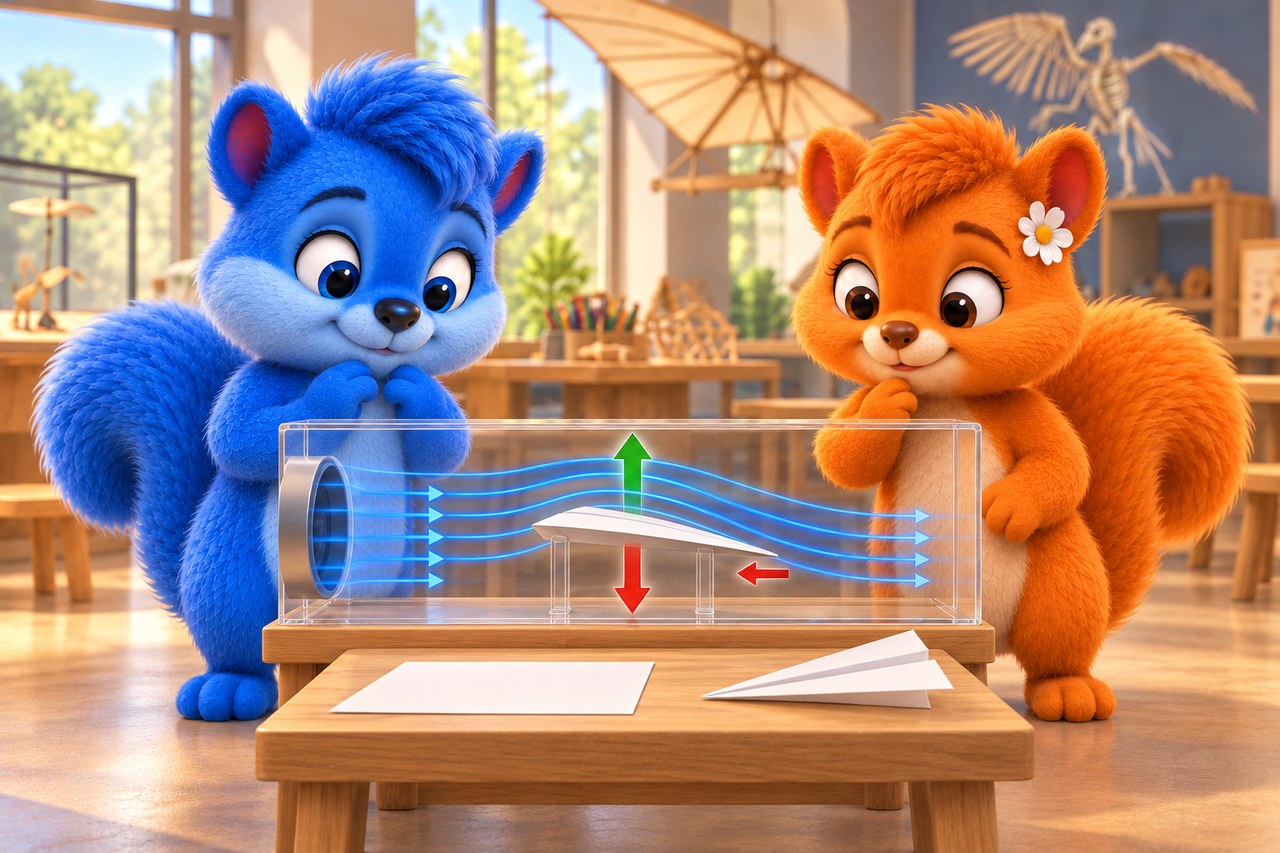
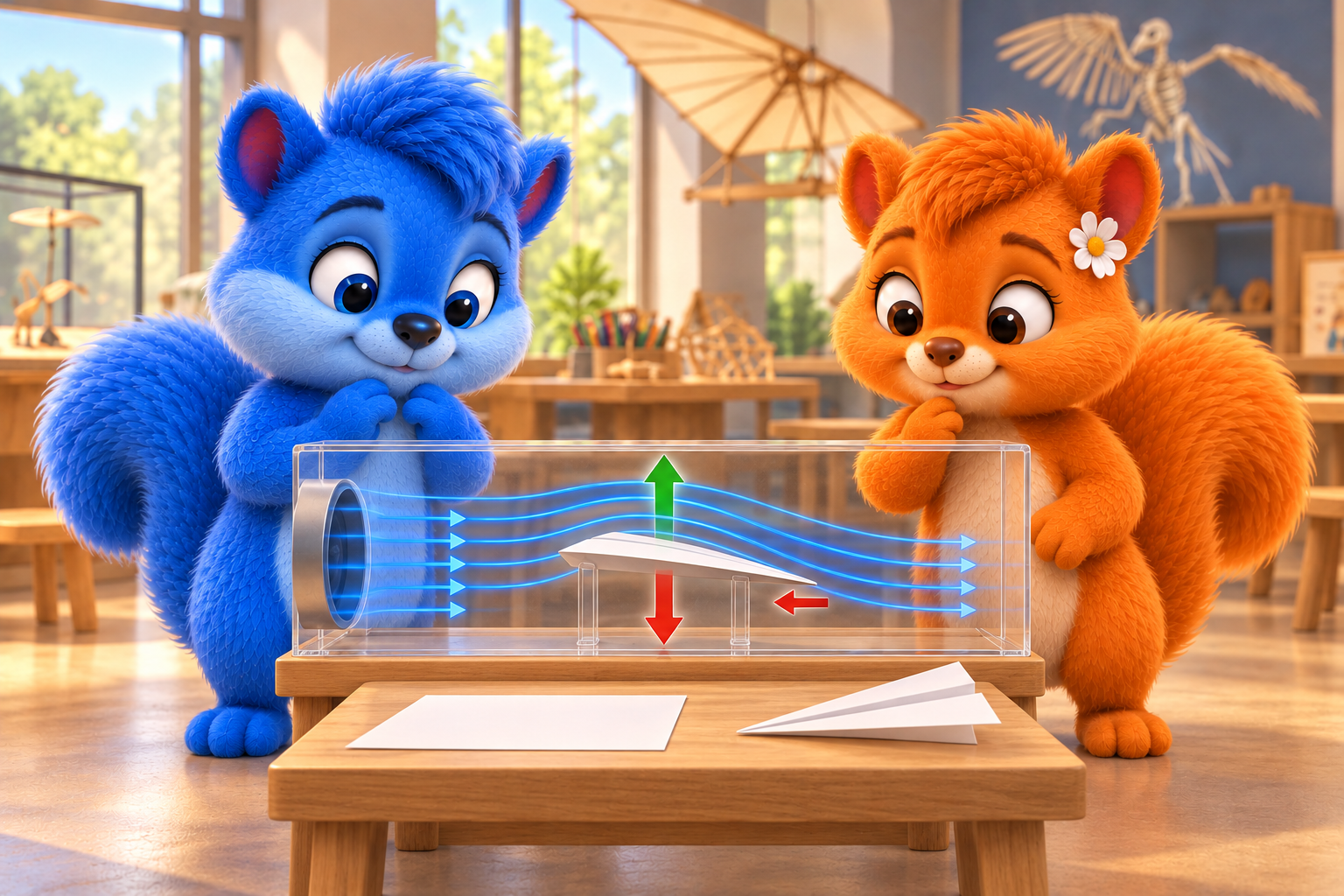
Puschel and Flauschi in the museum. Paper-plane model with airflow and arrows for lift, weight and drag. Simplified inanimate museum model; arrows and colours help explain it. AI-created illustration, not a photograph of nature.
Explained in three pictures
1 Air flows past a wing
The throw provides motion. The wings change the airflow.
2 Air is deflected
Overall, the wings deflect air downwards.
3 Force on the wing
Air partly supports it; weight pulls downwards, and air drag slows it.
More about the picture
A paper plane gains motion from the throw. Its wings deflect air, and air partly supports it. Without a motor it loses movement energy through drag and normally glides downwards. The arrows are not measurements or a guarantee for every folded design.
An imagined Wusel scene
Puschel and Flauschi investigate
Puschel changes both wings and nose on his paper model at once. Flauschi cannot tell what caused the difference. They return to the original shape and change only one thing. Now they can describe their gentle comparison flights meaningfully.
Look closely
Compare the museum model with the three picture steps. Overall, the wings deflect air downwards.
An example to help you understand
A simple folding start with adults: Place a rectangular sheet with its long side running away from you. Fold it lengthwise in half, then open it again. Fold both top corners to the center line. Fold both sloping outer edges to the center line again. Close along the first center fold, keeping earlier folds inside. Fold equally sized wings down on both sides; leave a narrow central section underneath for holding. Gently open the wings into two roughly equal sides. Try a gentle launch. Record three distances before a change and three afterward. Here, flight distance means the distance from launch to first contact with the ground. Our diagram numbers are invented: repeated comparison matters, rather than a record.
Try explaining it
Where does a paper plane first get motion energy at launch?
Choose a), b) or c), then explain your choice.
- a)From gravity pushing it forward at a horizontal launch.
- b)From your throwing hand.
- c)From lift providing the launch movement even before the throw.
Show the explanation
Correct: b): From your throwing hand.
Your hand gives a paper plane motion energy at launch. During its glide, weight pulls down, drag resists motion and its wings generate lift. Shape and a steady launch help determine its flight.
Word help
- lift
- An upward force generated by airflow around a wing.
Explore in more detail
Here you will find longer explanations and further details. You can explore them together.
1. Your hand provides the start
A gentle throw accelerates the airplane. Here, accelerate means to make it faster. After release, your hand no longer pushes. A paper airplane is a glider: an aircraft without an engine. It initially keeps moving because the launch gave it speed. Air slows it down. A powered airplane can keep receiving propulsion during flight. A drawn forward arrow therefore must not automatically mean continuous propulsion for our paper airplane.
2. Wings redirect air
While the airplane glides, air flows past its wings. A suitably angled wing turns air downward overall. A force with an upward component acts on the wing in response. This supporting effect is called lift. A force can change motion. Suitably angled means the wing is at an appropriate angle to incoming air. The flow along the upper surface contributes too. A wing therefore does not first need a thick, curved upper surface to produce lift.
Checked against: [3]
3. Gliding also means losing height
Three important forces act after release: weight pulls toward Earth, drag resists motion through the air, and lift acts across the incoming airflow. During a steady glide, the airplane travels forward and downward; lift then does not point exactly vertically up. Without an engine or rising air, it cannot keep its height indefinitely. Height and launch motion provide energy that is gradually transferred to the surroundings during flight. Here, energy describes the ability to produce motion and other changes.
4. One change, several flights
How well an airplane glides depends partly on shape and weight distribution. Begin with wings folded as equally as possible. Test one airplane several times from the same starting place. Then change only one thing, such as folding both wing edges equally. Launch gently and as similarly as possible again. One long flight does not prove the new shape is always better. A gust or a different throw can also affect the result.
Fold your own paper planes
Find four illustrated guides from easy to trickier. Fold, launch and compare your flights.
Open folding guides →An optional question for further exploration
You can use the longer explanation above. This is extra, not needed for the first quiz.
An extra question
After one especially long flight, you refold the airplane and throw once. Is that enough to say confidently the new fold is better?
Discover the answer
No. The throw and moving air may also have changed. Compare several flights under similar conditions and change only one thing. This helps you judge the effect of the change.
Pictures and sources for adults
Sources for further reading
Facts checked against the specialist sources below on 12 October 2026. The Wusel scene is fictional; comparisons and simplified models are explicitly explained. Sources are in English.