Why is Mercury hot by day and cold at night?
The smallest planet orbits close to the Sun. Its extremely thin gas envelope matters.
The short answer
Mercury has almost no atmosphere. Sunlight strongly heats its daytime surface; during its long night, heat escapes. There is hardly any air to spread or retain that warmth.
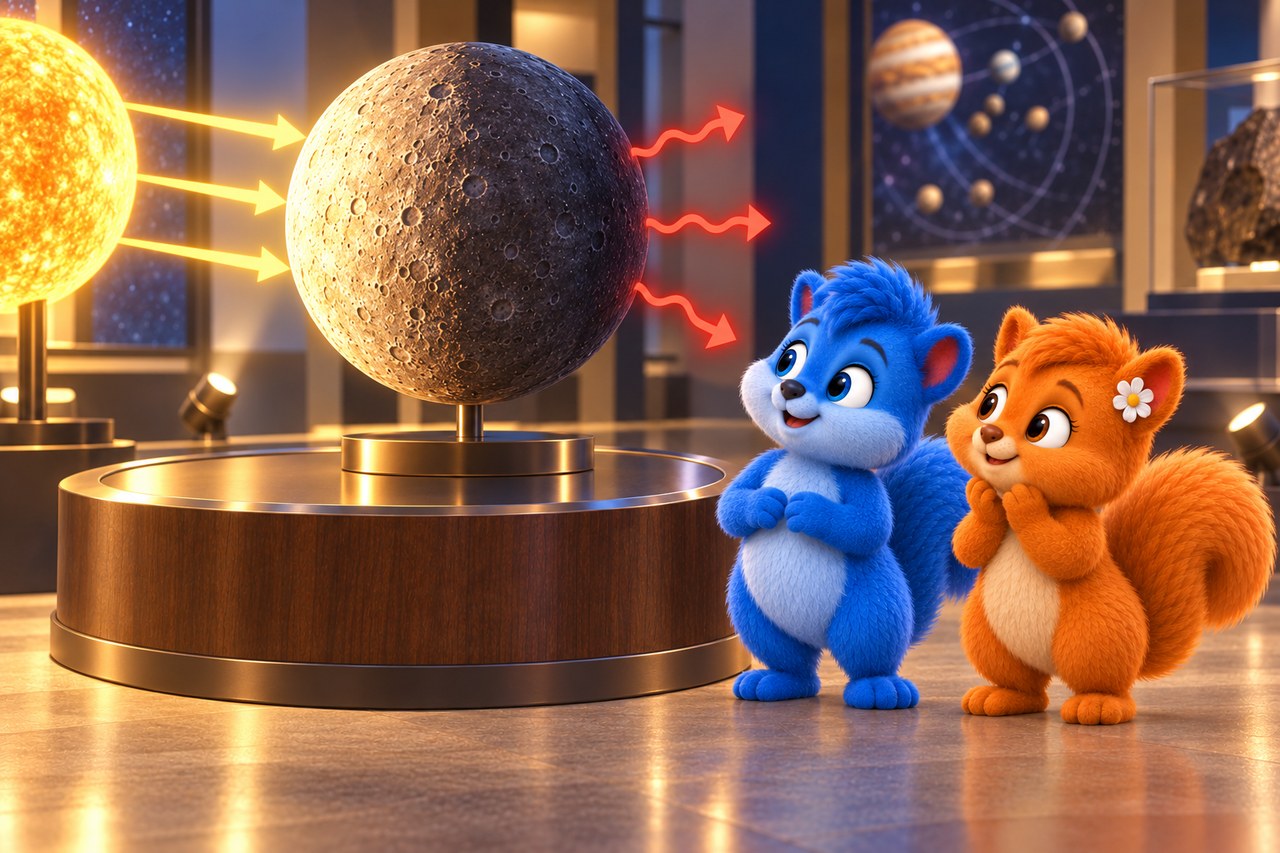
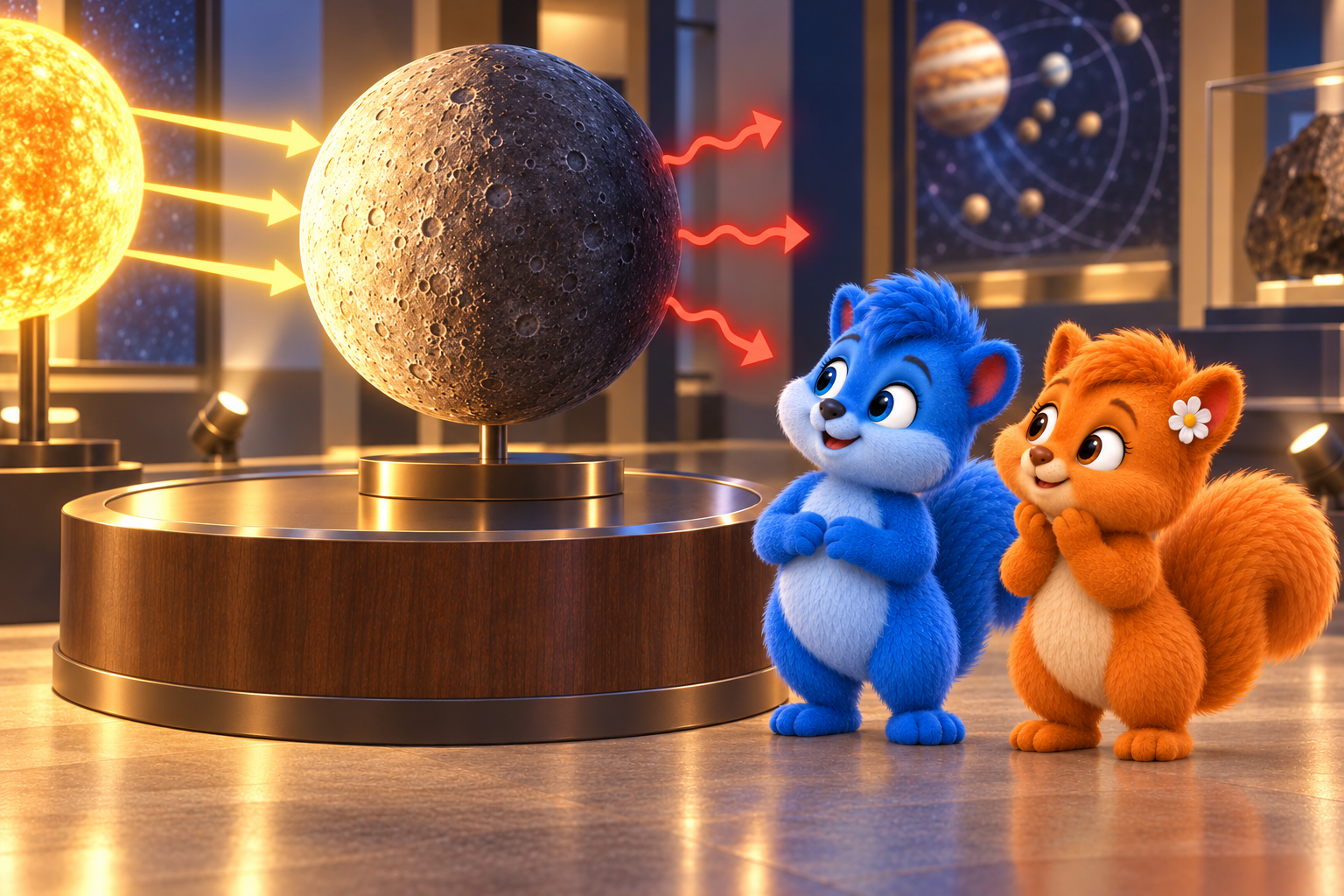
Puschel and Flauschi in the museum. Mercury model: sunlight arrives and heat leaves. Simplified inanimate museum model; arrows and colours help explain it. AI-created illustration, not a photograph of nature.
Explained in three pictures
1 Sunlight comes in
Sunlight heats Mercury’s day side.
2 Heat goes out
The ground releases heat outwards.
3 Almost no atmosphere
Mercury has almost no atmosphere. Its ground cools strongly at night.
More about the picture
Mercury has only an extremely thin particle envelope, not a dense atmosphere. Sunlight warms the day side; at night the surface loses heat. Possible surface temperatures are about 430 °C by day and −180 °C in darkness, not everywhere at once.
An imagined Wusel scene
Puschel and Flauschi investigate
Puschel puts Mercury close to the Sun on his chart and draws only heat symbols. Flauschi turns the model to its night side. They add a second card for the long night and almost absent air.
Their drawing now explains two very different sides.
Look closely
Compare the museum model with the three picture steps. The ground releases heat outwards.
An example to help you understand
Draw one arrow around a circle for rotation and another around a Sun symbol for orbit. These motions take different times. Label Mercury’s rotation 59 Earth days, its orbit 88, and a full sunrise cycle 176. This is a thought model, not a way to reproduce planetary heat.
Try explaining it
Why do Mercury's day and night temperatures differ so much?
Choose a), b) or c), then explain your choice.
- a)A thick cloud layer balances day and night.
- b)Almost no air spreads or retains heat.
- c)Mercury stores especially large amounts of solar heat on its night side.
Show the explanation
Correct: b): Almost no air spreads or retains heat.
Mercury has almost no atmosphere. Sunlight strongly heats its daytime surface; during its long night, heat escapes. There is hardly any air to spread or retain that warmth.
Word help
- atmosphere
- The gas layer around a world; on Earth it is the air above us.
- orbit
- The path of one body around another.
- rotation
- Turning around one's own axis.
Explore in more detail
Here you will find longer explanations and further details. You can explore them together.
1. A small rocky planet
Mercury is the nearest planet to the Sun and the smallest of the eight. Its solid rocky surface has many impact craters: hollows produced when space objects hit it. It resembles the Moon, but Mercury is a planet orbiting the Sun, not Earth’s moon.
2. Very little surrounding gas
An atmosphere is the layer of gases around a world. Mercury has no dense atmosphere like Earth’s. Its extremely thin envelope of particles is called an exosphere. Sunlit surface temperatures can reach about 430 degrees Celsius, while darkness can bring about minus 180. These are possible surface temperatures, not identical conditions everywhere. The thin gas envelope retains little warmth at night.
Checked against: [1]
3. Rotation and orbit are different
One orbit around the Sun takes about 88 Earth days: Mercury’s year. One rotation compared with distant stars takes about 59 Earth days. But sunrise to sunrise takes roughly 176 Earth days. Mercury moves around the Sun while rotating, so a rotation and a complete sunrise cycle are different measurements. More surprisingly, Mercury travels at changing speeds along its elongated orbit. From some locations the Sun can briefly rise, set again and rise once more. The 176 days therefore describe the complete solar cycle, not every individual brief local sunrise.
4. Distance is not the whole explanation
Although Mercury is nearer the Sun, Venus has the hotter surface. Venus’s much denser atmosphere strongly retains heat. Consider the surrounding gas as well as distance. Mercury has no moon or rings. Spacecraft have measured its surface; our model offers only a simplified overview.
An optional question for further exploration
You can use the longer explanation above. This is extra, not needed for the first quiz.
An extra question
Why does a 59-day rotation not mean sunrise happens every 59 Earth days?
Discover the answer
Mercury also moves around the Sun while rotating. One rotation relative to stars takes about 59 Earth days, but sunrise to sunrise takes roughly 176.
Pictures and sources for adults
Sources for further reading
Facts checked against the specialist sources below on 12 October 2026. The Wusel scene is fictional; comparisons and simplified models are explicitly explained. Sources are in English.