Fungi to observe · Hericium erinaceus
Discover lion’s mane fungus
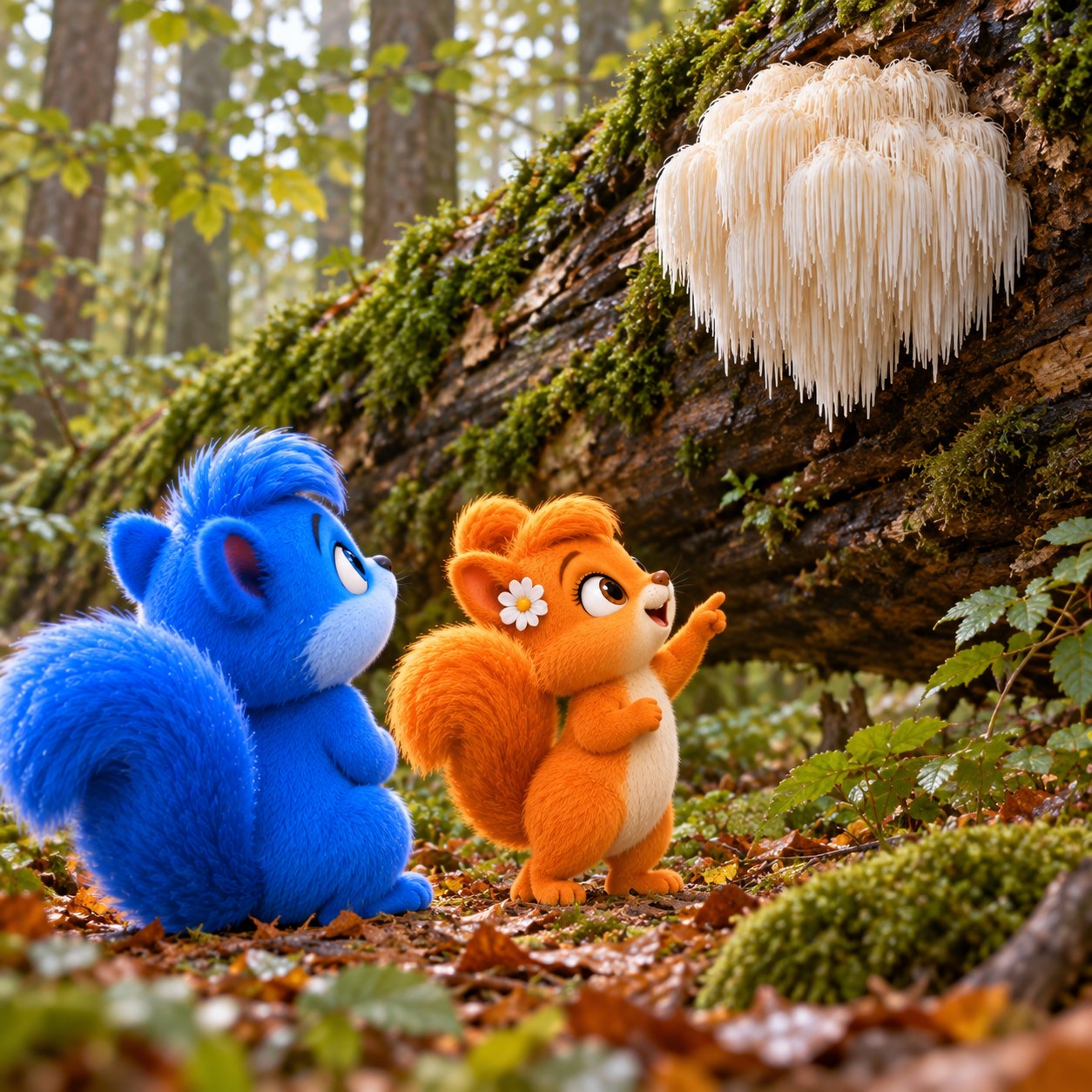
A white beard on an old trunk! Puschel spots lion’s mane fungus. Its hanging spines look very different from a mushroom cap.
The short answer
Lion's mane fungus grows on broadleaf wood and has long hanging spines. They belong to its fruiting body, the visible fungal part. Leave it and its wood undamaged.
See the connection
Simplified drawings, not to scale. Not a guide for identifying species.
An imagined Wusel scene
Puschel and Flauschi investigate
Flauschi stops by an old beech trunk. High above, something white hangs like a small curtain. Puschel sits down and looks up in wonder. They leave the rare fungus completely undisturbed.
Fungus facts
Three things to notice
Shape
The pale fruiting body carries many long, downward-hanging spines.
How it lives
It grows on broadleaf wood such as beech or oak.
In the forest
In Germany this species is rare in the wild and classified as strongly threatened. Its habitat with old and dead broadleaf wood matters.
Try explaining it
What are the hanging projections of lion’s mane fungus?
Choose a), b) or c), then explain your choice.
- a)Dead leaves left hanging on the fungus.
- b)Parts of a fungal fruiting body.
- c)Roots of the tree from which the fungus receives nutrients.
Show the explanation
Correct: b): Parts of a fungal fruiting body.
The projections belong to the visible fungal part. Tiny spores form on them.
Word help
- gills
- Thin blade-like surfaces under some mushroom caps; fish gills have a different role in breathing.
- spore
- A tiny unit that helps fungi or ferns spread. In suitable conditions it can start further development. It is not a seed.
- mycelium
- A network of fine fungal threads, often hidden in soil or wood.
- fruiting body
- The spore-producing part of a fungus. A cap and stalk are one example, not the whole fungus.
- gill
- A thin blade-like surface beneath some fungal caps. Spores can form on it.
Explore in more detail
Here you will find longer explanations and further details. You can explore them together.
Are those teeth or spines?
The long pale projections are parts of the fungal fruiting body. Their surfaces produce reproductive spores. They are neither hedgehog hairs nor teeth for chewing. Other fungi bear spore-producing surfaces on gills or inside tubes: different shapes can perform similar tasks.
Compare and understand
Bearded tooth grows on broadleaved wood. Old trees and dead wood support many organisms, not just this visible fungus. Its habitat needs protection. Leave fruiting bodies and wood undisturbed, observing only from a safe place.
An optional question for further exploration
You can use the longer explanation above. This is extra, not needed for the first quiz.
Mini quiz
An extra question
What does lion’s mane grow on?
Show answer
Wood, often beech or oak.