Fungi to observe · Armillaria mellea
Discover honey fungus
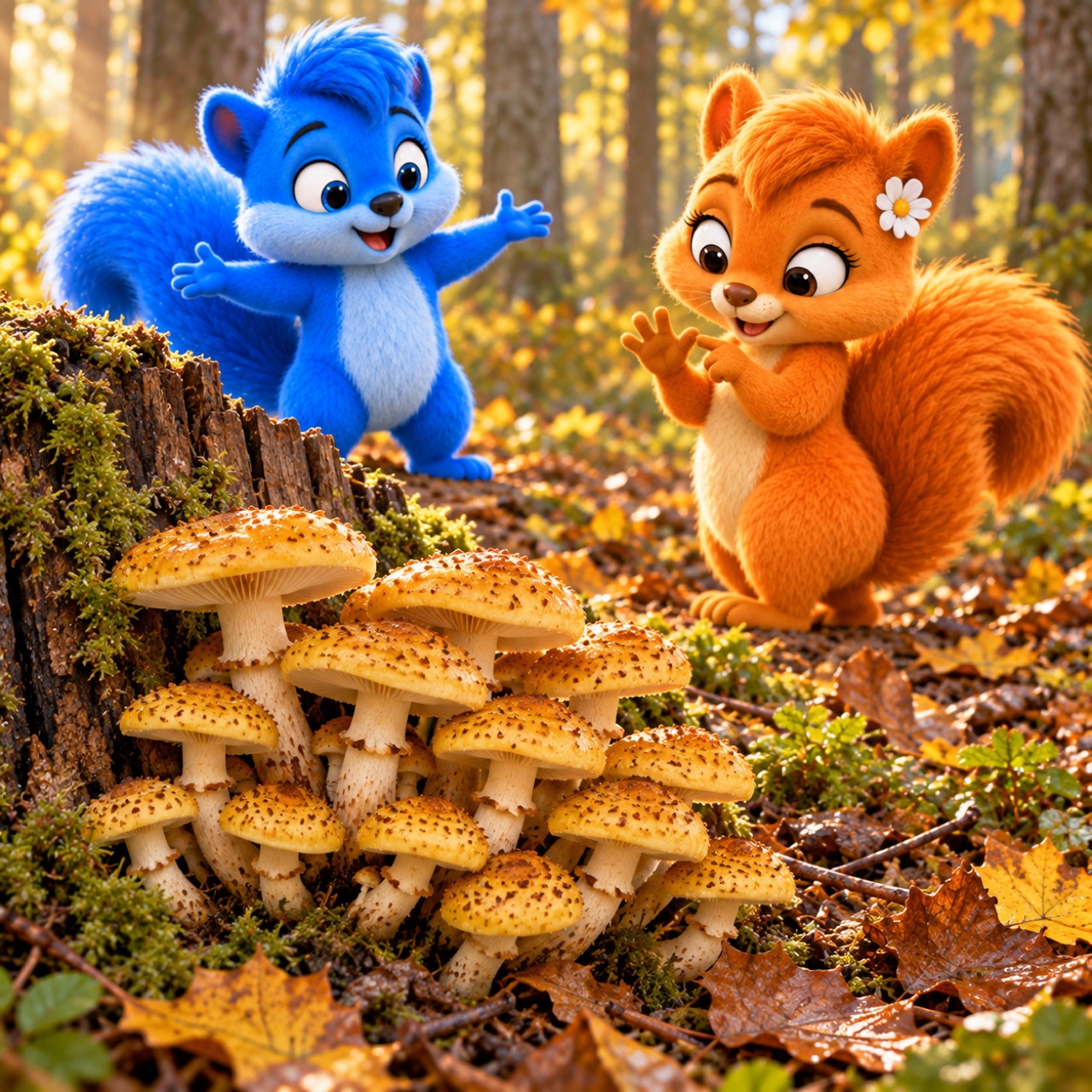
So many caps at once! Puschel spots a whole cluster on old wood. Flauschi introduces him to the honey fungus.
The short answer
Honey fungus often forms groups of fruiting bodies on wood. Its fine threads can break down wood and damage living trees. Only part of the fungus is visible. We do not handle unknown fungi.
An imagined Wusel scene
Puschel and Flauschi investigate
So many honey-coloured caps grow at the foot of an old stump that Puschel throws his arms wide. Puschel“How many are there?” Flauschi counts on her paws. They watch the dense cluster from the path and leave it undisturbed.
Fungus facts
Three things to notice
Shape
Honey fungus often forms dense clusters on wood.
How it lives
Its fungal threads break down dead wood. Honey fungus, Armillaria mellea, can also infect and damage living trees.
In the forest
Honey fungus is a name for several similar species. A picture cannot safely tell them apart.
Try explaining it
What can honey fungus do to wood?
Choose a), b) or c), then explain your choice.
- a)Keep dead wood permanently unchanged instead of breaking it down.
- b)Break down dead wood and harm living trees.
- c)Only support living trees without damaging their wood.
Show the explanation
Correct: b): Break down dead wood and harm living trees.
Honey fungus can use dead wood and infect living trees. Not every fungus is a helpful tree partner.
Word help
- mycelium
- A network of fine fungal threads, often hidden in soil or wood.
- mineral
- Here, a mineral nutrient such as potassium. Plants usually absorb these nutrients dissolved in water; they are not ready-made sugar.
Explore in more detail
Here you will find longer explanations and further details. You can explore them together.
Is every fungus a helpful tree partner?
No. Honey fungi can break dead wood down but also infect living trees. Their threads grow in roots and wood, among other places. Bundles of threads can form dark cords called rhizomorphs. These are fungal structures, not tree roots. The visible caps are only fruiting bodies.
Compare and understand
Compare this with a fungus exchanging water and minerals for sugar: not every fungus-tree relationship has the same effect. Honey fungus also refers to several similar species. Our honey-coloured example cannot safely identify them. Do not remove bark or collect fungi to taste.
An optional question for further exploration
You can use the longer explanation above. This is extra, not needed for the first quiz.
Mini quiz
An extra question
Does honey fungus help break down wood, or can it harm living trees?
Show answer
Both: honey fungus breaks down dead wood and can also infect living trees.