How were baby dinosaurs born?
Eggs, shells and rare tiny skeletons reveal clues to the start of a dinosaur’s life.
The short answer
Dinosaurs laid eggs. Young developed inside and later hatched. Fossil eggs, nests and embryos provide evidence. Parental care was not the same across all dinosaurs.
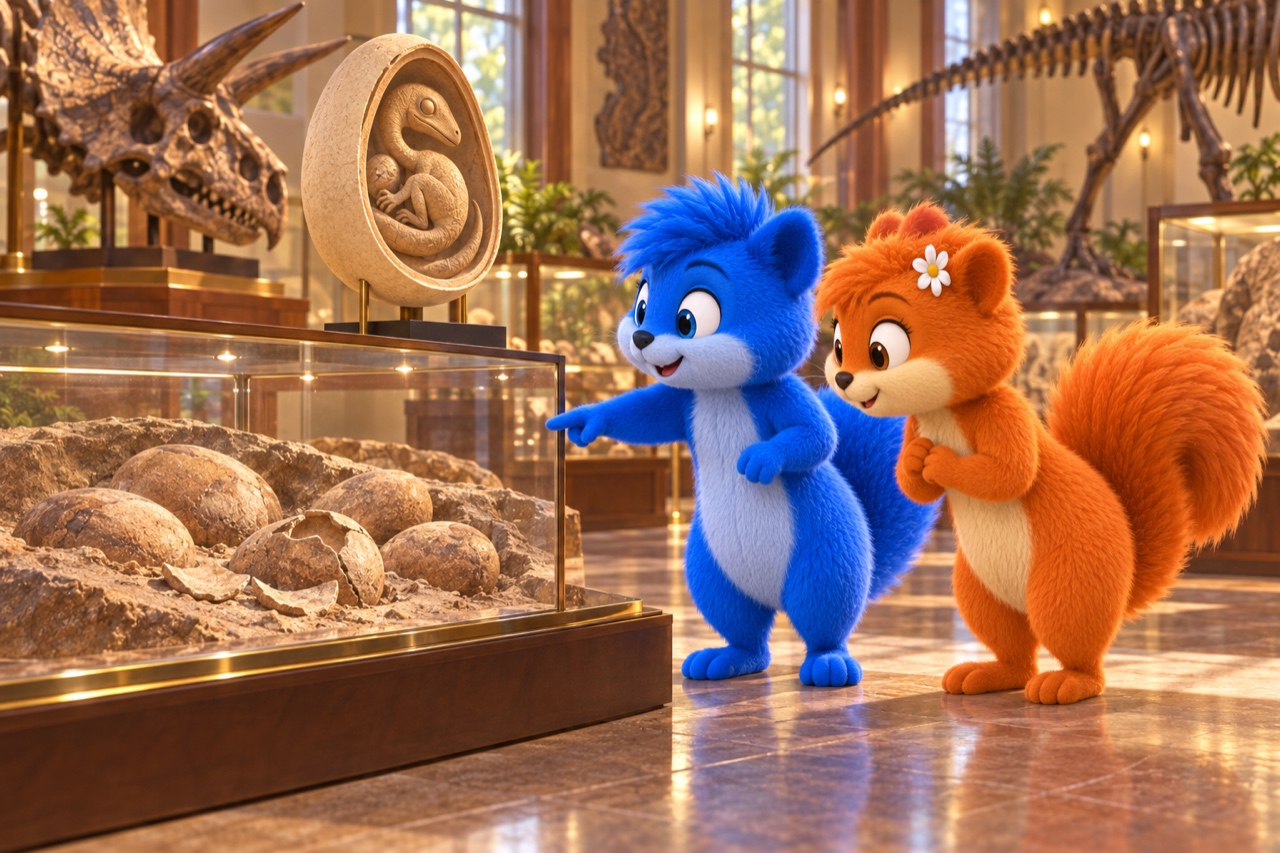
The Wusels study replica fossil eggs and a simplified cutaway egg model with a young animal inside. The clutch and embryo model are invented and not assigned to a particular species. Their shapes and sizes are not shown at a matching scale. AI-created museum illustration, not a photograph of a real exhibit.
An imagined Wusel scene
Puschel and Flauschi investigate
Puschel wants to draw a whole family from one fossil egg. Flauschi adds nest and young-animal finds. They check which question each find can answer. The egg shows reproduction, not every detail of care.
Look closely
Compare the eggs in rock below with the cutaway learning model above. Why show both?
An example to help you understand
The museum displays eggs in rock beside a cutaway model. The model helps show what would otherwise be hidden: a young animal before hatching. It is not a real opened egg. When explaining a picture, ask whether it shows an old discovery, a copy or a model for learning.
Try explaining it
Where did young dinosaurs develop before hatching?
Choose a), b) or c), then explain your choice.
- a)Inside eggs.
- b)In the mother's body until birth, like most living mammals.
- c)In nests as fully born young without earlier development in eggs.
Show the explanation
Correct: a): Inside eggs.
Dinosaurs laid eggs. Preserved eggs, nests and unhatched young provide evidence.
Word help
- fossil
- A preserved remain or trace of life from past geological times.
Explore in more detail
Here you will find longer explanations and further details. You can explore them together.
1. A baby grows inside an egg
Dinosaurs laid eggs in which their young developed before hatching. A developing animal inside an egg is an embryo. Birds, the dinosaurs living today, also hatch from eggs. Fossil eggs, sometimes with tiny bones inside, are evidence of reproduction in extinct dinosaurs.
2. Eggs were not all alike
Shapes, sizes and arrangements varied between dinosaur groups. Researchers have also found evidence of soft-shelled dinosaur eggs. We should not imagine every dinosaur egg as an oversized hard-shelled chicken egg. A group of eggs laid together is called a clutch.
Checked against: [2]
3. Who laid this egg?
An egg’s shape alone often cannot identify the dinosaur that laid it. A rare preserved embryo can help because its bones provide extra features. An Argentine discovery allowed researchers to link eggs to titanosaurs, a group of long-necked dinosaurs. The eggs in our picture do not represent that particular specimen.
4. A fossil cannot hatch
A fossil egg is a discovery from the distant past, not a living egg today. No dinosaur baby can hatch from it. Clutches, tiny bones and adults found nearby help researchers investigate nests and possible care of young. They do not prove that all dinosaurs cared for their young in the same way.
An optional question for further exploration
You can use the longer explanation above. This is extra, not needed for the first quiz.
An extra question
Why is an embryo inside a fossil egg especially helpful?
Discover the answer
Egg shape alone often cannot identify its dinosaur group. Embryo bones give researchers additional features to compare. A fossil egg is still no longer alive.
Pictures and sources for adults
Sources for further reading
The factual content was checked against these specialist sources on 10 October 2026. The Wusel scene is fictional. Sources are in English.