How do we know so much about dinosaurs?
Dinosaur research is detective work: many kinds of clues build a picture.
The short answer
What did a dinosaur look like? Bones reveal body parts, teeth give clues about food and footprints about movement. Researchers compare these finds like puzzle pieces. Missing pieces leave questions. A new find can change the picture.
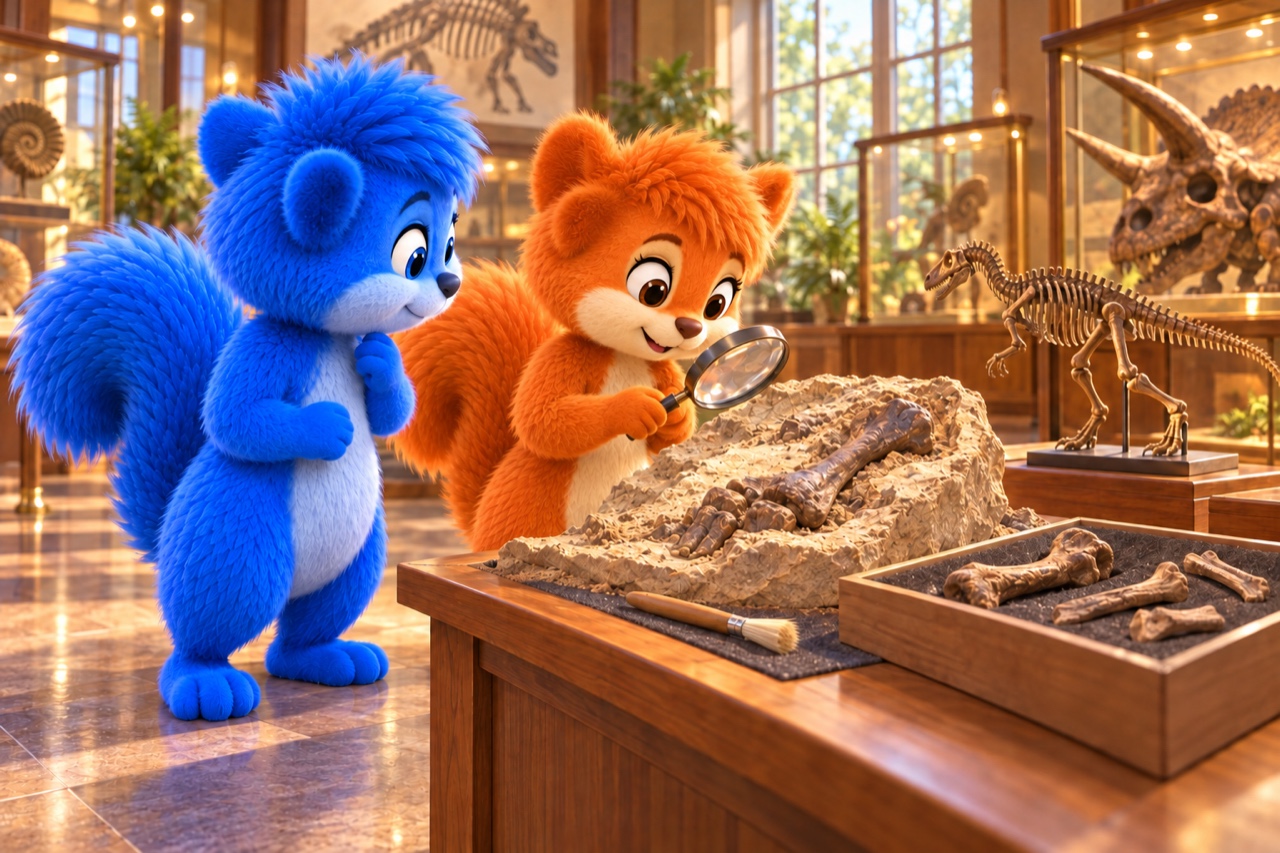
Puschel and Flauschi use a magnifying glass to study a bone cast in a rock model at a museum station, beside other replicas. An invented learning station with simplified fossil replicas. The small skeleton was not reconstructed from the separate bones in the tray. AI-created museum illustration, not a photograph of a real exhibit.
An imagined Wusel scene
Puschel and Flauschi investigate
Puschel colours his bone model in his favourite shade and calls it a discovery. Flauschi asks which find reveals that colour. They have no such clue here. He labels the colour his own design and the bone shape an observed feature.
Look closely
Find the bone, magnifying glass and brush. These are learning replicas. What can a shape reveal, and what can it not reveal?
An example to help you understand
Imagine a shoe print in mud. It can reveal the shape of the sole but not the colour of the shoe. Dinosaur tracks likewise help answer some questions and leave others open. Good detective work includes explaining which clue supports an idea and what that clue cannot reveal.
Try explaining it
Which finds help us study dinosaur bodies?
Choose a), b) or c), then explain your choice.
- a)A drawing provides the same evidence as a bone find.
- b)One trace reveals every body part and the exact skin colour.
- c)Bones, teeth, eggs and traces.
Show the explanation
Correct: c): Bones, teeth, eggs and traces.
Researchers compare real finds. Imagined picture colours are not evidence without further clues.
Word help
- fossil
- A preserved remain or trace of life from past geological times.
Explore in more detail
Here you will find longer explanations and further details. You can explore them together.
1. Not just digging anywhere
Palaeontology is the study of life in the past. Palaeontologists look for preserved remains and traces called fossils. They first check maps and rocks: are the rocks from the right time, and could they contain fossils? Excavations also need permission and expert knowledge.
Checked against: [1]
2. From the ground to the laboratory
A discovery is photographed, measured and its position recorded. Its rock layer matters too. Taking only a bone would lose information. Specialists carefully free fragile fossils and protect them for transport. Work continues in a laboratory, a room for detailed study. Parts of a skeleton, the framework of bones, are often missing.
3. Putting different clues together
Bones reveal body parts, teeth give clues to food, and footprints to movement. Impressions can preserve skin or feathers. Researchers compare different discoveries and living animals. They build a reconstruction, an evidence-based model of the animal’s appearance or life, not a photograph of the past.
4. There are gaps too
An ordinary bone does not reveal skin colour. Rare, exceptionally preserved fossils may contain tiny traces of structures associated with pigments, substances that produce colour. Powerful microscopes, instruments that enlarge very small things, can provide clues to certain colours. This is not possible for every dinosaur. New discoveries may change earlier reconstructions.
An optional question for further exploration
You can use the longer explanation above. This is extra, not needed for the first quiz.
An extra question
Why record where a fossil was found and which rock layer it came from?
Discover the answer
Its position and surrounding rock provide clues to its time and environment. Without them an important part of the discovery’s story is missing. Specialists therefore record the context carefully, not just take away the bone.
Pictures and sources for adults
Sources for further reading
The factual content was checked against these specialist sources on 10 October 2026. The Wusel scene is fictional. Sources are in English.