How do animals hide?
An insect looks like a twig. Discover how colour, shape and behaviour help animals hide.
The short answer
Colour, body shape and behaviour can make an animal resemble its background. This camouflage makes it harder to notice. It can help with protection or hunting, but does not make an animal invisible.
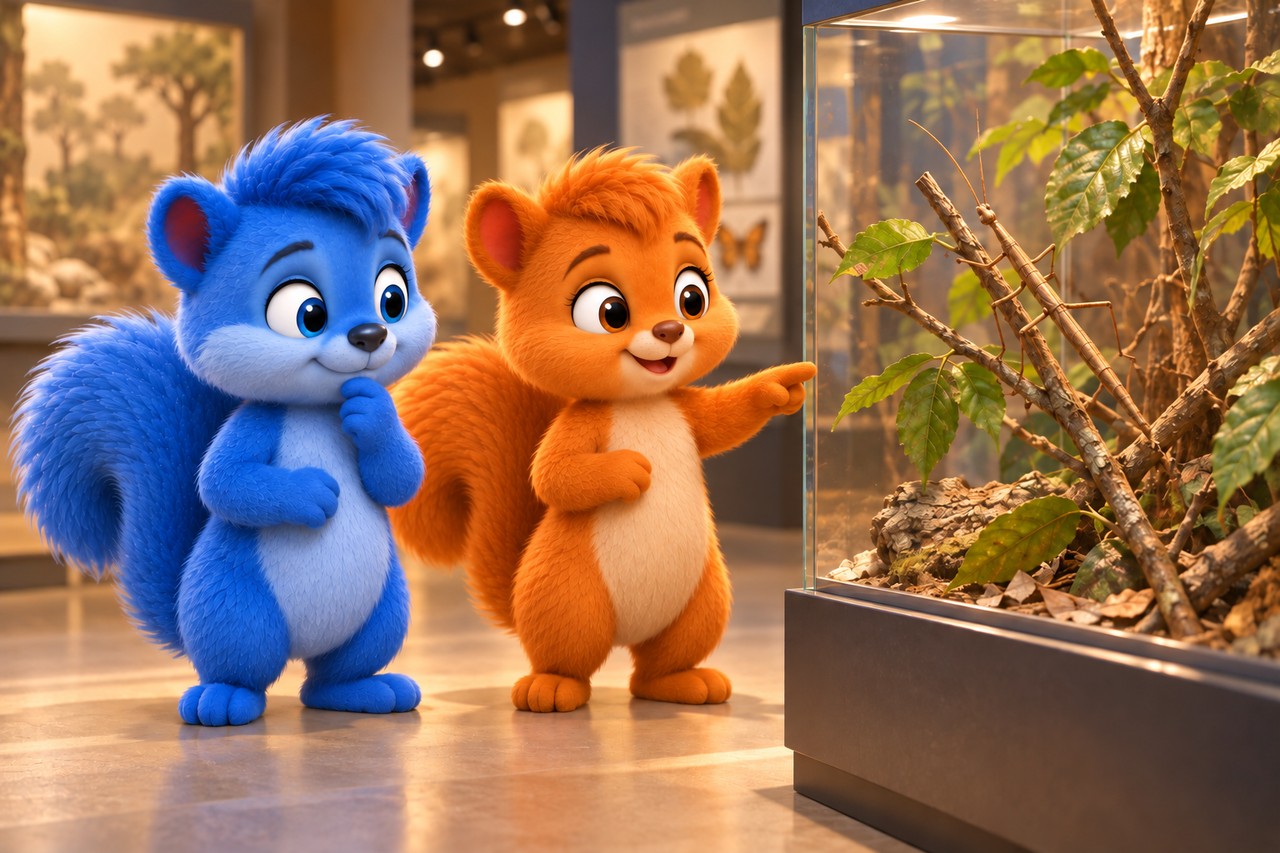
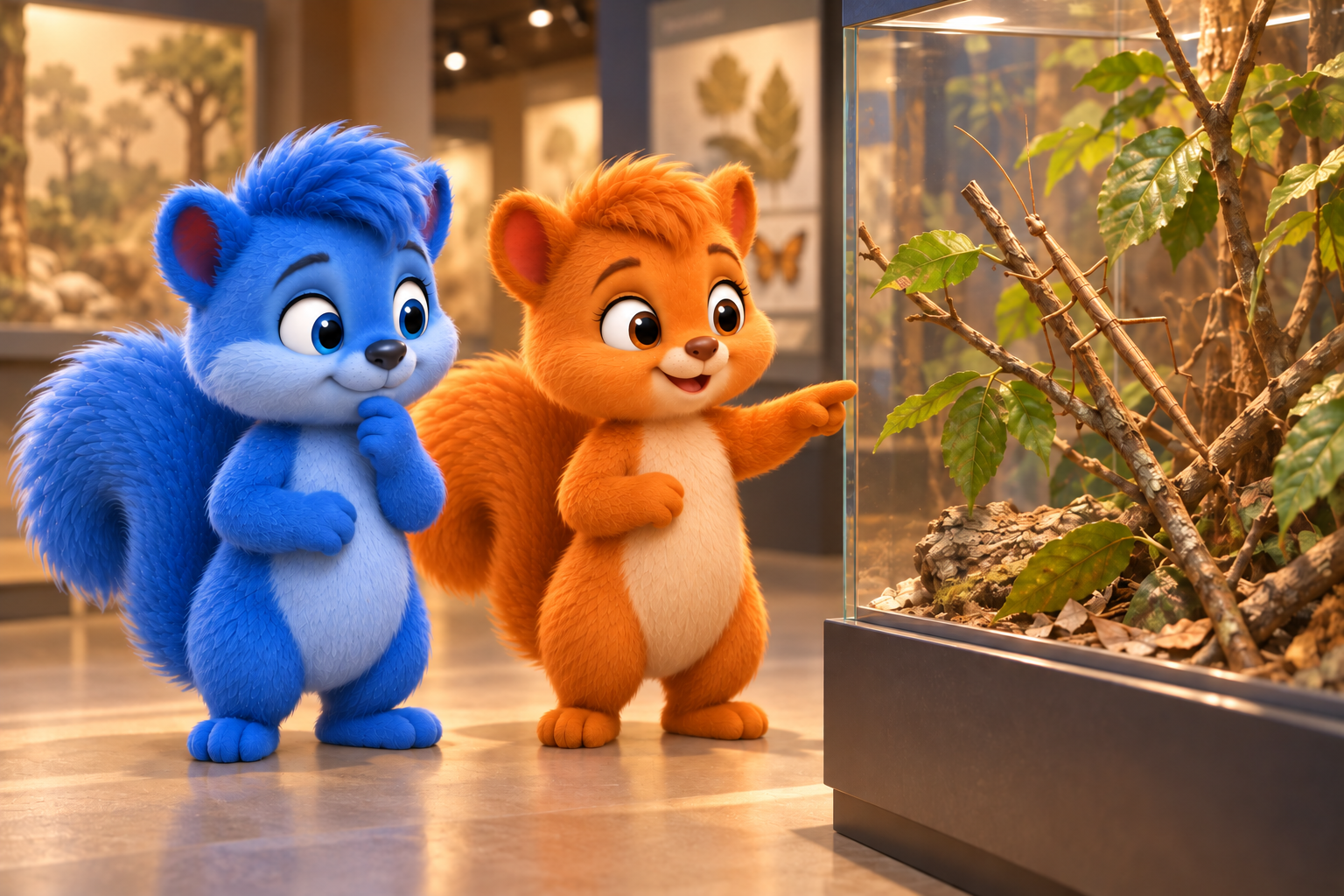
Equal-sized Puschel and Flauschi examine a museum model of a stick insect among twigs and leaves. An artistic museum model, not an identification guide for a particular species. An additional search picture compares the same shape against two backgrounds. AI-created illustration, not a photograph of nature.
What the diagram shows
The diagram simplifies the process. First compare its shapes and arrows. You can read its labels in larger text below.
Read the picture labels
These are the words and sentences from the diagram above. The full explanation follows below.
- Same shape, different background
- Brown among brown twigs
- Brown against a pale background
- Model: same stick insect, six legs. Not a species guide.
An imagined Wusel scene
Puschel and Flauschi investigate
At first, Puschel notices only twigs. Flauschi points towards a thin leg. He looks again and recognises the whole insect. Together they compare the shapes without tapping the glass.
Look closely
Find the stick insect's long body and the thin legs branching out at its sides. Flauschi points towards it. Compare its shape and colour with the twig.
An example to help you understand
With an adult, place six large brown and six large yellow paper pieces on a brown cloth. Use pieces of the same size, scattered randomly. Someone who did not place them searches for them. Which stand out first? Try again on a yellow cloth. You are comparing backgrounds. This is a model: real animals move, and other animals may see them differently from us.
Try explaining it
Why is a brown animal less noticeable among brown twigs?
Choose a), b) or c), then explain your choice.
- a)It changes to match each twig at that moment.
- b)Its colour and shape fit the background.
- c)Its body becomes transparent.
Show the explanation
Correct: b): Its colour and shape fit the background.
Colour, body shape and behaviour can make an animal resemble its background. This camouflage makes it harder to notice. It can help with protection or hunting, but does not make an animal invisible.
Word help
- cell
- A tiny living unit. Living things are made of cells.
Explore in more detail
Here you will find longer explanations and further details. You can explore them together.
1. It is there, but hard to notice
Imagine a brown moth resting on brown bark. Its colours and pattern resemble its surroundings, making it harder for a bird to spot. This is camouflage: a living thing is difficult to distinguish from its background. It is still there! You may notice it when you find its outline, the line around the edge of its body.
Checked against: [1]
2. Some bodies look like twigs
A stick insect has a long, narrow body and thin legs that resemble twigs. It is an insect with six legs and two antennae: feelers on its head. Look for the legs in the museum picture. A real twig has no legs! Stick insects eat plants. Their camouflage makes them harder for predators, animals that might eat them, to notice.
Checked against: [2]
3. Keeping still helps too
Colour alone is not the whole explanation. A stick insect can stay still for a long time. Some also sway like a twig in the breeze. Body shape and behaviour work together. Other animals use camouflage when hunting: a praying mantis can wait unnoticed for prey. Camouflage can help an animal avoid being eaten or help it catch food.
4. The background matters
A brown animal stands out more against a pale wall than among brown twigs. Some animals can change colour; others cannot. An animal does not simply decide to grow a completely new body. These body shapes developed over many generations. Even good camouflage does not make an animal invisible: movement or a different viewing angle may give it away. A concrete example is Alaska’s white-tailed ptarmigan: its mottled summer plumage becomes white for winter through a change of feathers. A day octopus can change colour quickly using special skin cells instead. Different animals solve a similar problem in different ways.
An optional question for further exploration
You can use the longer explanation above. This is extra, not needed for the first quiz.
An extra question
Why would the same brown stick insect be easier to spot on white paper?
Discover the answer
Its brown body and outline contrast more strongly with a white background. Among brown twigs, its colour and shape resemble the surroundings. It is the same animal in both places.
Pictures and sources for adults
Sources for further reading
Facts checked against the specialist sources below on 12 October 2026. The Wusel scene is fictional; comparisons and simplified models are explicitly explained. Sources are in English.