Discovery 20 / 27
Puschel & Flauschi’s Forest Discoveries
The Autumn Leaf’s Second Journey
The green explorer’s magnifying glass with a leaf-shaped handle
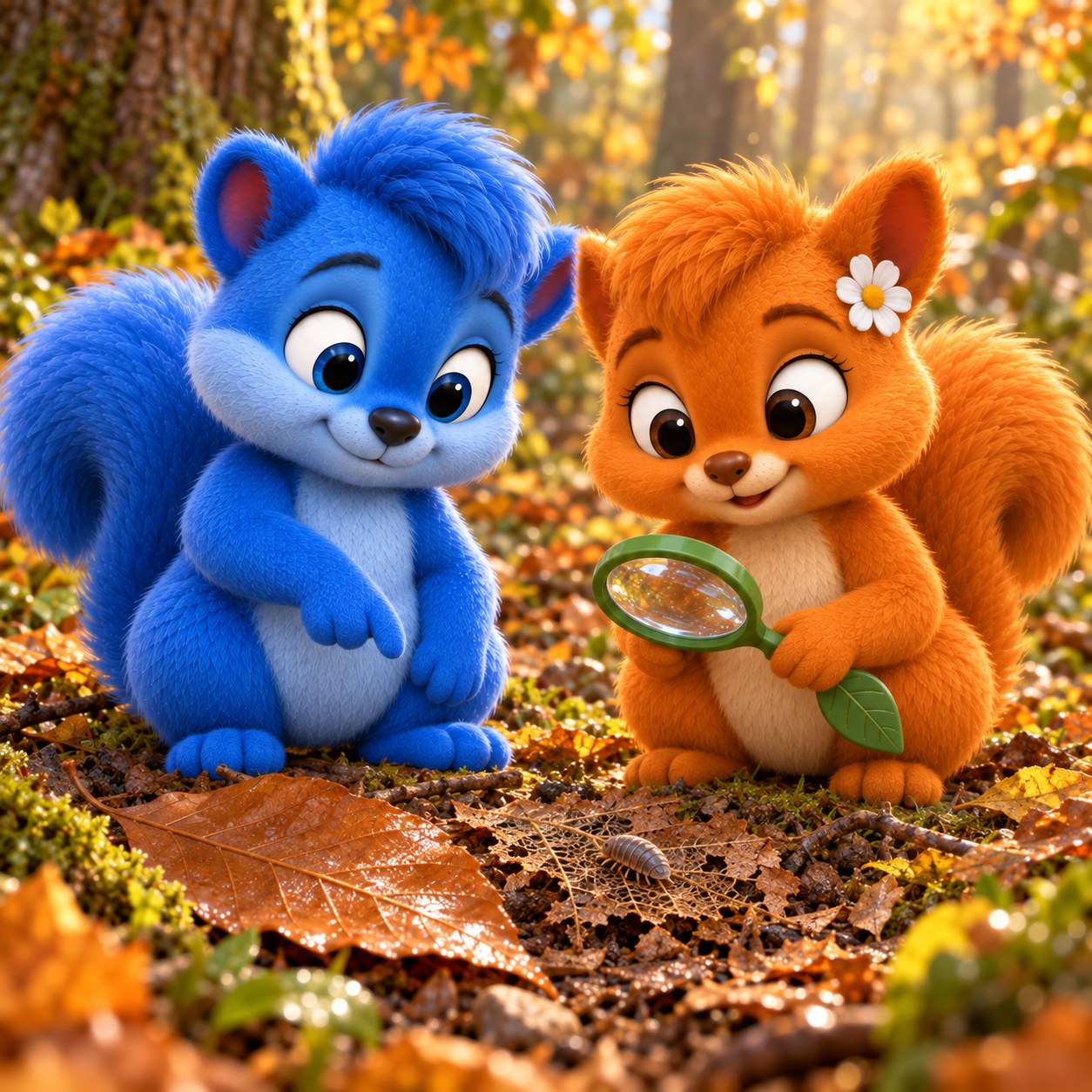
Two very different leaves lay beside the woodland path. One was still brown and almost whole. The other had fine veins and little crumbly pieces left. Puschel stopped beside them.
Puschel“The leaf took off its coat! Or someone made a lace curtain from it.”
Flauschi held the green magnifying glass above the older leaf. They lifted nothing. A little woodlouse walked over the already visible remains. Puschel pointed at the holes from a distance.
Flauschi“This leaf has been here longer. Small animals, fungi and tiny living things slowly break old leaves down. This is called decomposition: a whole leaf becomes smaller parts and other substances.”
Puschel watched the woodlouse. Flauschi explained that no single animal did all the work. Woodlice and other animals break leaves into pieces. Fungi and bacteria help break them down further. Bacteria are so small that we cannot see individual ones with our eyes alone.
Puschel“A woodland tidy-up team! But where is their broom?”
Flauschi“They need no broom. Some plant remains become part of humus. That is the name for remains of living things in soil. Humus is an important part of soil, but it is not the whole soil.”
Flauschi explained that soil also held small pieces of rock, water and air. As leaves broke down, things that new plants needed to grow could be released. But a leaf did not turn into a heap of soil in a minute.
Puschel“Then these leaves are in no hurry. Their second journey is a very slow one.”
It took different lengths of time depending on the leaf and weather. They left every leaf and the woodlouse in place. Puschel thought about the green leaves above them. The fallen ones had not simply become useless. They still belonged to the woods.
Look closely
What the two discovered
Leaves that fall to the ground make a layer of fallen leaves. Small animals can bite them into pieces. Fungi and bacteria help break their substances down further. Bacteria are tiny living things. This process is called decomposition.
Remains of plants and other living things in soil are called humus. Old leaves contribute to it. Woodland soil also holds small pieces of rock, water and air. One leaf does not become the whole soil by itself.
Things that plants need to grow are also released as leaves break down. These are called nutrients. Things are used again in the woods. This is a cycle, not a quick magical change.
Different leaves break down at different speeds. Moisture, warmth and soil life all matter. We only look at leaves and remains that are already visible. We do not disturb the soil or bring animals out of hiding.
Explorer’s rule: Leave animals and plants in peace. Just watch and do not damage anything.
Sources for adults: WSL: Der Waldboden lebt – Humus und Zersetzung
Keep exploring
Where shall we wusel next?
Choose how to keep exploring: another story or a related activity.
Look for woodland treasures
Take an adult along and choose the printable nature bingo. Leave plants and animal homes untouched.
Start exploring →Keep exploring together
Look closely with nature bingo and woodland games.
Explore woodland games →