Discovery 3 / 27
Puschel & Flauschi’s Forest Discoveries
The Colour Secret of Autumn Leaves
The green explorer’s magnifying glass with a leaf-shaped handle
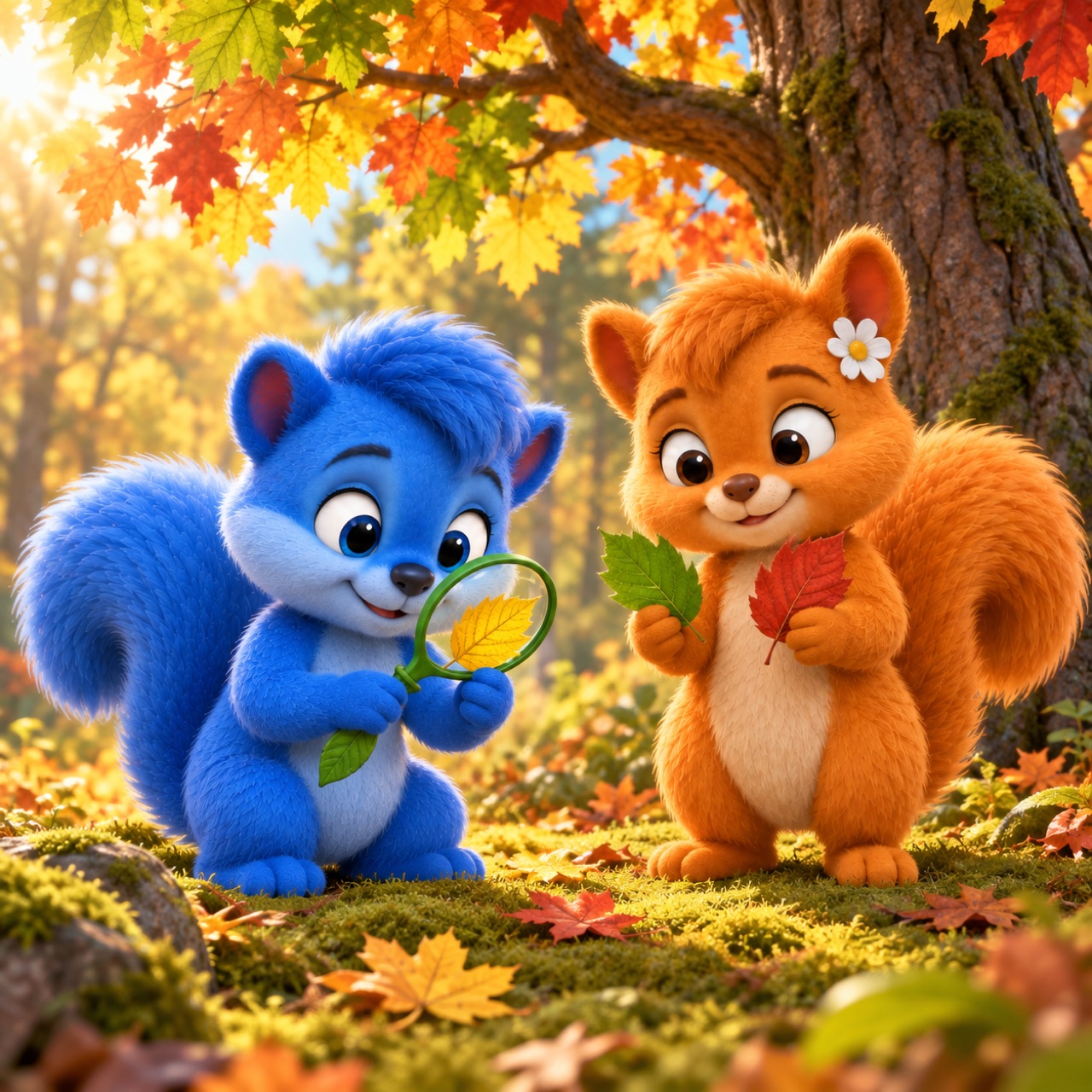
A warm sunbeam fell through the leafy top of a large tree. Yellow, orange and red leaves suddenly glowed among the green ones. Puschel picked up a yellow leaf from the moss and turned it over in amazement.
Puschel“Everything was green here yesterday. Did someone paint the tree overnight?”
Flauschi held a green leaf and a red one in her paws. Puschel examined the yellow leaf with the green explorer’s magnifying glass. He found no brush marks and not a single spot of paint.
Flauschi“The tree needs no forest painter. Its leaves contain several coloured pigments. In summer, we mainly see the strong green one.”
Flauschi explained that the green colouring is called chlorophyll. It helps the leaf use sunlight. The plant also takes in water and an invisible part of the air called carbon dioxide. It is a gas, like air. It uses these to make sugar to help it grow. This is called photosynthesis. In autumn the days grow shorter, and the tree prepares for winter.
Puschel“So the tree is tidying away its summer green?”
That was exactly how Puschel imagined it: the tree moved useful building blocks from the leaves back into its twigs and trunk. As the green chlorophyll gradually broke down, yellow and orange pigments that had been hidden by it could shine through.
Flauschi“Some trees also make red pigments in autumn. That is why not every tree wears the same colours.”
Puschel looked up at the crown. It no longer resembled a painted roof. It looked like a colour cupboard that autumn was slowly opening. He carefully returned the leaf to the moss.
Puschel“No secret forest painter—yellow and orange were already there, and some leaves make new red pigments too. That is even better!”
Look closely
What the two discovered
A green leaf contains a green colouring called chlorophyll. It helps the leaf use sunlight. With light, water and an invisible part of the air, the plant makes sugar to help it grow. This part is called carbon dioxide. It is a gas, like air. Making sugar with light is called photosynthesis.
In autumn it gets dark earlier. Many trees with leaves then make less new green colouring. The old green slowly disappears. The tree takes useful things back from its leaves. These things that help it grow are called nutrients.
Yellow and orange colourings are often in the leaf in summer already. The strong green hides them, like one colour covering another. When the green disappears, we can see yellow and orange better. These colourings are called carotenoids.
Some leaves make new red or purple colourings in autumn. They are called anthocyanins. So not every autumn colour was there before. The colours also depend on the tree, the light and the weather.
Explorer’s rule: Leave animals and plants in peace. Just watch and do not damage anything.
Sources for adults: Smithsonian: Herbstfarben / autumn leaf colours
Keep exploring
Where shall we wusel next?
Choose how to keep exploring: another story or a related activity.
Look for woodland treasures
Take an adult along and choose the printable nature bingo. Leave plants and animal homes untouched.
Start exploring →Keep making in the workshop
Safe craft ideas include materials, steps and the adult help needed.
See workshop ideas →